JP 3-0, page 134
Joint Operations
Joint Publication: Joint Operations
11 August 2011 public edition
Searchable page text (OCR / PDF)
Chapter V
V-28
JP 3-0
Grenada 1983, to protect US citizens and restore the lawful government). Raids end with
a planned withdrawal upon completion of the assigned mission.
f. Homeland Defense and Defense Support of Civil Authorities. Security and
defense of the US homeland is the USG’s top responsibility and is conducted as a
continuous cooperative effort among all federal agencies as well as state, tribal, and local
government. Military operations inside the United States and its territories, though
limited in many respects, are conducted to accomplish two missions—HD and DSCA.
HD is the protection of US sovereignty, territory, domestic population, and critical
defense infrastructure against external threats and aggression or other threats as
directed by the President. DSCA consists of DOD support to US civil authorities for
domestic emergencies and for designated law enforcement and other activities. Requests
for federal assistance of this nature must be submitted to the DOD Executive Secretary.
(1) Homeland Defense. The purpose of HD is to protect against and mitigate
the impact of incursions or attacks on sovereign territory, the domestic population, and
critical defense infrastructure. DOD is the federal agency with lead responsibility,
supported by other agencies, in defending against external threats/aggression.
However, against internal threats DOD may be in support of an OGA. When ordered to
conduct HD operations within US territory, DOD will coordinate closely with
OGAs. Consistent with laws and policy, the Services will provide capabilities to support
CCDR requirements against a variety of threats to national security. These include
invasion, CNA, and air and missile attacks.
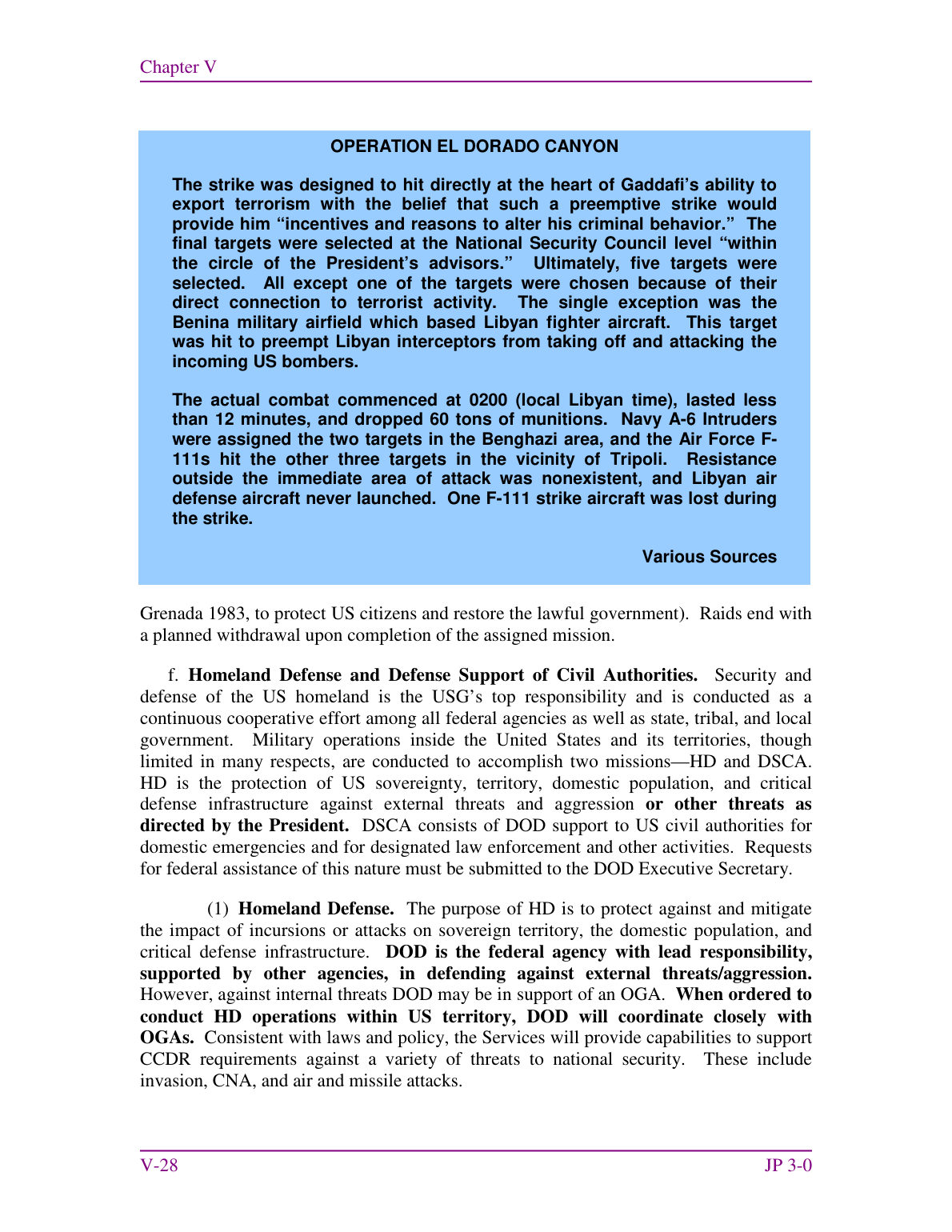
OPERATION EL DORADO CANYON
The strike was designed to hit directly at the heart of Gaddafi’s ability to
export terrorism with the belief that such a preemptive strike would
provide him “incentives and reasons to alter his criminal behavior.” The
final targets were selected at the National Security Council level “within
the circle of the President’s advisors.” Ultimately, five targets were
selected. All except one of the targets were chosen because of their
direct connection to terrorist activity. The single exception was the
Benina military airfield which based Libyan fighter aircraft. This target
was hit to preempt Libyan interceptors from taking off and attacking the
incoming US bombers.
The actual combat commenced at 0200 (local Libyan time), lasted less
than 12 minutes, and dropped 60 tons of munitions. Navy A-6 Intruders
were assigned the two targets in the Benghazi area, and the Air Force F-
111s hit the other three targets in the vicinity of Tripoli. Resistance
outside the immediate area of attack was nonexistent, and Libyan air
defense aircraft never launched. One F-111 strike aircraft was lost during
the strike.
Various Sources