JP 3-0, page 173
Joint Operations
Joint Publication: Joint Operations
11 August 2011 public edition
Searchable page text (OCR / PDF)
A-1
APPENDIX A
PRINCIPLES OF JOINT OPERATIONS
1. Introduction
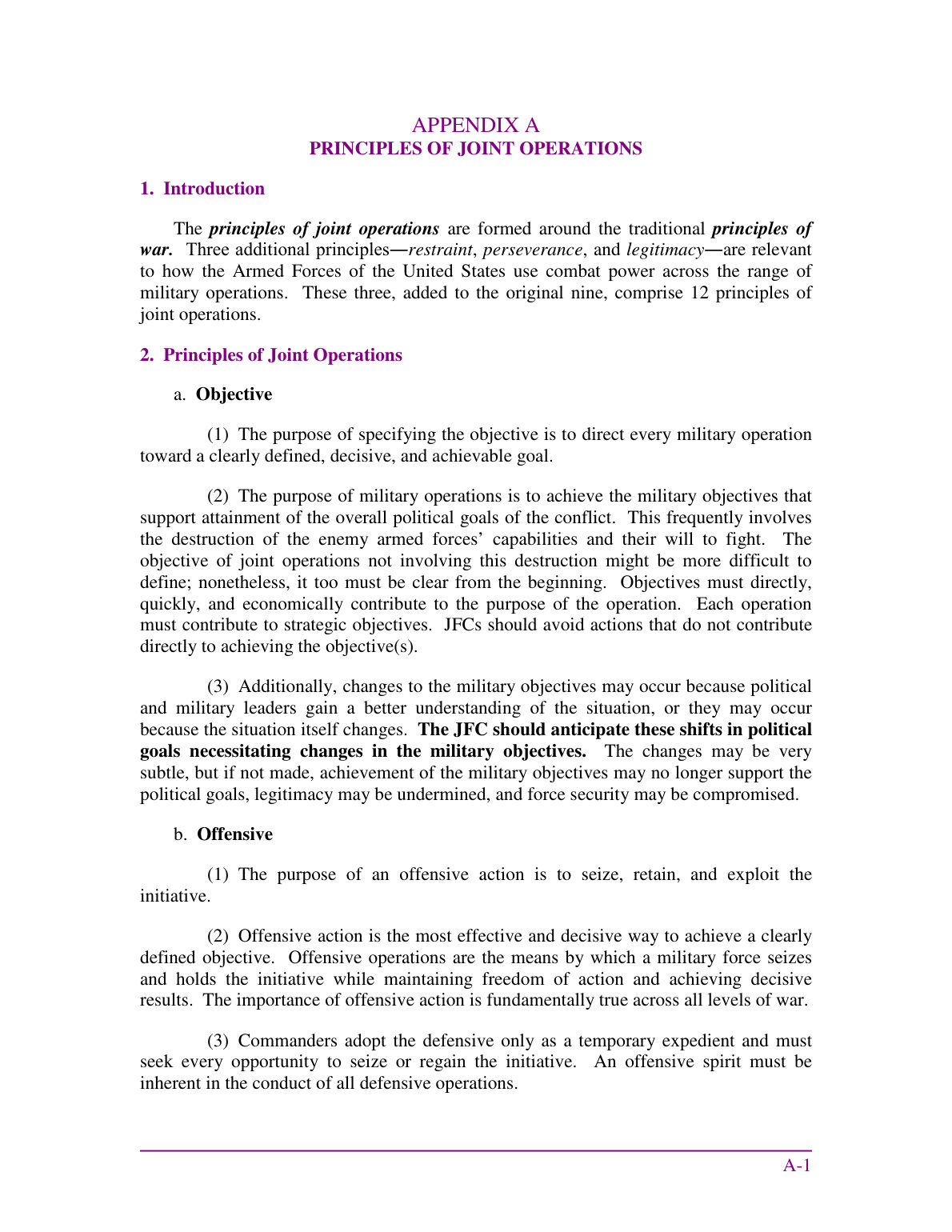
The principles of joint operations are formed around the traditional principles of
war. Three additional principles―restraint, perseverance, and legitimacy―are relevant
to how the Armed Forces of the United States use combat power across the range of
military operations. These three, added to the original nine, comprise 12 principles of
joint operations.
2. Principles of Joint Operations
a. Objective
(1) The purpose of specifying the objective is to direct every military operation
toward a clearly defined, decisive, and achievable goal.
(2) The purpose of military operations is to achieve the military objectives that
support attainment of the overall political goals of the conflict. This frequently involves
the destruction of the enemy armed forces’ capabilities and their will to fight. The
objective of joint operations not involving this destruction might be more difficult to
define; nonetheless, it too must be clear from the beginning. Objectives must directly,
quickly, and economically contribute to the purpose of the operation. Each operation
must contribute to strategic objectives. JFCs should avoid actions that do not contribute
directly to achieving the objective(s).
(3) Additionally, changes to the military objectives may occur because political
and military leaders gain a better understanding of the situation, or they may occur
because the situation itself changes. The JFC should anticipate these shifts in political
goals necessitating changes in the military objectives. The changes may be very
subtle, but if not made, achievement of the military objectives may no longer support the
political goals, legitimacy may be undermined, and force security may be compromised.
b. Offensive
(1) The purpose of an offensive action is to seize, retain, and exploit the
initiative.
(2) Offensive action is the most effective and decisive way to achieve a clearly
defined objective. Offensive operations are the means by which a military force seizes
and holds the initiative while maintaining freedom of action and achieving decisive
results. The importance of offensive action is fundamentally true across all levels of war.
(3) Commanders adopt the defensive only as a temporary expedient and must
seek every opportunity to seize or regain the initiative. An offensive spirit must be
inherent in the conduct of all defensive operations.