JP 3-0, page 45
Joint Operations
Joint Publication: Joint Operations
11 August 2011 public edition
Searchable page text (OCR / PDF)
The Art of Joint Command
II-5
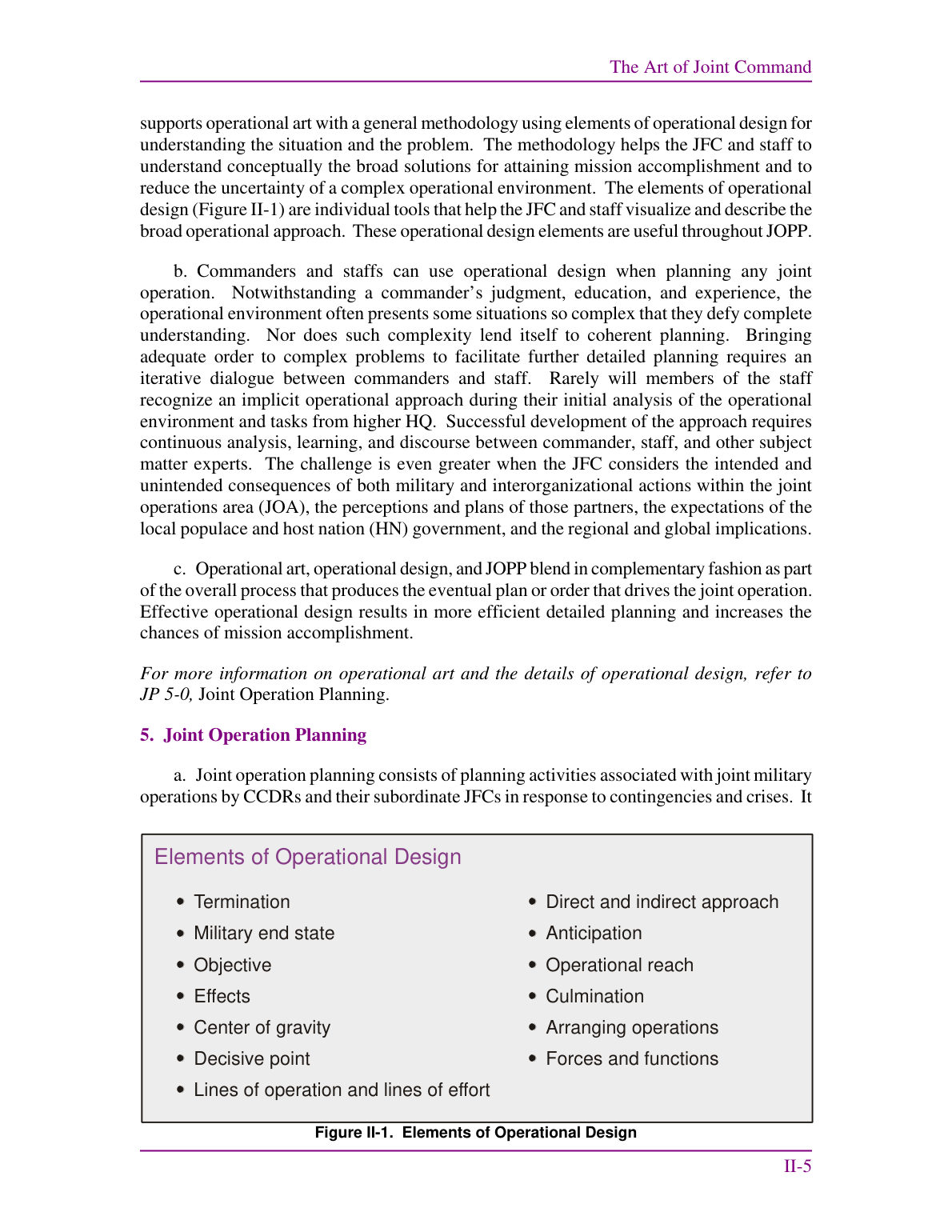
supports operational art with a general methodology using elements of operational design for
understanding the situation and the problem. The methodology helps the JFC and staff to
understand conceptually the broad solutions for attaining mission accomplishment and to
reduce the uncertainty of a complex operational environment. The elements of operational
design (Figure II-1) are individual tools that help the JFC and staff visualize and describe the
broad operational approach. These operational design elements are useful throughout JOPP.
b. Commanders and staffs can use operational design when planning any joint
operation. Notwithstanding a commander’s judgment, education, and experience, the
operational environment often presents some situations so complex that they defy complete
understanding. Nor does such complexity lend itself to coherent planning. Bringing
adequate order to complex problems to facilitate further detailed planning requires an
iterative dialogue between commanders and staff. Rarely will members of the staff
recognize an implicit operational approach during their initial analysis of the operational
environment and tasks from higher HQ. Successful development of the approach requires
continuous analysis, learning, and discourse between commander, staff, and other subject
matter experts. The challenge is even greater when the JFC considers the intended and
unintended consequences of both military and interorganizational actions within the joint
operations area (JOA), the perceptions and plans of those partners, the expectations of the
local populace and host nation (HN) government, and the regional and global implications.
c. Operational art, operational design, and JOPP blend in complementary fashion as part
of the overall process that produces the eventual plan or order that drives the joint operation.
Effective operational design results in more efficient detailed planning and increases the
chances of mission accomplishment.
For more information on operational art and the details of operational design, refer to
JP 5-0, Joint Operation Planning.
5. Joint Operation Planning
a. Joint operation planning consists of planning activities associated with joint military
operations by CCDRs and their subordinate JFCs in response to contingencies and crises. It
Figure II-1. Elements of Operational Design
Elements of Operational Design
Termination
Military end state
Objective
Effects
Center of gravity
Decisive point
Lines of operation and lines of effort
Direct and indirect approach
Anticipation
Operational reach
Culmination
Arranging operations
Forces and functions