JP 3-0, page 55
Joint Operations
Joint Publication: Joint Operations
11 August 2011 public edition
Searchable page text (OCR / PDF)
Joint Functions
III-3
supports an efficient decision-making process. Enabled by timely intelligence, surveillance,
and reconnaissance (ISR), the goal is to provide the ability to make decisions and execute
those decisions more rapidly and effectively than the adversary. This decreases risk and
allows the commander more control over the timing and tempo of operations.
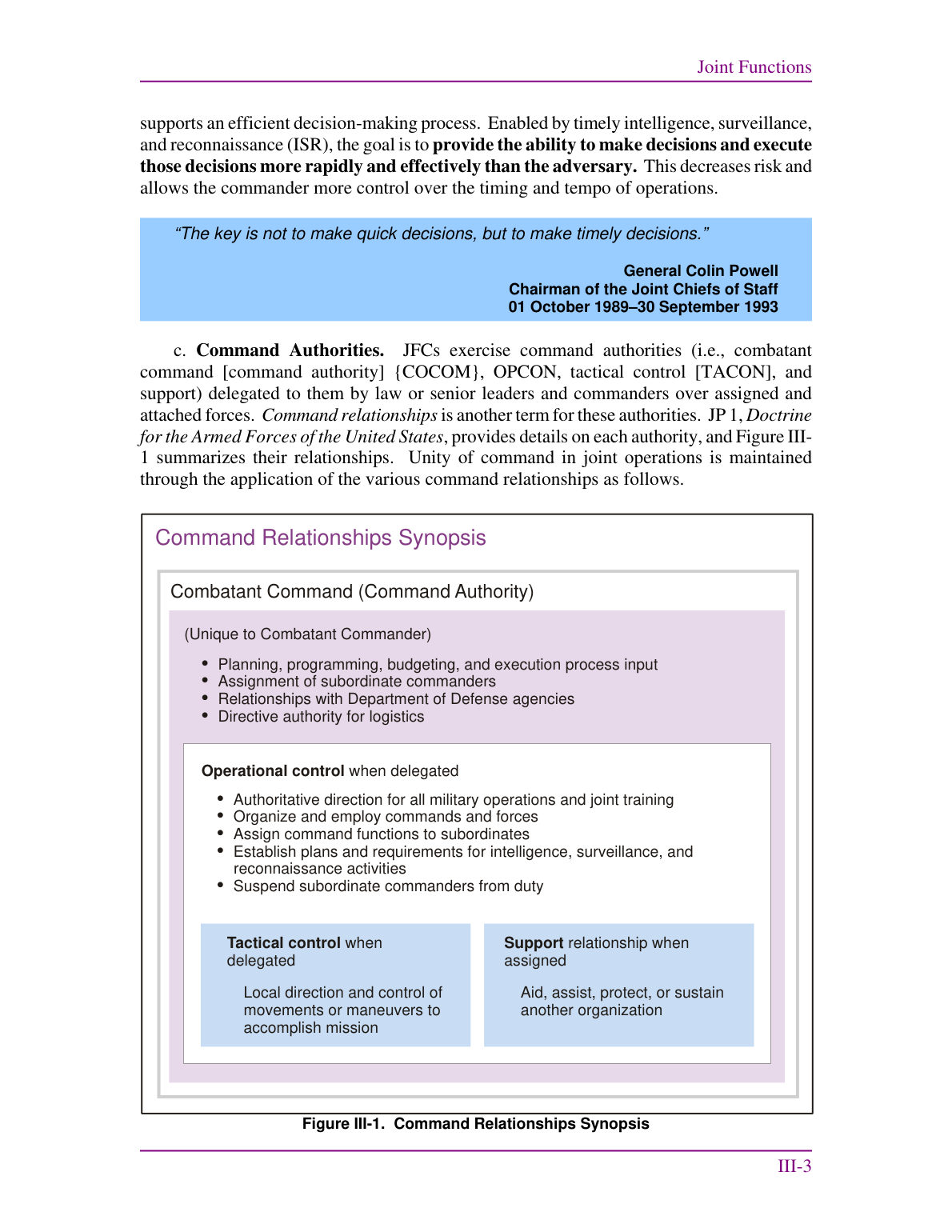
c. Command Authorities. JFCs exercise command authorities (i.e., combatant
command [command authority] {COCOM}, OPCON, tactical control [TACON], and
support) delegated to them by law or senior leaders and commanders over assigned and
attached forces. Command relationships is another term for these authorities. JP 1, Doctrine
for the Armed Forces of the United States, provides details on each authority, and Figure III-
1 summarizes their relationships. Unity of command in joint operations is maintained
through the application of the various command relationships as follows.
“The key is not to make quick decisions, but to make timely decisions.”
General Colin Powell
Chairman of the Joint Chiefs of Staff
01 October 1989–30 September 1993
Figure III-1. Command Relationships Synopsis
Command Relationships Synopsis
Authoritative direction for all military operations and joint training
Organize and employ commands and forces
Assign command functions to subordinates
Establish plans and requirements for intelligence, surveillance, and
reconnaissance activities
Suspend subordinate commanders from duty
Operational control when delegated
Tactical control when
delegated
Support relationship when
assigned
Planning, programming, budgeting, and execution process input
Assignment of subordinate commanders
Relationships with Department of Defense agencies
Directive authority for logistics
Combatant Command (Command Authority)
(Unique to Combatant Commander)
Local direction and control of
movements or maneuvers to
accomplish mission
Aid, assist, protect, or sustain
another organization