JP 3-28, page 107
Defense Support of Civil Authorities
Joint Publication: Defense Support of Civil Authorities
29 October 2018 public edition (Wayback JCS copy; S2 cited as JP 328 / JP 3-28 DSCA)
Searchable page text (OCR / PDF)
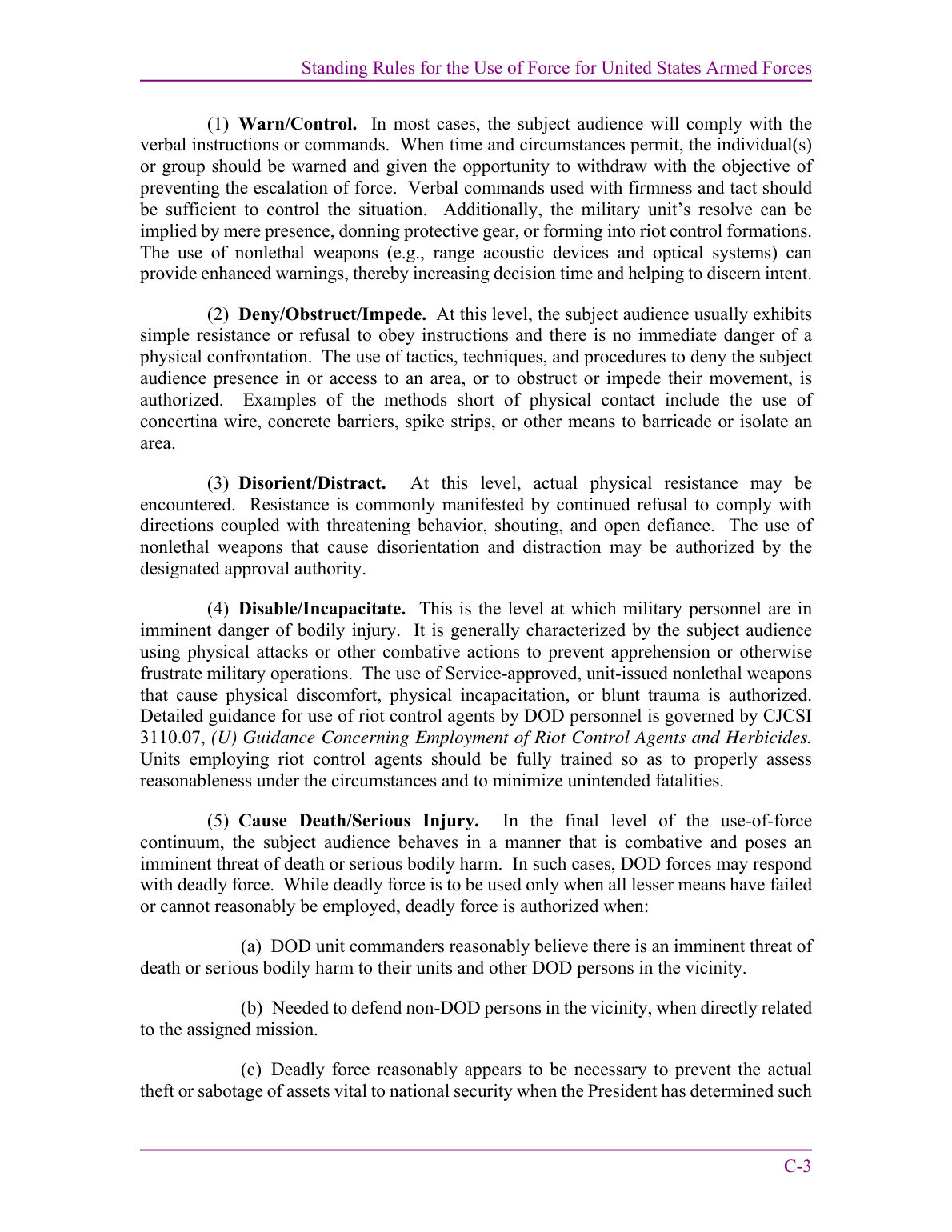
Standing Rules for the Use of Force for United States Armed Forces
C-3
(1) Warn/Control. In most cases, the subject audience will comply with the
verbal instructions or commands. When time and circumstances permit, the individual(s)
or group should be warned and given the opportunity to withdraw with the objective of
preventing the escalation of force. Verbal commands used with firmness and tact should
be sufficient to control the situation. Additionally, the military unit’s resolve can be
implied by mere presence, donning protective gear, or forming into riot control formations.
The use of nonlethal weapons (e.g., range acoustic devices and optical systems) can
provide enhanced warnings, thereby increasing decision time and helping to discern intent.
(2) Deny/Obstruct/Impede. At this level, the subject audience usually exhibits
simple resistance or refusal to obey instructions and there is no immediate danger of a
physical confrontation. The use of tactics, techniques, and procedures to deny the subject
audience presence in or access to an area, or to obstruct or impede their movement, is
authorized. Examples of the methods short of physical contact include the use of
concertina wire, concrete barriers, spike strips, or other means to barricade or isolate an
area.
(3) Disorient/Distract. At this level, actual physical resistance may be
encountered. Resistance is commonly manifested by continued refusal to comply with
directions coupled with threatening behavior, shouting, and open defiance. The use of
nonlethal weapons that cause disorientation and distraction may be authorized by the
designated approval authority.
(4) Disable/Incapacitate. This is the level at which military personnel are in
imminent danger of bodily injury. It is generally characterized by the subject audience
using physical attacks or other combative actions to prevent apprehension or otherwise
frustrate military operations. The use of Service-approved, unit-issued nonlethal weapons
that cause physical discomfort, physical incapacitation, or blunt trauma is authorized.
Detailed guidance for use of riot control agents by DOD personnel is governed by CJCSI
3110.07, (U) Guidance Concerning Employment of Riot Control Agents and Herbicides.
Units employing riot control agents should be fully trained so as to properly assess
reasonableness under the circumstances and to minimize unintended fatalities.
(5) Cause Death/Serious Injury. In the final level of the use-of-force
continuum, the subject audience behaves in a manner that is combative and poses an
imminent threat of death or serious bodily harm. In such cases, DOD forces may respond
with deadly force. While deadly force is to be used only when all lesser means have failed
or cannot reasonably be employed, deadly force is authorized when:
(a) DOD unit commanders reasonably believe there is an imminent threat of
death or serious bodily harm to their units and other DOD persons in the vicinity.
(b) Needed to defend non-DOD persons in the vicinity, when directly related
to the assigned mission.
(c) Deadly force reasonably appears to be necessary to prevent the actual
theft or sabotage of assets vital to national security when the President has determined such