JP 3-60, page 49
Joint Targeting
Joint Publication: Joint Targeting
31 January 2013 public edition
Searchable page text (OCR / PDF)
The Joint Targeting Cycle
II-19
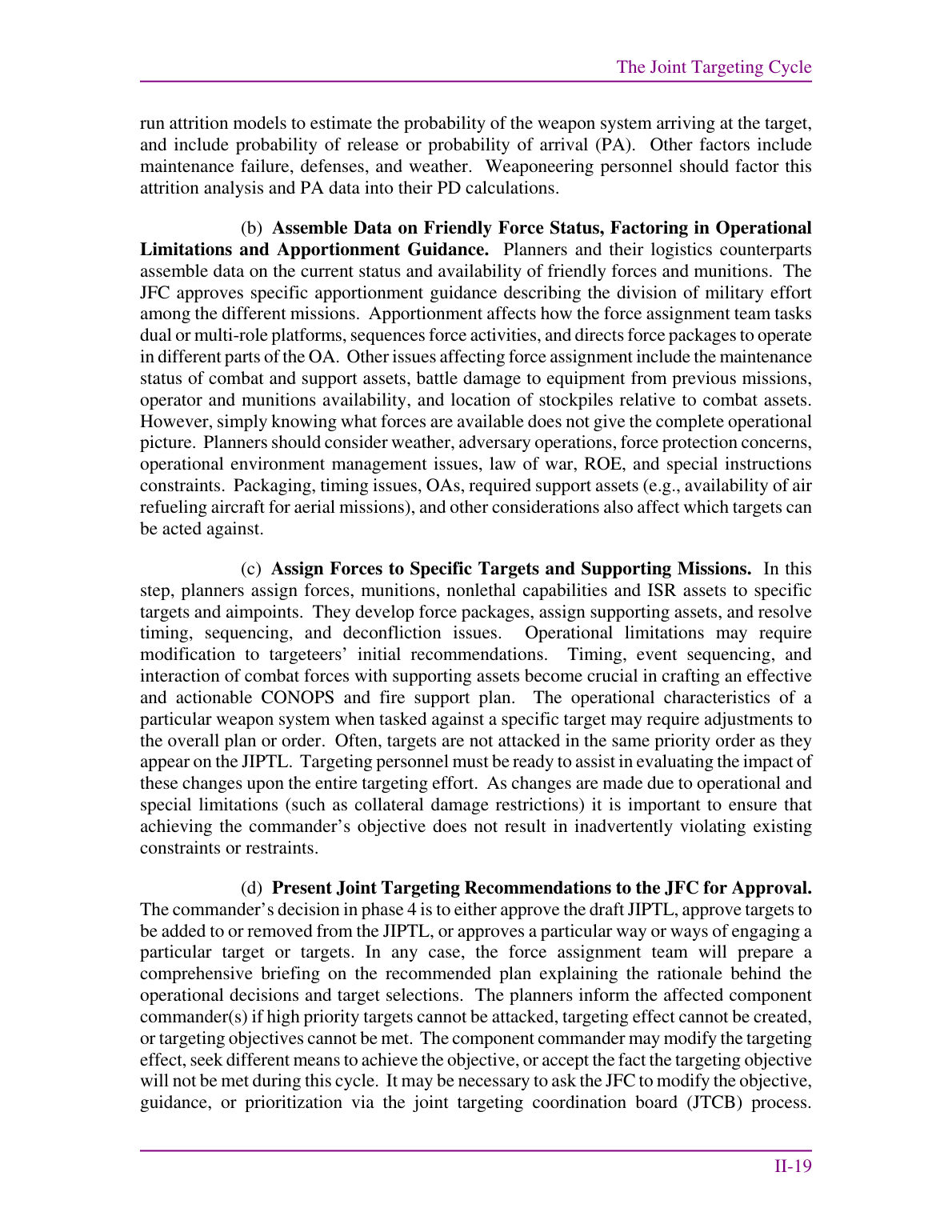
run attrition models to estimate the probability of the weapon system arriving at the target,
and include probability of release or probability of arrival (PA). Other factors include
maintenance failure, defenses, and weather. Weaponeering personnel should factor this
attrition analysis and PA data into their PD calculations.
(b) Assemble Data on Friendly Force Status, Factoring in Operational
Limitations and Apportionment Guidance. Planners and their logistics counterparts
assemble data on the current status and availability of friendly forces and munitions. The
JFC approves specific apportionment guidance describing the division of military effort
among the different missions. Apportionment affects how the force assignment team tasks
dual or multi-role platforms, sequences force activities, and directs force packages to operate
in different parts of the OA. Other issues affecting force assignment include the maintenance
status of combat and support assets, battle damage to equipment from previous missions,
operator and munitions availability, and location of stockpiles relative to combat assets.
However, simply knowing what forces are available does not give the complete operational
picture. Planners should consider weather, adversary operations, force protection concerns,
operational environment management issues, law of war, ROE, and special instructions
constraints. Packaging, timing issues, OAs, required support assets (e.g., availability of air
refueling aircraft for aerial missions), and other considerations also affect which targets can
be acted against.
(c) Assign Forces to Specific Targets and Supporting Missions. In this
step, planners assign forces, munitions, nonlethal capabilities and ISR assets to specific
targets and aimpoints. They develop force packages, assign supporting assets, and resolve
timing, sequencing, and deconfliction issues. Operational limitations may require
modification to targeteers’ initial recommendations. Timing, event sequencing, and
interaction of combat forces with supporting assets become crucial in crafting an effective
and actionable CONOPS and fire support plan. The operational characteristics of a
particular weapon system when tasked against a specific target may require adjustments to
the overall plan or order. Often, targets are not attacked in the same priority order as they
appear on the JIPTL. Targeting personnel must be ready to assist in evaluating the impact of
these changes upon the entire targeting effort. As changes are made due to operational and
special limitations (such as collateral damage restrictions) it is important to ensure that
achieving the commander’s objective does not result in inadvertently violating existing
constraints or restraints.
(d) Present Joint Targeting Recommendations to the JFC for Approval.
The commander’s decision in phase 4 is to either approve the draft JIPTL, approve targets to
be added to or removed from the JIPTL, or approves a particular way or ways of engaging a
particular target or targets. In any case, the force assignment team will prepare a
comprehensive briefing on the recommended plan explaining the rationale behind the
operational decisions and target selections. The planners inform the affected component
commander(s) if high priority targets cannot be attacked, targeting effect cannot be created,
or targeting objectives cannot be met. The component commander may modify the targeting
effect, seek different means to achieve the objective, or accept the fact the targeting objective
will not be met during this cycle. It may be necessary to ask the JFC to modify the objective,
guidance, or prioritization via the joint targeting coordination board (JTCB) process.