MCRP 12-10B.1, page 112
Military Operations on Urbanized Terrain (MOUT)
Marine Corps Reference Publication: Military Operations on Urbanized Terrain (MOUT)
Public distribution statement A; S2 KOCOA cited as MCRP 12-10 b.1
Searchable page text (OCR / PDF)
c.
Infantry often accompany armored vehicles in built-up areas to provide them with close-in
protection. Antiarmor weapons should be supported by an effective antipersonnel defense.
d. At a planned signal (for example, the detonation of a mine), all targets in the engagement
area are attcked at the same time. If that is not possible, then the most dangerous target
should be engaged first. Although tanks present the greatest threat, BMPs are also dangerous
because their infantry can dismount and destroy friendly antiarmor positions. Rubble and
mines should be used to reduce target mobility so that a target's time in the engagement area is
increased.
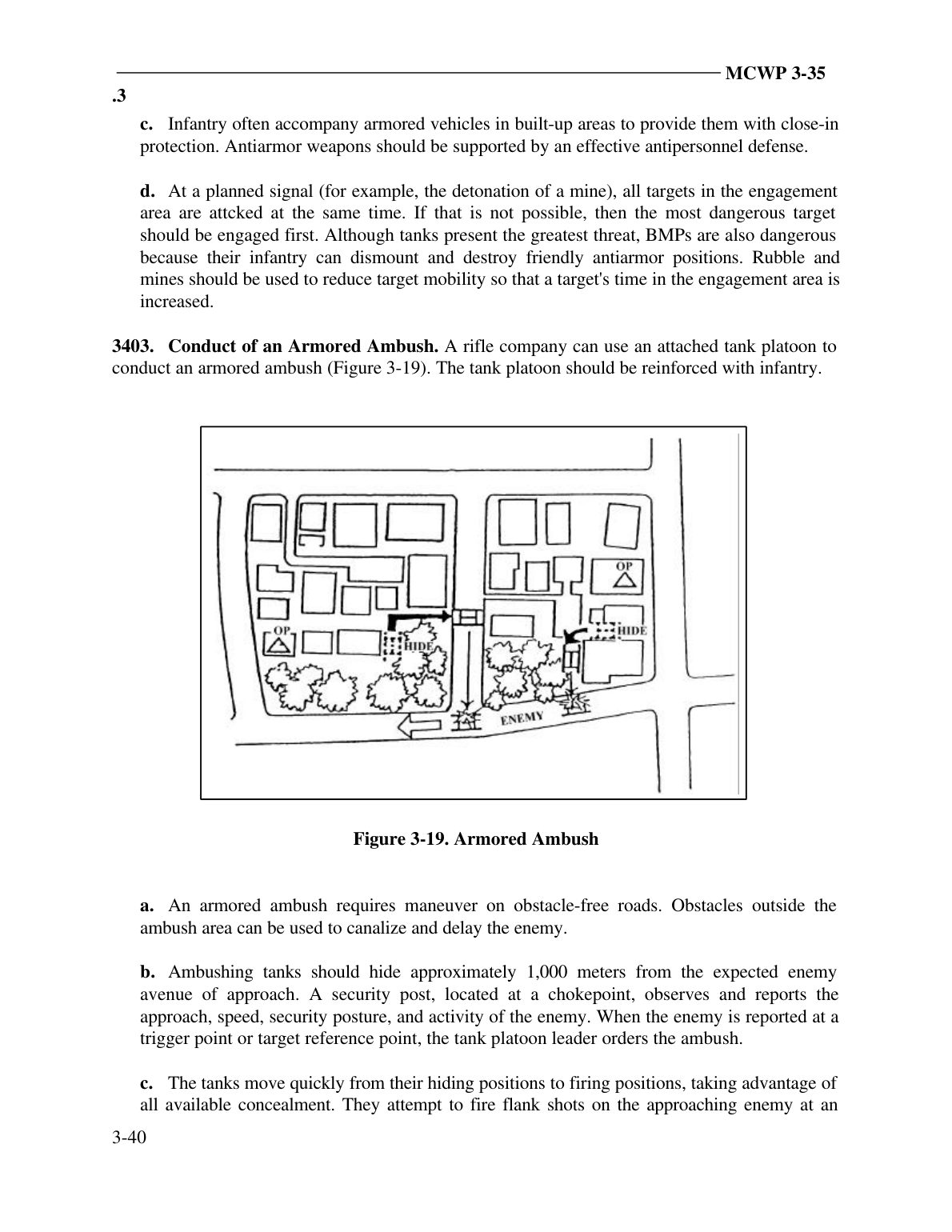
3403. Conduct of an Armored Ambush. A rifle company can use an attached tank platoon to
conduct an armored ambush (Figure 3-19). The tank platoon should be reinforced with infantry.
Figure 3-19. Armored Ambush
a. An armored ambush requires maneuver on obstacle-free roads. Obstacles outside the
ambush area can be used to canalize and delay the enemy.
b. Ambushing tanks should hide approximately 1,000 meters from the expected enemy
avenue of approach. A security post, located at a chokepoint, observes and reports the
approach, speed, security posture, and activity of the enemy. When the enemy is reported at a
trigger point or target reference point, the tank platoon leader orders the ambush.
c.
The tanks move quickly from their hiding positions to firing positions, taking advantage of
all available concealment. They attempt to fire flank shots on the approaching enemy at an
MCWP 3-35
.3
3-40