MCRP 12-10B.1, page 153
Military Operations on Urbanized Terrain (MOUT)
Marine Corps Reference Publication: Military Operations on Urbanized Terrain (MOUT)
Public distribution statement A; S2 KOCOA cited as MCRP 12-10 b.1
Searchable page text (OCR / PDF)
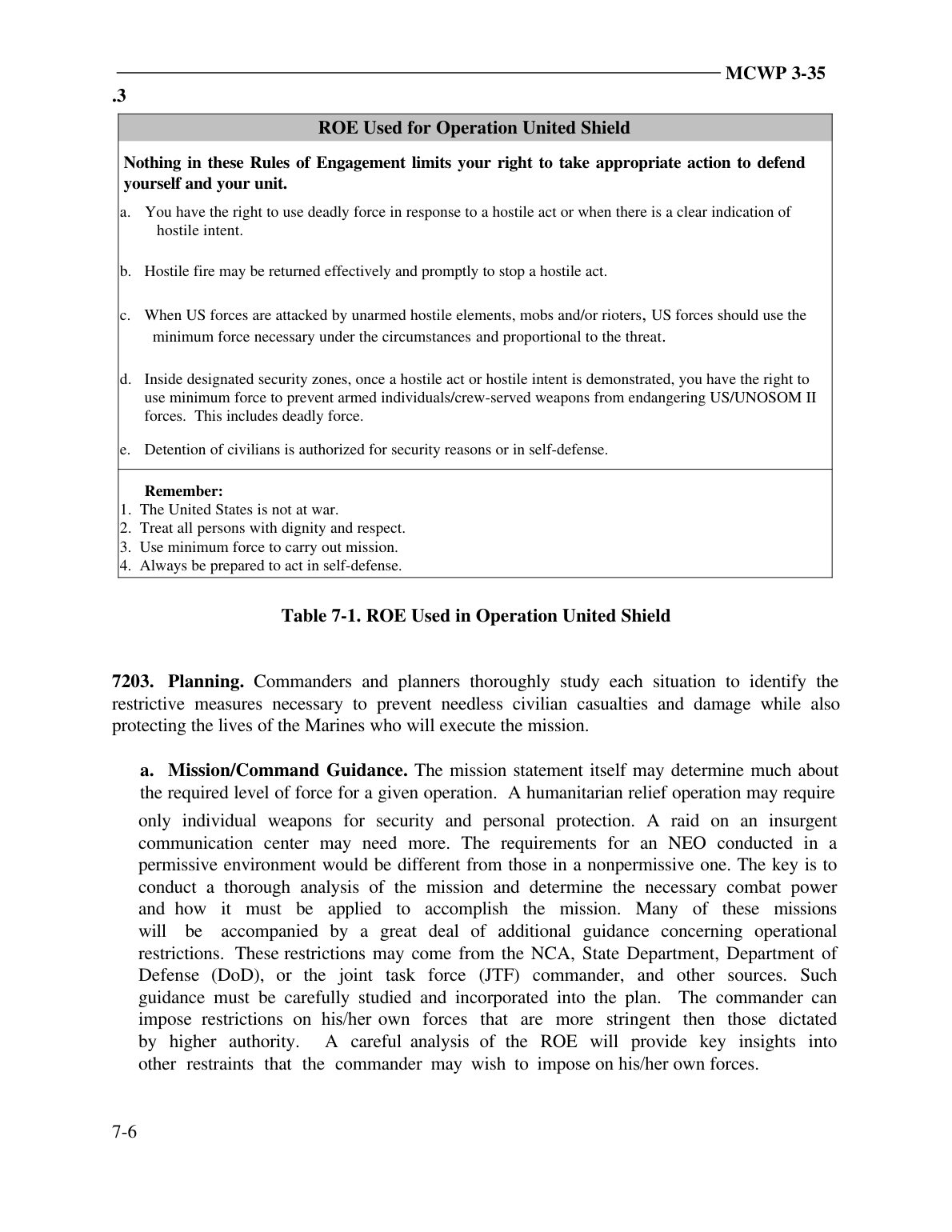
ROE Used for Operation United Shield
Nothing in these Rules of Engagement limits your right to take appropriate action to defend
yourself and your unit.
a.
You have the right to use deadly force in response to a hostile act or when there is a clear indication of
hostile intent.
b.
Hostile fire may be returned effectively and promptly to stop a hostile act.
c.
When US forces are attacked by unarmed hostile elements, mobs and/or rioters, US forces should use the
minimum force necessary under the circumstances and proportional to the threat.
d.
Inside designated security zones, once a hostile act or hostile intent is demonstrated, you have the right to
use minimum force to prevent armed individuals/crew-served weapons from endangering US/UNOSOM II
forces. This includes deadly force.
e.
Detention of civilians is authorized for security reasons or in self-defense.
Remember:
1. The United States is not at war.
2. Treat all persons with dignity and respect.
3. Use minimum force to carry out mission.
4. Always be prepared to act in self-defense.
Table 7-1. ROE Used in Operation United Shield
7203. Planning. Commanders and planners thoroughly study each situation to identify the
restrictive measures necessary to prevent needless civilian casualties and damage while also
protecting the lives of the Marines who will execute the mission.
a. Mission/Command Guidance. The mission statement itself may determine much about
the required level of force for a given operation. A humanitarian relief operation may require
only individual weapons for security and personal protection. A raid on an insurgent
communication center may need more. The requirements for an NEO conducted in a
permissive environment would be different from those in a nonpermissive one. The key is to
conduct a thorough analysis of the mission and determine the necessary combat power
and how it must be applied to accomplish the mission. Many of these missions
will be accompanied by a great deal of additional guidance concerning operational
restrictions. These restrictions may come from the NCA, State Department, Department of
Defense (DoD), or the joint task force (JTF) commander, and other sources. Such
guidance must be carefully studied and incorporated into the plan. The commander can
impose restrictions on his/her own forces that are more stringent then those dictated
by higher authority. A careful analysis of the ROE will provide key insights into
other restraints that the commander may wish to impose on his/her own forces.
MCWP 3-35
.3
7-6