MCRP 12-10B.1, page 158
Military Operations on Urbanized Terrain (MOUT)
Marine Corps Reference Publication: Military Operations on Urbanized Terrain (MOUT)
Public distribution statement A; S2 KOCOA cited as MCRP 12-10 b.1
Searchable page text (OCR / PDF)
Section II
Weapons Handling and Firing Techniques
2.
Weapons Carries. During MOUT, a Marine often finds himself/herself very unexpectedly
engaging targets at close ranges. Weapons carries provide a safe and effective method for
handling the service rifle. For additional in-depth discussion of weapons handling and firing
techniques, refer to MCWP 3-01X, Field Firing of the M16A2 Rifle.
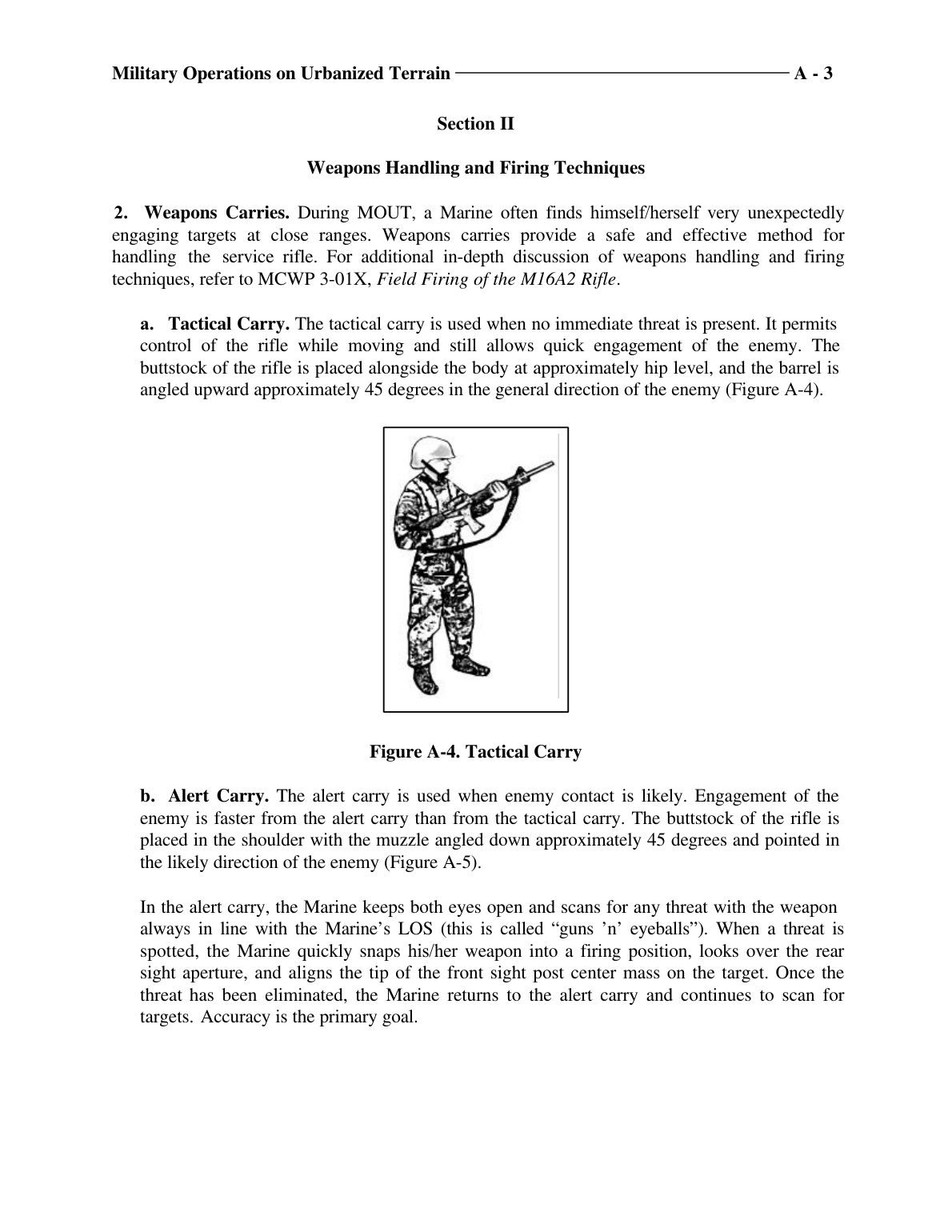
a. Tactical Carry. The tactical carry is used when no immediate threat is present. It permits
control of the rifle while moving and still allows quick engagement of the enemy. The
buttstock of the rifle is placed alongside the body at approximately hip level, and the barrel is
angled upward approximately 45 degrees in the general direction of the enemy (Figure A-4).
Figure A-4. Tactical Carry
b. Alert Carry. The alert carry is used when enemy contact is likely. Engagement of the
enemy is faster from the alert carry than from the tactical carry. The buttstock of the rifle is
placed in the shoulder with the muzzle angled down approximately 45 degrees and pointed in
the likely direction of the enemy (Figure A-5).
In the alert carry, the Marine keeps both eyes open and scans for any threat with the weapon
always in line with the Marine’s LOS (this is called “guns ’n’ eyeballs”). When a threat is
spotted, the Marine quickly snaps his/her weapon into a firing position, looks over the rear
sight aperture, and aligns the tip of the front sight post center mass on the target. Once the
threat has been eliminated, the Marine returns to the alert carry and continues to scan for
targets. Accuracy is the primary goal.
Military Operations on Urbanized Terrain
A - 3