MCRP 12-10B.1, page 209
Military Operations on Urbanized Terrain (MOUT)
Marine Corps Reference Publication: Military Operations on Urbanized Terrain (MOUT)
Public distribution statement A; S2 KOCOA cited as MCRP 12-10 b.1
Searchable page text (OCR / PDF)
i.
Operating in a built-up area presents new considerations. Marines should select numerous
alternate positions, particularly when the structure does not provide cover from small-arms
fire. They should position their weapons in the shadows and within the building.
j.
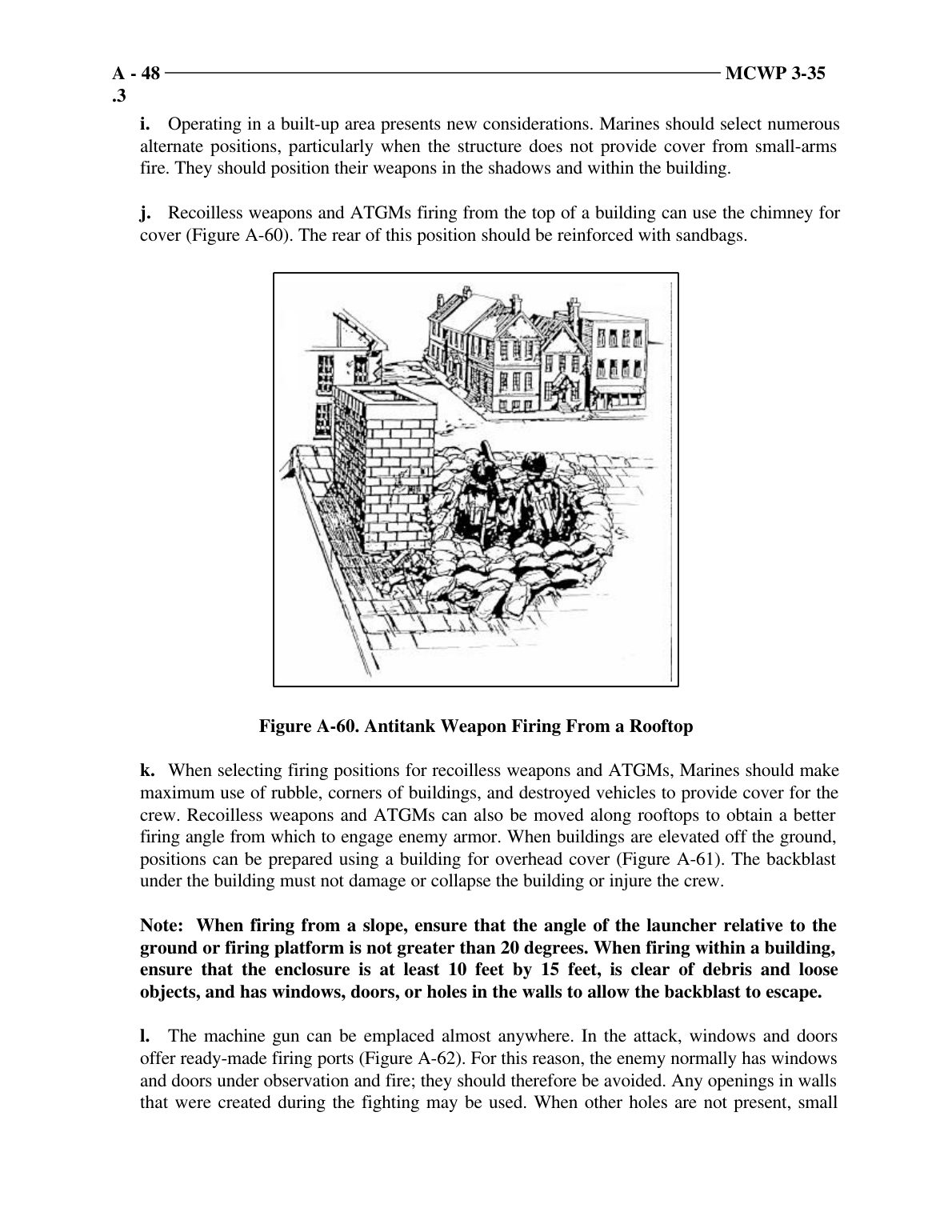
Recoilless weapons and ATGMs firing from the top of a building can use the chimney for
cover (Figure A-60). The rear of this position should be reinforced with sandbags.
Figure A-60. Antitank Weapon Firing From a Rooftop
k. When selecting firing positions for recoilless weapons and ATGMs, Marines should make
maximum use of rubble, corners of buildings, and destroyed vehicles to provide cover for the
crew. Recoilless weapons and ATGMs can also be moved along rooftops to obtain a better
firing angle from which to engage enemy armor. When buildings are elevated off the ground,
positions can be prepared using a building for overhead cover (Figure A-61). The backblast
under the building must not damage or collapse the building or injure the crew.
Note: When firing from a slope, ensure that the angle of the launcher relative to the
ground or firing platform is not greater than 20 degrees. When firing within a building,
ensure that the enclosure is at least 10 feet by 15 feet, is clear of debris and loose
objects, and has windows, doors, or holes in the walls to allow the backblast to escape.
l.
The machine gun can be emplaced almost anywhere. In the attack, windows and doors
offer ready-made firing ports (Figure A-62). For this reason, the enemy normally has windows
and doors under observation and fire; they should therefore be avoided. Any openings in walls
that were created during the fighting may be used. When other holes are not present, small
A - 48
MCWP 3-35
.3