MCRP 12-10B.1, page 214
Military Operations on Urbanized Terrain (MOUT)
Marine Corps Reference Publication: Military Operations on Urbanized Terrain (MOUT)
Public distribution statement A; S2 KOCOA cited as MCRP 12-10 b.1
Searchable page text (OCR / PDF)
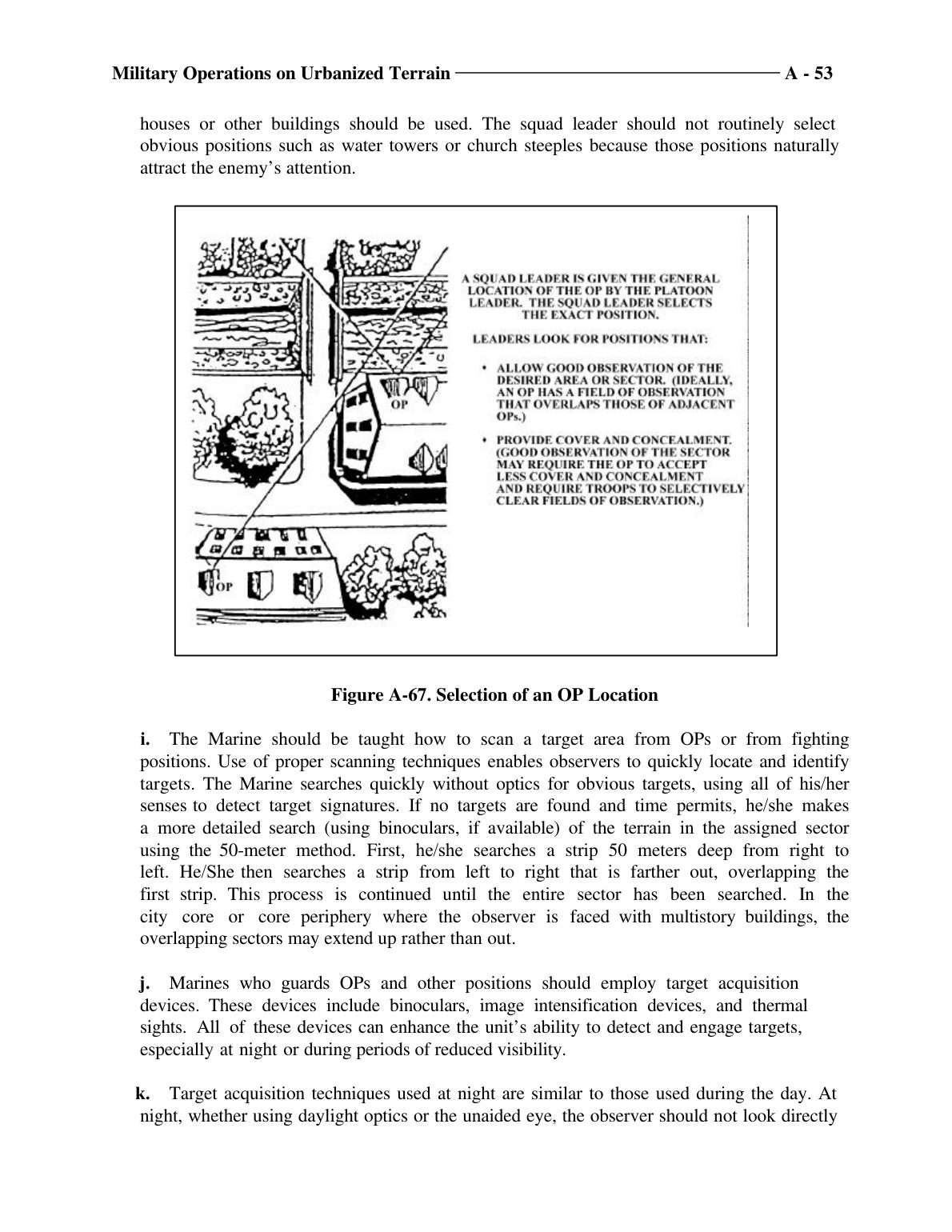
houses or other buildings should be used. The squad leader should not routinely select
obvious positions such as water towers or church steeples because those positions naturally
attract the enemy’s attention.
Figure A-67. Selection of an OP Location
i.
The Marine should be taught how to scan a target area from OPs or from fighting
positions. Use of proper scanning techniques enables observers to quickly locate and identify
targets. The Marine searches quickly without optics for obvious targets, using all of his/her
senses to detect target signatures. If no targets are found and time permits, he/she makes
a more detailed search (using binoculars, if available) of the terrain in the assigned sector
using the 50-meter method. First, he/she searches a strip 50 meters deep from right to
left. He/She then searches a strip from left to right that is farther out, overlapping the
first strip. This process is continued until the entire sector has been searched. In the
city core or core periphery where the observer is faced with multistory buildings, the
overlapping sectors may extend up rather than out.
j.
Marines who guards OPs and other positions should employ target acquisition
devices. These devices include binoculars, image intensification devices, and thermal
sights. All of these devices can enhance the unit’s ability to detect and engage targets,
especially at night or during periods of reduced visibility.
k.
Target acquisition techniques used at night are similar to those used during the day. At
night, whether using daylight optics or the unaided eye, the observer should not look directly
Military Operations on Urbanized Terrain
A - 53