MCRP 12-10B.1, page 234
Military Operations on Urbanized Terrain (MOUT)
Marine Corps Reference Publication: Military Operations on Urbanized Terrain (MOUT)
Public distribution statement A; S2 KOCOA cited as MCRP 12-10 b.1
Searchable page text (OCR / PDF)
g. The firer and target may each be inside or outside the same or separate buildings. The
enclosed nature of combat in built-up areas means that a weapon’s signature effect, such as a
muzzle blast or backblast, must be considered, as well as the round’s impact on the target.
h. Usually the manmade structure that is protecting the enemy must be attacked before
enemy personnel inside can be engaged. Therefore, weapons and demolitions can be chosen
for employment based on their effects against masonry and concrete rather than against enemy
personnel.
i.
Modern engineering and design improvements mean that most large buildings constructed
since World War II are resilient to the blast effects of bomb and artillery attack. Even though
modern buildings may burn easily, they often retain their structural integrity and remain
standing. Once high-rise buildings burn out, they are still useful to the military and are almost
impossible to damage further. A large structure can take 24 to 48 hours to burn out and
become cool enough for people to enter.
j.
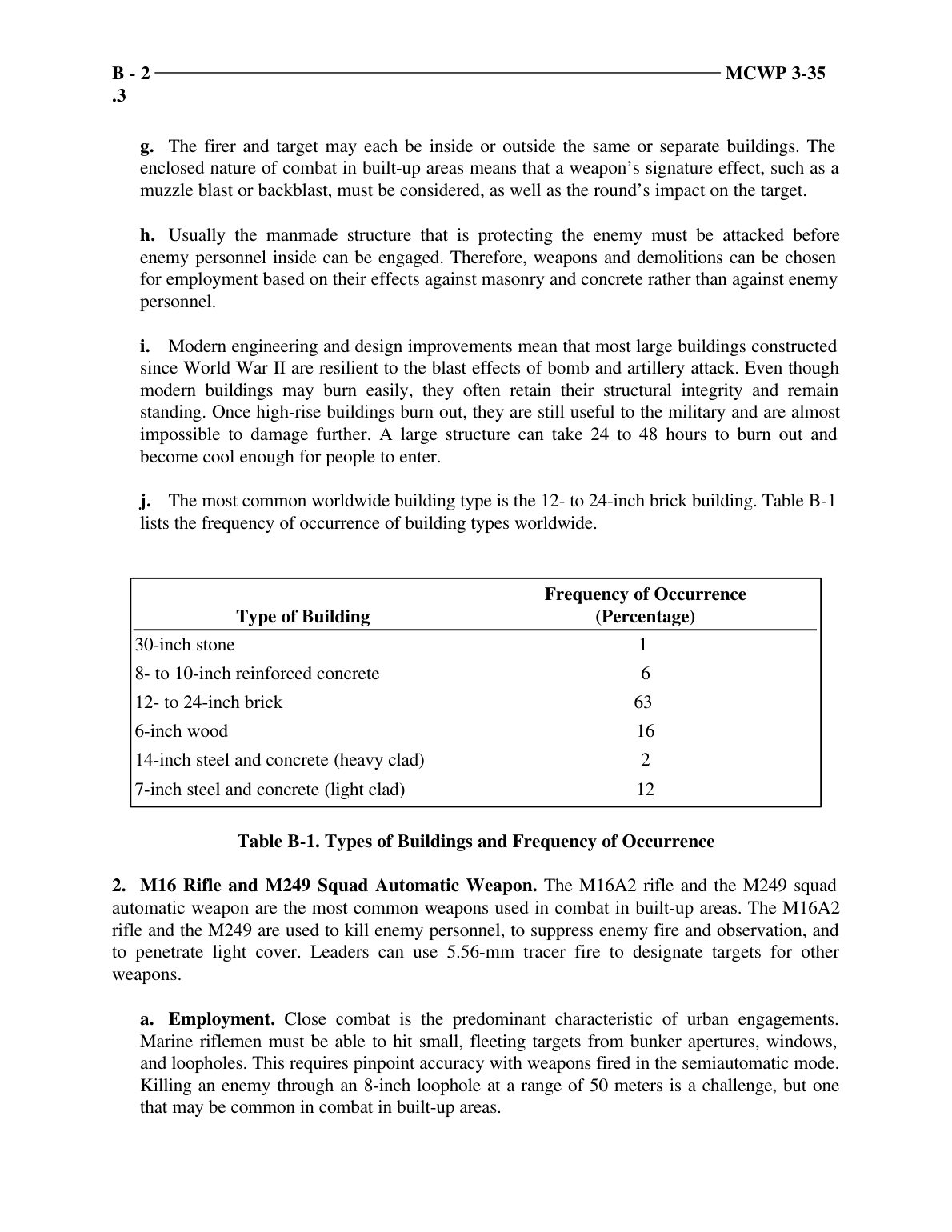
The most common worldwide building type is the 12- to 24-inch brick building. Table B-1
lists the frequency of occurrence of building types worldwide.
Type of Building
Frequency of Occurrence
(Percentage)
30-inch stone
1
8- to 10-inch reinforced concrete
6
12- to 24-inch brick
63
6-inch wood
16
14-inch steel and concrete (heavy clad)
2
7-inch steel and concrete (light clad)
12
Table B-1. Types of Buildings and Frequency of Occurrence
2. M16 Rifle and M249 Squad Automatic Weapon. The M16A2 rifle and the M249 squad
automatic weapon are the most common weapons used in combat in built-up areas. The M16A2
rifle and the M249 are used to kill enemy personnel, to suppress enemy fire and observation, and
to penetrate light cover. Leaders can use 5.56-mm tracer fire to designate targets for other
weapons.
a. Employment. Close combat is the predominant characteristic of urban engagements.
Marine riflemen must be able to hit small, fleeting targets from bunker apertures, windows,
and loopholes. This requires pinpoint accuracy with weapons fired in the semiautomatic mode.
Killing an enemy through an 8-inch loophole at a range of 50 meters is a challenge, but one
that may be common in combat in built-up areas.
B - 2
MCWP 3-35
.3