MCRP 12-10B.1, page 244
Military Operations on Urbanized Terrain (MOUT)
Marine Corps Reference Publication: Military Operations on Urbanized Terrain (MOUT)
Public distribution statement A; S2 KOCOA cited as MCRP 12-10 b.1
Searchable page text (OCR / PDF)
tanks, these weapons should always be employed against these weaker areas in volley or
paired firing. They normally require multiple hits to achieve a kill on a tank. Flank, top,
and rear shots hit the most vulnerable parts of armored vehicles. Firing from upper stories
protects the firer from tank main gun and coaxial machine gun fire because tanks cannot
sharply elevate their cannons. The BMP-2 can elevate its 30-mm cannon to engage targets
in upper stories. The BTR-series armored vehicles can also fire into upper stories with
their heavy machine gun.
(5) Modern IFVs such as the BMP-2 and the BTR-80 have significantly improved frontal
protection against shaped-charge weapons. Many main battle tanks have some form of
reactive armor in addition to their thick armor plate. Head-on, ground-level shots against
these vehicles have little probability of obtaining a kill. Even without reactive armor,
modern main battle tanks are hard to destroy with a light antiarmor weapon.
(6) The easiest technique to improve the probability of hitting and killing an armored
vehicle is to increase the firing depression angle. A 45-degree downward firing angle
doubles the probability of a first-round hit as compared to a ground-level shot.
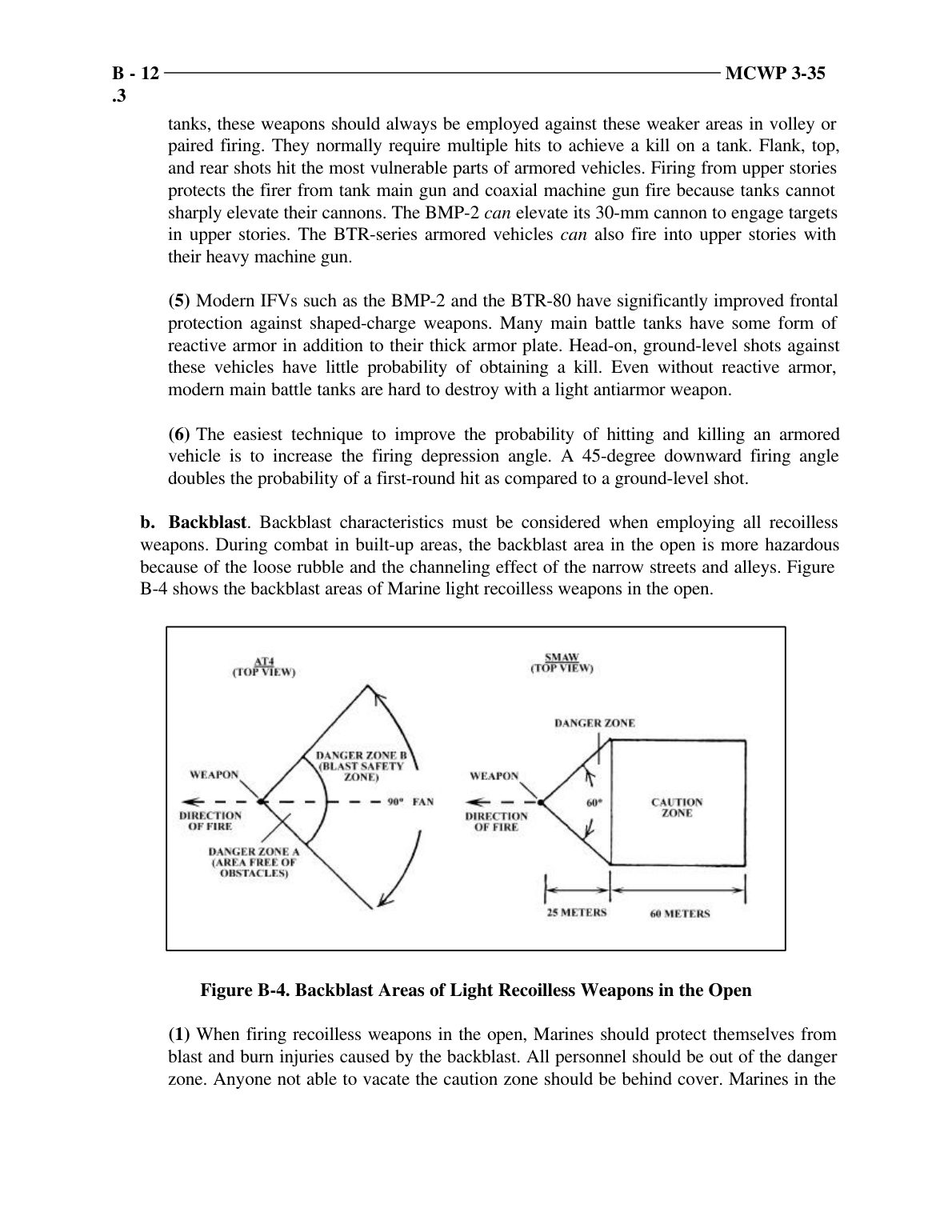
b. Backblast. Backblast characteristics must be considered when employing all recoilless
weapons. During combat in built-up areas, the backblast area in the open is more hazardous
because of the loose rubble and the channeling effect of the narrow streets and alleys. Figure
B-4 shows the backblast areas of Marine light recoilless weapons in the open.
Figure B-4. Backblast Areas of Light Recoilless Weapons in the Open
(1) When firing recoilless weapons in the open, Marines should protect themselves from
blast and burn injuries caused by the backblast. All personnel should be out of the danger
zone. Anyone not able to vacate the caution zone should be behind cover. Marines in the
B - 12
MCWP 3-35
.3