MCRP 12-10B.1, page 245
Military Operations on Urbanized Terrain (MOUT)
Marine Corps Reference Publication: Military Operations on Urbanized Terrain (MOUT)
Public distribution statement A; S2 KOCOA cited as MCRP 12-10 b.1
Searchable page text (OCR / PDF)
caution zone should wear helmets, protective vests, and eye protection. The firer and all
Marines in the area should wear earplugs.
(2) Extensive testing on the effects of firing recoilless weapons from within enclosures has
been conducted since 1948. These tests showed that firing these weapons from enclosures
presented no serious hazards, even when the overpressure was enough to produce
structural damage to the building. The following were other findings of these tests.
(a) Little hazard exists to the gunnery or crew from any type of flying debris. Loose
items were not hurled around the room.
(b) No substantial degradation occurs to the operator’s tracking performance as a
result of obscuration or blast overpressure.
(c) The most serious hazard that can be expected is hearing loss. This must be
evaluated against the advantage gained in combat from firing from cover. To place this
hazard in perspective, a gunner wearing earplugs and firing the loudest combination
(the Dragon from within a masonry building) is exposed to less noise hazard than if he/
she fired a LAW or AT4 in the open without earplugs.
(d) The safest place for other Marines in the room with the firer is against the wall
from which the weapon is fired. Plastic ignition plugs are a hazard to anyone standing
directly behind a LAW or TOW when it is fired.
(e) Firers should take advantage of all available sources of ventilation by opening
doors and windows. Ventilation does not reduce the noise hazard, but it helps clear the
room of smoke and dust and reduces the effective duration of the overpressure.
(f) The only difference between firing these weapons from enclosures and firing them
in the open is the duration of the pressure fluctuation.
(g) Frame buildings, especially small ones, can suffer structural damage to the rear
walls, windows, and doors. Large rooms suffer slight damage, if any.
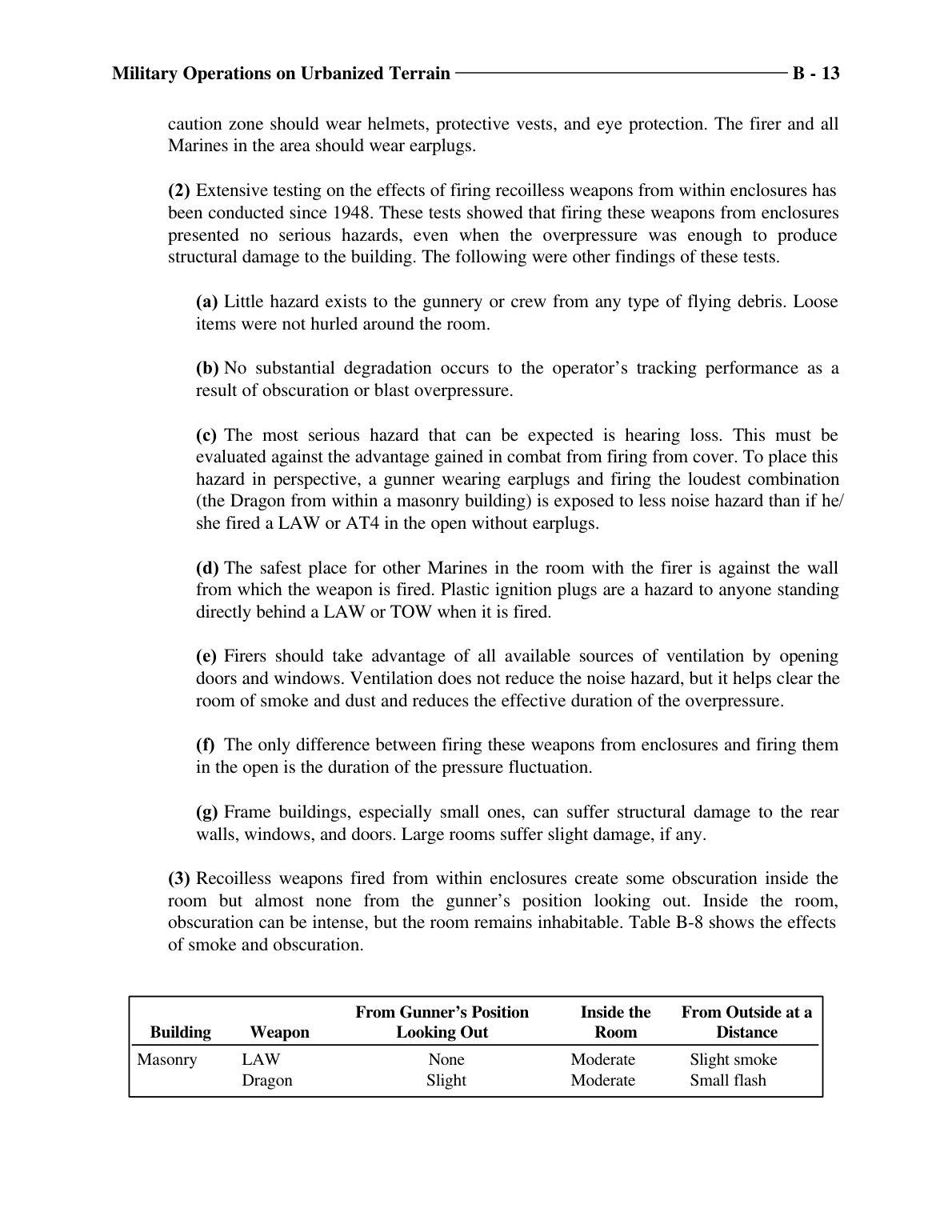
(3) Recoilless weapons fired from within enclosures create some obscuration inside the
room but almost none from the gunner’s position looking out. Inside the room,
obscuration can be intense, but the room remains inhabitable. Table B-8 shows the effects
of smoke and obscuration.
Building
Weapon
From Gunner’s Position
Looking Out
Inside the
Room
From Outside at a
Distance
Masonry
LAW
Dragon
None
Slight
Moderate
Moderate
Slight smoke
Small flash
Military Operations on Urbanized Terrain
B - 13