MCRP 12-10B.1, page 255
Military Operations on Urbanized Terrain (MOUT)
Marine Corps Reference Publication: Military Operations on Urbanized Terrain (MOUT)
Public distribution statement A; S2 KOCOA cited as MCRP 12-10 b.1
Searchable page text (OCR / PDF)
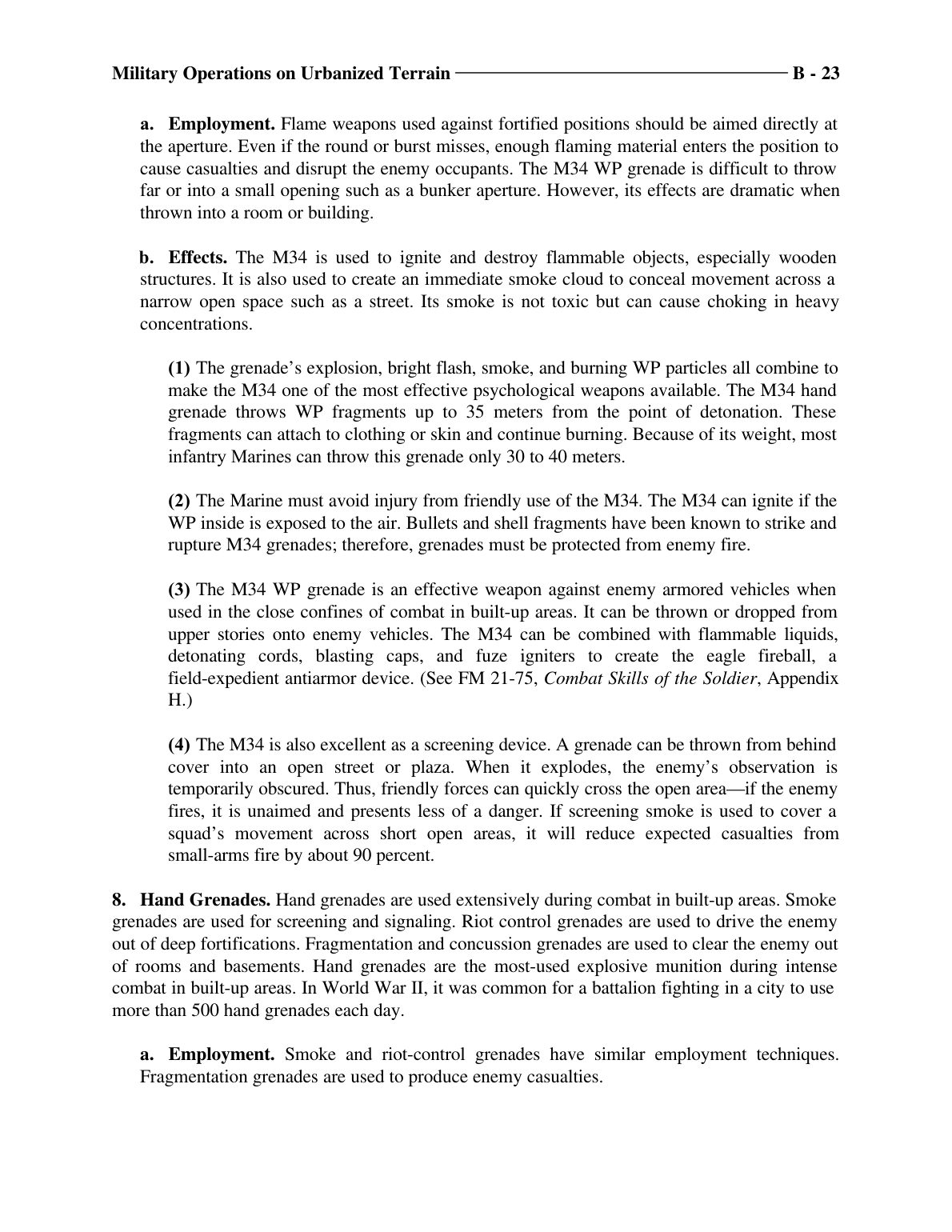
a. Employment. Flame weapons used against fortified positions should be aimed directly at
the aperture. Even if the round or burst misses, enough flaming material enters the position to
cause casualties and disrupt the enemy occupants. The M34 WP grenade is difficult to throw
far or into a small opening such as a bunker aperture. However, its effects are dramatic when
thrown into a room or building.
b. Effects. The M34 is used to ignite and destroy flammable objects, especially wooden
structures. It is also used to create an immediate smoke cloud to conceal movement across a
narrow open space such as a street. Its smoke is not toxic but can cause choking in heavy
concentrations.
(1) The grenade’s explosion, bright flash, smoke, and burning WP particles all combine to
make the M34 one of the most effective psychological weapons available. The M34 hand
grenade throws WP fragments up to 35 meters from the point of detonation. These
fragments can attach to clothing or skin and continue burning. Because of its weight, most
infantry Marines can throw this grenade only 30 to 40 meters.
(2) The Marine must avoid injury from friendly use of the M34. The M34 can ignite if the
WP inside is exposed to the air. Bullets and shell fragments have been known to strike and
rupture M34 grenades; therefore, grenades must be protected from enemy fire.
(3) The M34 WP grenade is an effective weapon against enemy armored vehicles when
used in the close confines of combat in built-up areas. It can be thrown or dropped from
upper stories onto enemy vehicles. The M34 can be combined with flammable liquids,
detonating cords, blasting caps, and fuze igniters to create the eagle fireball, a
field-expedient antiarmor device. (See FM 21-75, Combat Skills of the Soldier, Appendix
H.)
(4) The M34 is also excellent as a screening device. A grenade can be thrown from behind
cover into an open street or plaza. When it explodes, the enemy’s observation is
temporarily obscured. Thus, friendly forces can quickly cross the open area—if the enemy
fires, it is unaimed and presents less of a danger. If screening smoke is used to cover a
squad’s movement across short open areas, it will reduce expected casualties from
small-arms fire by about 90 percent.
8. Hand Grenades. Hand grenades are used extensively during combat in built-up areas. Smoke
grenades are used for screening and signaling. Riot control grenades are used to drive the enemy
out of deep fortifications. Fragmentation and concussion grenades are used to clear the enemy out
of rooms and basements. Hand grenades are the most-used explosive munition during intense
combat in built-up areas. In World War II, it was common for a battalion fighting in a city to use
more than 500 hand grenades each day.
a. Employment. Smoke and riot-control grenades have similar employment techniques.
Fragmentation grenades are used to produce enemy casualties.
Military Operations on Urbanized Terrain
B - 23