MCRP 12-10B.1, page 26
Military Operations on Urbanized Terrain (MOUT)
Marine Corps Reference Publication: Military Operations on Urbanized Terrain (MOUT)
Public distribution statement A; S2 KOCOA cited as MCRP 12-10 b.1
Searchable page text (OCR / PDF)
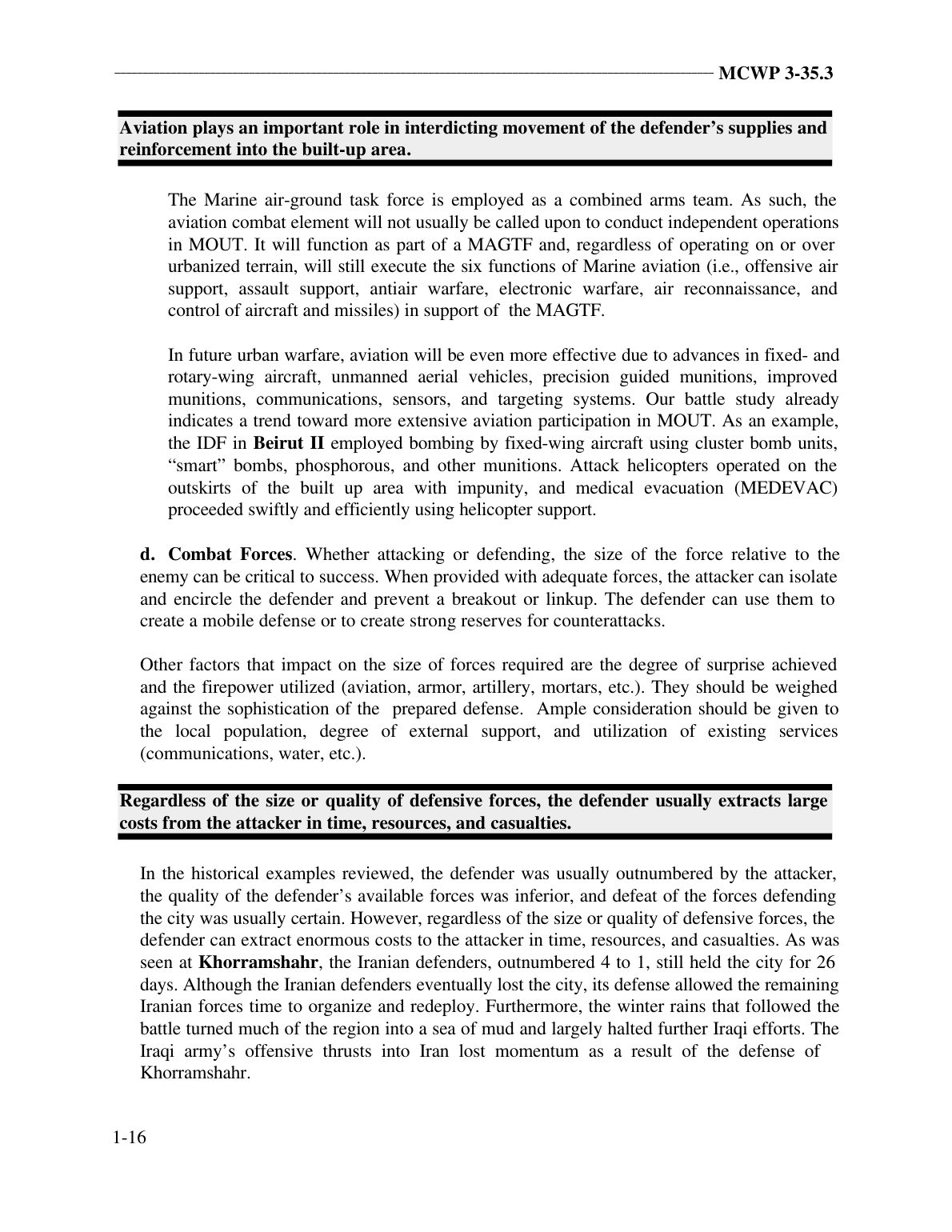
Aviation plays an important role in interdicting movement of the defender’s supplies and
reinforcement into the built-up area.
The Marine air-ground task force is employed as a combined arms team. As such, the
aviation combat element will not usually be called upon to conduct independent operations
in MOUT. It will function as part of a MAGTF and, regardless of operating on or over
urbanized terrain, will still execute the six functions of Marine aviation (i.e., offensive air
support, assault support, antiair warfare, electronic warfare, air reconnaissance, and
control of aircraft and missiles) in support of the MAGTF.
In future urban warfare, aviation will be even more effective due to advances in fixed- and
rotary-wing aircraft, unmanned aerial vehicles, precision guided munitions, improved
munitions, communications, sensors, and targeting systems. Our battle study already
indicates a trend toward more extensive aviation participation in MOUT. As an example,
the IDF in Beirut II employed bombing by fixed-wing aircraft using cluster bomb units,
“smart” bombs, phosphorous, and other munitions. Attack helicopters operated on the
outskirts of the built up area with impunity, and medical evacuation (MEDEVAC)
proceeded swiftly and efficiently using helicopter support.
d. Combat Forces. Whether attacking or defending, the size of the force relative to the
enemy can be critical to success. When provided with adequate forces, the attacker can isolate
and encircle the defender and prevent a breakout or linkup. The defender can use them to
create a mobile defense or to create strong reserves for counterattacks.
Other factors that impact on the size of forces required are the degree of surprise achieved
and the firepower utilized (aviation, armor, artillery, mortars, etc.). They should be weighed
against the sophistication of the prepared defense. Ample consideration should be given to
the local population, degree of external support, and utilization of existing services
(communications, water, etc.).
Regardless of the size or quality of defensive forces, the defender usually extracts large
costs from the attacker in time, resources, and casualties.
In the historical examples reviewed, the defender was usually outnumbered by the attacker,
the quality of the defender’s available forces was inferior, and defeat of the forces defending
the city was usually certain. However, regardless of the size or quality of defensive forces, the
defender can extract enormous costs to the attacker in time, resources, and casualties. As was
seen at Khorramshahr, the Iranian defenders, outnumbered 4 to 1, still held the city for 26
days. Although the Iranian defenders eventually lost the city, its defense allowed the remaining
Iranian forces time to organize and redeploy. Furthermore, the winter rains that followed the
battle turned much of the region into a sea of mud and largely halted further Iraqi efforts. The
Iraqi army’s offensive thrusts into Iran lost momentum as a result of the defense of
Khorramshahr.
___________________________________________________________________________________________________________ MCWP 3-35.3
1-16