MCRP 12-10B.1, page 261
Military Operations on Urbanized Terrain (MOUT)
Marine Corps Reference Publication: Military Operations on Urbanized Terrain (MOUT)
Public distribution statement A; S2 KOCOA cited as MCRP 12-10 b.1
Searchable page text (OCR / PDF)
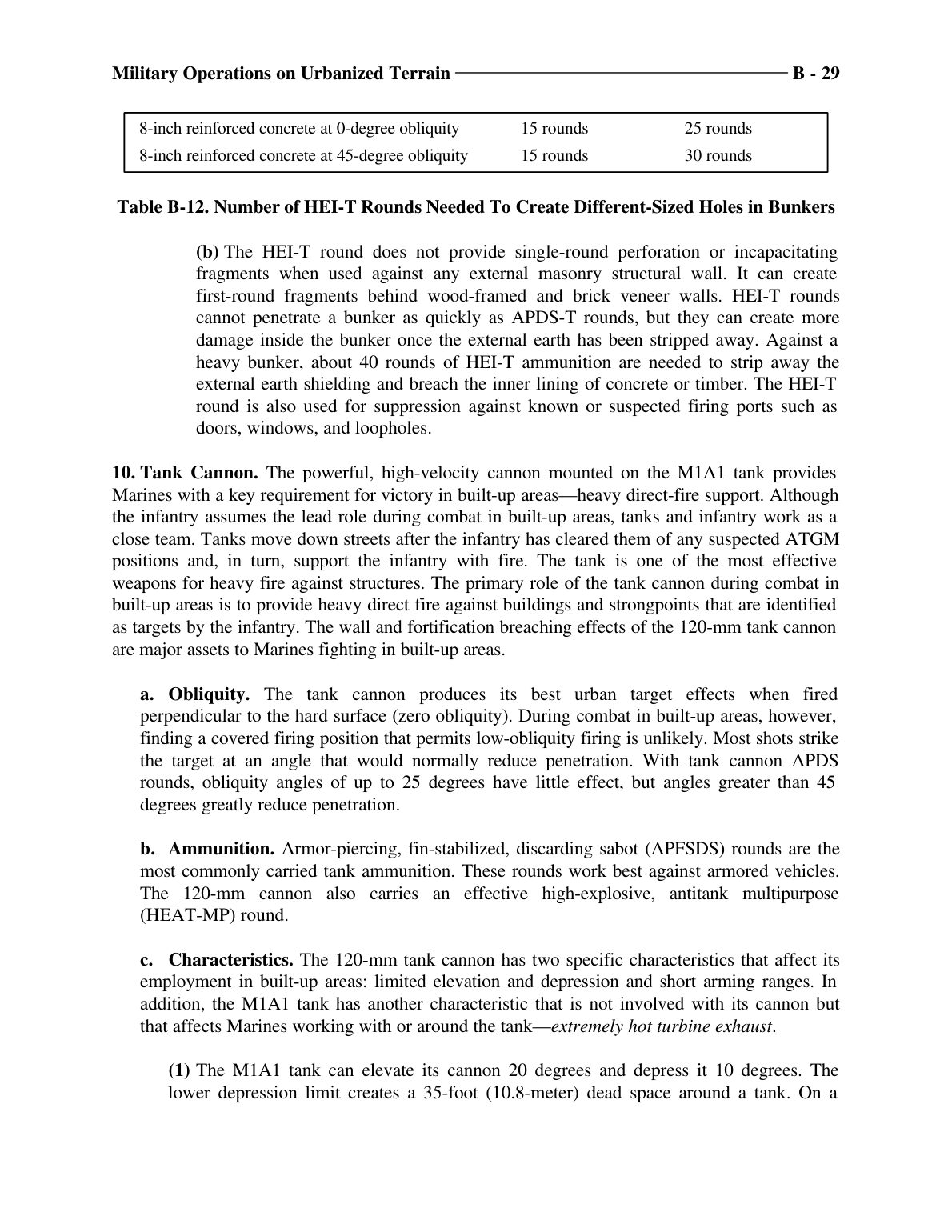
8-inch reinforced concrete at 0-degree obliquity
15 rounds
25 rounds
8-inch reinforced concrete at 45-degree obliquity
15 rounds
30 rounds
Table B-12. Number of HEI-T Rounds Needed To Create Different-Sized Holes in Bunkers
(b) The HEI-T round does not provide single-round perforation or incapacitating
fragments when used against any external masonry structural wall. It can create
first-round fragments behind wood-framed and brick veneer walls. HEI-T rounds
cannot penetrate a bunker as quickly as APDS-T rounds, but they can create more
damage inside the bunker once the external earth has been stripped away. Against a
heavy bunker, about 40 rounds of HEI-T ammunition are needed to strip away the
external earth shielding and breach the inner lining of concrete or timber. The HEI-T
round is also used for suppression against known or suspected firing ports such as
doors, windows, and loopholes.
10. Tank Cannon. The powerful, high-velocity cannon mounted on the M1A1 tank provides
Marines with a key requirement for victory in built-up areas—heavy direct-fire support. Although
the infantry assumes the lead role during combat in built-up areas, tanks and infantry work as a
close team. Tanks move down streets after the infantry has cleared them of any suspected ATGM
positions and, in turn, support the infantry with fire. The tank is one of the most effective
weapons for heavy fire against structures. The primary role of the tank cannon during combat in
built-up areas is to provide heavy direct fire against buildings and strongpoints that are identified
as targets by the infantry. The wall and fortification breaching effects of the 120-mm tank cannon
are major assets to Marines fighting in built-up areas.
a. Obliquity. The tank cannon produces its best urban target effects when fired
perpendicular to the hard surface (zero obliquity). During combat in built-up areas, however,
finding a covered firing position that permits low-obliquity firing is unlikely. Most shots strike
the target at an angle that would normally reduce penetration. With tank cannon APDS
rounds, obliquity angles of up to 25 degrees have little effect, but angles greater than 45
degrees greatly reduce penetration.
b. Ammunition. Armor-piercing, fin-stabilized, discarding sabot (APFSDS) rounds are the
most commonly carried tank ammunition. These rounds work best against armored vehicles.
The 120-mm cannon also carries an effective high-explosive, antitank multipurpose
(HEAT-MP) round.
c.
Characteristics. The 120-mm tank cannon has two specific characteristics that affect its
employment in built-up areas: limited elevation and depression and short arming ranges. In
addition, the M1A1 tank has another characteristic that is not involved with its cannon but
that affects Marines working with or around the tank—extremely hot turbine exhaust.
(1) The M1A1 tank can elevate its cannon 20 degrees and depress it 10 degrees. The
lower depression limit creates a 35-foot (10.8-meter) dead space around a tank. On a
Military Operations on Urbanized Terrain
B - 29