MCRP 12-10B.1, page 297
Military Operations on Urbanized Terrain (MOUT)
Marine Corps Reference Publication: Military Operations on Urbanized Terrain (MOUT)
Public distribution statement A; S2 KOCOA cited as MCRP 12-10 b.1
Searchable page text (OCR / PDF)
Appendix E
Subterranean Operations
Knowledge of the nature and location of underground facilities is valuable to both the
urban attacker and defender.
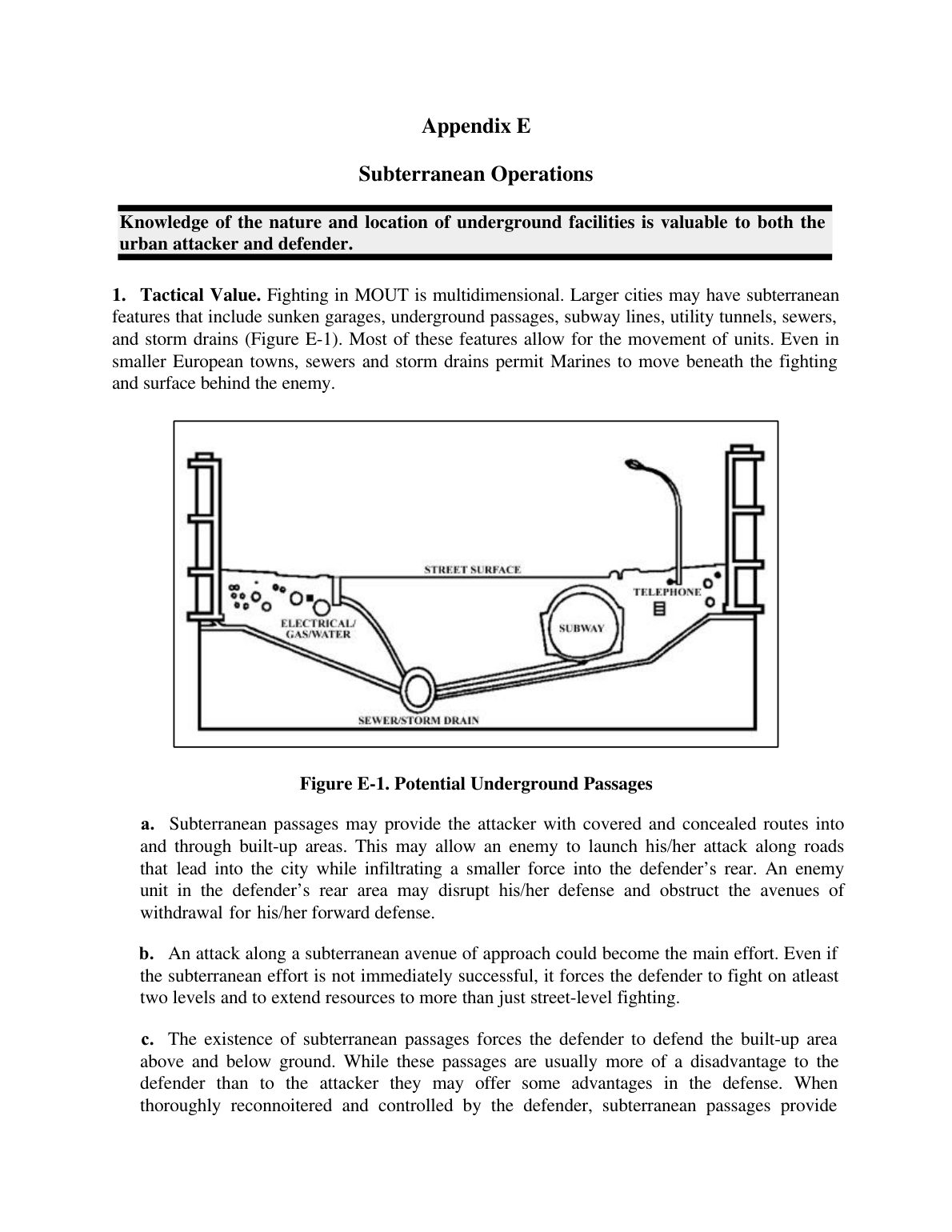
1. Tactical Value. Fighting in MOUT is multidimensional. Larger cities may have subterranean
features that include sunken garages, underground passages, subway lines, utility tunnels, sewers,
and storm drains (Figure E-1). Most of these features allow for the movement of units. Even in
smaller European towns, sewers and storm drains permit Marines to move beneath the fighting
and surface behind the enemy.
Figure E-1. Potential Underground Passages
a. Subterranean passages may provide the attacker with covered and concealed routes into
and through built-up areas. This may allow an enemy to launch his/her attack along roads
that lead into the city while infiltrating a smaller force into the defender’s rear. An enemy
unit in the defender’s rear area may disrupt his/her defense and obstruct the avenues of
withdrawal for his/her forward defense.
b. An attack along a subterranean avenue of approach could become the main effort. Even if
the subterranean effort is not immediately successful, it forces the defender to fight on atleast
two levels and to extend resources to more than just street-level fighting.
c. The existence of subterranean passages forces the defender to defend the built-up area
above and below ground. While these passages are usually more of a disadvantage to the
defender than to the attacker they may offer some advantages in the defense. When
thoroughly reconnoitered and controlled by the defender, subterranean passages provide