S2 Search · Reading list

S2 Actual reading list

Books from S2 Actual on Goodreads, organized by his shelves and topic buckets (intel lists, military history, logistics, etc.). Metadata filled via Open Library.

Not official S2 Underground. Independent fan index — not affiliated with or endorsed by S2. Official hub: linktr.ee/S2_underground. S2 materials are CC BY-NC-SA 4.0.

S2 topic buckets (Goodreads)

Subjects & genres

137 books · Advanced intel · page 2 of 6

No cover · Amazon

Sniping in France: Winning the Sniping War in the Trenches

H. Hesketh-Prichard

★★★★★
Read Advanced intel Intel history Military history Technical warfare WWII

“Now, if any one cares to do a mathematical sum, and to work out the number of battalions we had in the line, they will be surprised at the figures, and when they multiply these figures by thirty and look at the month’s losses, they will find that in a war of attrition the sniper on this count alone justifies his existence and wipes out large numbers of the enemy.” During the initial stages of the First World War in 1914, Allied forces lost breathtaking numbers of men on the Western Front to Germany’s highly efficient and superior snipers. However, the passion of Major Hesketh-Prichard – hunter and excellent marksman – for the promotion and advancement of sniping practices led to the implementation of brand new sniping methods by the British Army. These new practices contributed to the reversal of fortune of the Allied forces, tipping the balance in their favour towards victory in the sniping war. This excellent book, as told in the inimitable style of Major Hesketh-Prichard, recounts the genesis, development, and advancement of sniping style and practice, intermingled with a charming autobiographical style. Truly a classic account of war, this is a must read for avid military enthusiasts. Major Hesketh-Prichard, born in India in 1876, led a vibrant life as an explorer and adventurer, big-game hunter turned animal rights activist, novelist and travel writer, excellent cricket player, and marksman. He contributed significantly to the advancement of sniping practice in the British Army during the First World War, and the measures he introduced are credited as saving the lives of thousands of Allied soldiers.
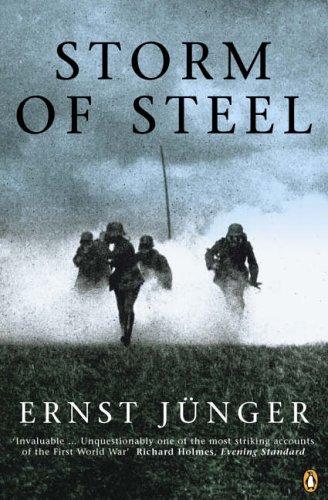
Storm of Steel

Ernst Jünger

★★★★★
Read Advanced intel Basic intel Military history WWI Biography ISBN 9780141186917

Penguin Books Ltd · June 3, 2004

A memoir of astonishing power, savagery, and ashen lyricism, 'Storm of Steel' illuminates not only the horrors but also the fascination of total war, seen through the eyes of an ordinary German soldier. Young, tough, patriotic, but also disturbingly self-aware, Jünger exulted in the Great War, which he saw not just as a great national conflict, but more importantly as a unique personal struggle. Leading raiding parties, defending trenches against murderous British incursions, simply enduring as shells tore his comrades apart, Jünger kept testing himself, braced for the death that will mark his failure. Published shortly after the war's end, 'Storm of Steel' was a worldwide bestseller and can now be rediscovered through Michael Hofmann's brilliant new translation.

Tequila Junction: 4th-Generation Counterinsurgency

H. John Poole

★★★★★
Read Advanced intel GWOT Special ops Guerrilla / COIN ISBN 9780963869517

Posterity Press · 2008

Don't recognize this drug-funded Maoist army ? Its operatives have been busy in at least nine Latin American countries. Bringing an end to America's white-heroin deluge may take temporarily reinforcing -- with a lone U.S. infantry squad -- a few police outposts in Colombia, Panama, and Mexico. After briefly noting the extent of criminal, Communist, and Islamist subversion throughout the region, this book shows the Unconventional Warfare (UW) techniques that 14 isolated GIs might need to vie with many times their number of drug runners and revolutionaries. Among the "how-to" chapters (1) "Best 4GW Defense Is Locally Tailored;" (2) "Deep Interdiction;" (3) "Buffer Zones"; and (4) "Working a Heavily Populated Area." well illustrated, full of tiny element maneuvers, and quite exciting to read. One even shows how to blanket an area with secretly occupied fire team zones. Such an advanced UW concept would also work in other parts of the world. According to Australian Army Journal, "Poole's methods in Tequila Junction are an example of a decentralised approach to counterinsurgency that may provide a tactical level solution ... [to] keep the insurgents off balance in Uruzgan [Afghanistan]." As a final bonus , this book's appendix shows a fully tested way for any U.S. infantry or special operations company to develop its own state-of-the-art techniques for any intensity of combat.

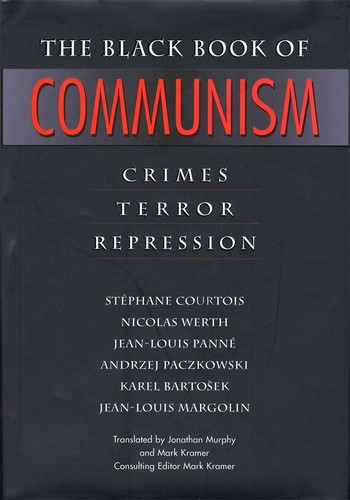
The Black Book of Communism: Crimes, Terror, Repression

Stéphane Courtois

★★★★★
Read Military history Advanced intel Vietnam Korea Cold War GWOT Guerrilla / COIN China Russia / USSR Orthodox / theology ISBN 0674076087

Harvard University Press · 1999

Already famous throughout Europe, this international bestseller plumbs recently opened archives in the former Soviet bloc to reveal the actual, practical accomplishments of Communism around the terror, torture, famine, mass deportations, and massacres. Astonishing in the sheer detail it amasses, the book is the first comprehensive attempt to catalogue and analyze the crimes of Communism over seventy years. "Revolutions, like trees, must be judged by their fruit," Ignazio Silone wrote, and this is the standard the authors apply to the Communist experience―in the China of "the Great Helmsman," Kim Il Sung's Korea, Vietnam under "Uncle Ho" and Cuba under Castro, Ethiopia under Mengistu, Angola under Neto, and Afghanistan under Najibullah. The authors, all distinguished scholars based in Europe, document Communist crimes against humanity, but also crimes against national and universal culture, from Stalin's destruction of hundreds of churches in Moscow to Ceausescu's leveling of the historic heart of Bucharest to the widescale devastation visited on Chinese culture by Mao's Red Guards. As the death toll mounts―as many as 25 million in the former Soviet Union, 65 million in China, 1.7 million in Cambodia, and on and on―the authors systematically show how and why, wherever the millenarian ideology of Communism was established, it quickly led to crime, terror, and repression. An extraordinary accounting, this book amply documents the unparalleled position and significance of Communism in the hierarchy of violence that is the history of the twentieth century.

No cover · Amazon

The Crucible of War Book 3: Montgomery and Alamein

Barrie Pitt

★★★★★
Read Advanced intel Intel history Military history Technical warfare Strategy / theory

The Crucible of War Book 3 ‘Masterly and lucid in its descriptions not only of the fighting and strategy, but of the political machinations’ Sunday Telegraph Throughout the first half of the Second World War, control of the inhospitable North African desert was strategically vital for the Allies. In the middle of 1942, the outcome hung in the balance. Rommel and his Afrika Korps had been fought to a standstill at the first battle of Alamein and were desperately short of fuel and equipment. But the British and Commonwealth forces were in little better shape. The next encounter between the two armies would however be decisive. Montgomery, the new Allied commander, set about rebuilding his weary army and establishing an overwhelming superiority in both men and material. The scene was set for a second, and bludgeoning, encounter at El Alamein in October. It was to prove Britain’s first decisive victory of the war. Montgomery and Alamein is the third volume of Barrie Pitt’s definitive history of the Desert War. The first and second volumes, Wavell’s Command and Auchinleck’s Command, are also published by Sharpe Books. Barrie Pitt is also the author of Zeebrugge, Coronel & Falkland the history of the Special Boat Squadron. Praise for the Crucible of War Trilogy: ‘Barrie Pitt tells this exciting history well. He has assembled a mass of information and organised it with admirable clarity. His narrative is scrupulously accurate in detail. The whole work will have great appeal for the general reader.’ Times Literary Supplement ‘The definitive work on the Desert War.’ Manchester Evening News ‘A magnificent book, Barrie Pitt has almost a novelist’s skill and perception of character.’ Daily Telegraph ‘Totally readable, Mr Pitt’s study depicts equally well the broad outlines of strategy, the confusions and hazards of the battlefield and the personalities of the generals or private soldiers fighting there.’ Oxford Times

No cover · Amazon

The Crucible of War: The Complete Volumes

Barrie Pitt

★★★★★
Read Advanced intel WWII Middle East Strategy / theory

‘The definitive work on the Desert War.’ Manchester Evening News WAVELL’S Volume 1 of The Crucible of War trilogy covers General Wavell’s command, a period that began triumphantly with the rout of the Italian Army and ended in catastrophe with the devastating entry of Rommel into the conflict. On 11th June 1940, Mussolini declared war on Britain and France. From their colony in Libya, the Italians began invading Egypt in an attempt to expand their African Empire. Thus began the Desert War – a battle to secure critical Middle East oil supplies which would last for three years. Commander-in-Chief of the Middle East was General Sir Archibald Wavell. By 1940, and with limited resources, he was responsible for all British land forces in Egypt, the Sudan, Palestine, Transjordan and Cyprus, as well as the Army formations in British Somaliland, Aden, Iraq and along the shores of the Persian Gulf. Attack was the only form of defence and under field commander General Richard O’Connor, an immensely successful and exhilarating campaign was carried out against Marshal Graziani’s forces. The Italians were pushed back hundreds of miles and 130,000 prisoners were taken. By February 1941 nearly all Axis forces had been expelled from North Africa. It was a remarkable triumph in one of the most dramatic theatres of the Second World War. AUCHINLECK’S Volume Two of The Crucible of War trilogy covers General Auchinleck’s command — a period of disaster and defeat for the British Army, driven back towards Cairo by the Africa Korps under the tactical genius of Rommel. The book ends however with the replacing of Auchinleck by Montgomery in August 1942. Auchinleck's Command is essential reading for anyone interested in WW2, the British Army (it's strengths and weaknesses) and military leadership. MONTGOMERY AND Throughout the first half of the Second World War, control of the inhospitable North African desert was strategically vital for the Allies. In the middle of 1942, the outcome hung in the balance. Rommel and his Afrika Korps had been fought to a standstill at the first battle of Alamein and were desperately short of fuel and equipment. The next encounter between the two armies would be decisive. The scene was set for a second, and bludgeoning, encounter at El Alamein in October. It was to prove Britain’s first decisive victory of the war. Praise for the Crucible of War ‘Barrie Pitt tells this exciting history well. He has assembled a mass of information and organised it with admirable clarity. His narrative is scrupulously accurate in detail. The whole work will have great appeal for the general reader.’ Times Literary Supplement ‘Masterly and lucid in its descriptions not only of the fighting and strategy, but of the political machinations’ Sunday Telegraph ‘A magnificent book, Barrie Pitt has almost a novelist’s skill and perception of character.’ Daily Telegraph ‘Comes as close as any work yet published to being a definitive account of the battles between German and Allied armies in the Sahara.’ Financial Times Barrie Pitt (1918-2006) was well known as a military historian and editor of Purnell’s History of the Second Wor

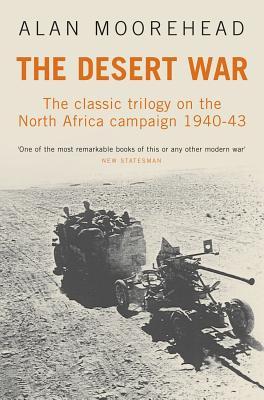
The Desert War Trilogy

Alan Moorehead

★★★★★
Read Advanced intel Intel history Military history Logistics Armor Logistics ISBN 9781845133917

Quarto Publishing Group UK · 2009

The seminal account of the battle between Montgomery’s Eighth Army and Rommel’s Afrika Corps, amidst the endless harsh wastes of the Western Desert. In 1940, Alan Moorehead was sent to cover the North Africa campaign by the Daily Express, and he followed its dramatic course all the way to 1943. The three books he subsequently wrote about the Desert War – later collected as his ‘African Trilogy’ – were swiftly acclaimed as a classic account of the tussle between Montgomery’s Eighth Army and Rommel’s Afrika Corps, under the beating sun of the Egyptian Sahara's Western Desert. Moorehead was responsible for the celebrated insight that tank battles in the desert are like battles at sea, the lumbering tanks like ships lost in a vast ocean of sand. The New Statesman could not have put it better when it described his achievement with this riveting book: ‘There is something of genius in the breadth and penetration of his vision , which encompasses the whole panorama of war and then narrows it down to the particular: the soldier stubbing out his cigarette before going into action, the expression on a tank commander’s face as he is hit… The story of the African campaigns will go down in history as one of the great epics of mankind, largely thanks to Mr Moorehead’s account.’

No cover · Amazon

The Emperor's Handbook

Marcus Aurelius

★★★★★
Read Advanced intel Military history

"Do not act as if thou were going to live ten thousand years. Death hangs over thee. While thoug livest, while it is in thy power, be good." Meditations contains the private wisdom of Marcus Aurelius, Roman Emperor from AD 161 to 180, and a great philosopher. His Meditations were never intended for publication. They were his personal thoughts and spiritual reflections, which he wrote down and referred to in order to help him manage the challenges of governing the Roman Empire while maintaining a peaceful private life. His philosophy articulated the need for inner peace and moral certainty in a world filled with chaos and suffering. The insights found in Meditations are just as helpful today as when Marcus Aurelius first wrote them nearly two millennia ago.

No cover · Amazon

The Handbook of 5GW: A Fifth Generation of War?

Daniel H. Abbott

★★★★★
Read Advanced intel Basic intel Technical warfare

The successful application of the Fifth Generation of Warfare (5GW) is "indistinguishable from magic" (Rees 2009, following in the spirit of Clarke's Law, propounded by the author of 2001: A Space Odyssey) "any sufficiently advanced technology is indistinguishable from magic"). The Fifth-Generation warrior hides in the shadows, or in the static. So, then, how can analysts and researchers study and discuss 5GW? Other questions also demand answers. What is the xGW framework, which many theorists use to describe 5GW? What alternatives to the xGW framework exist? What 5GWs have been observed? What are the source documents for the xGW framework? What is the universe of discourse that the xGW framework emerged from? Why bother trying to understand 5GW? This handbook attempts to provide systematic answers to these questions in several major sections, each of which is written by many contributors. While this handbook records many different voices of 5GW research, it speaks with one voice on the need to understand 5GW, the fifth gradient of warfare. This Kindle version includes all images and figures from the printed book; some images will not display well on grayscale devices.

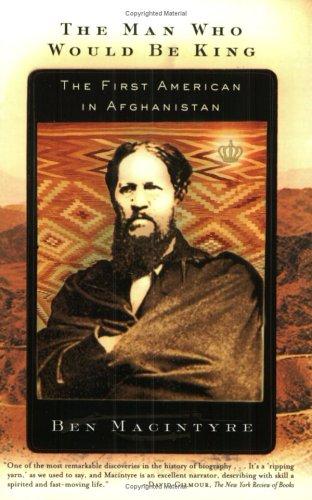
The Man Who Would Be King: The First American in Afghanistan

Ben Macintyre

★★★★★
Read Advanced intel Intel history Espionage GWOT Intel history Biography ISBN 9780374529574

Farrar, Straus and Giroux · April 14, 2005

The riveting story that inspired Kipling's classic tale and a John Huston movie The true story of Josiah Harlan, a Pennsylvania Quaker and the first American ever to enter Afghanistan, has never been told before. Soldier, spy, doctor, naturalist, traveler and writer, Josiah Harlan wanted to be a king, with all the imperialist hubris of his times. In an amazing twenty-year journey around Central Asia, he was variously employed as surgeon to the Maharaja of Punjab, revolutionary agent for the exiled Afghan King, and then commander-in-chief of the Afghan armies. In 1838, he set off in the footsteps of Alexander the Great across the Hindu Kush and forged his own kingdom, only to be ejected from Afghanistan a few months later by the invading British. Using a trove of newly-discovered documents, Harlan's own unpublished journals, and with a revised Preface detailing the unexpected discovery of Harlan's descendents, Ben Macintyre's The Man Who Would Be King tells the astonishing tale of the man who would be the first and last American king.

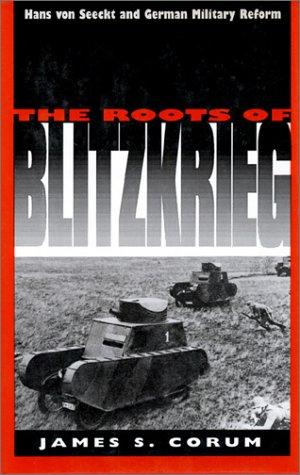
The Roots Of Blitzkrieg: Hans von Seeckt And German Military Reform

James S. Corum

★★★★★
Read Advanced intel Basic intel Military history Intel history Logistics WWII WWI Logistics Strategy / theory ISBN 9780700606283

University Press of Kansas · February 1994

Following Germany's defeat in World War I, the Germans signed the Versailles Treaty, superficially agreeing to limit their war powers. The Allies envisioned the future German army as a lightly armed border guard and international security force. The Germans had other plans. As early as 1919, James Corum contends, the tactical foundations were being laid for the Nazi Blitzkrieg. Between 1919 and 1933, German military leaders created and nurtured the Reichswehr, a new military organization built on the wreckage of the old Imperial Army. It was not being groomed for policing purposes. Focusing on Hans von Seeckt, General Staff Chief and Army Commander, Corum traces the crucial transformations in German military tactical doctrine, organization, and training that laid the foundations for fighting Germany's future wars. In doing so, he restores balance to prior assessment of von Seeckt's influence and demonstrates how the general, along with a few other "visionary" officers--including armor tactician Ernst Volckheim and air tactician Helmut Wilberg--collaborated to develop the core doctrine for what became the Blitzkrieg. The concepts of mobile war so essential to Germany's strength in World War II, Corum shows, were in place well before the tools became available. As an unforeseen consequence of the Versailles Treaty, the Germans were not saddled with a stockpile of outdated equipment as the Allies were. This, ironically, resulted in an advantage for the Germans, who were able to create doctrine first and design equipment to match it.

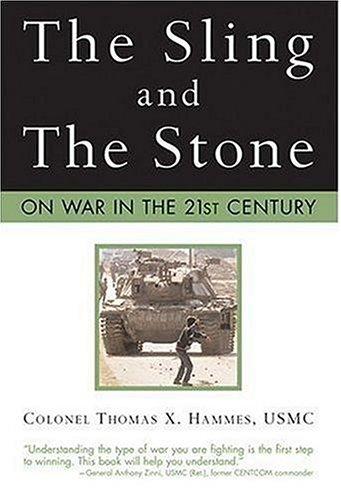
The Sling and the Stone: On War in the 21st Century

Thomas X. Hammes

★★★★★
Read Basic intel Advanced intel Military history Intel history Vietnam Cold War GWOT Guerrilla / COIN Russia / USSR Middle East Strategy / theory ISBN 9780760324073

Zenith Press · February 17, 2006

4GW (Fourth Generation Warfare) is the only kind of war America has ever lost. And we have done so three times - in Vietnam, Lebanon, and Somalia. This form of warfare has also defeated the French in Vietnam and Algeria, and the USSR in Afghanistan.As the only Goliath left in the world, we should be worried that the world's Davids have found a sling and stone that work." - Chapter 1, The Sling and the Stone: On War in the 21st Century. The War in Iraq. The War on Terror. These types of "asymmetrical" warfare are the conflicts of the 21st century - and show how difficult it is for the world's remaining superpower to battle insurgents and terrorists who will fight unconventionally in the face of superior military power. This change in military conflict may seem sudden.

The Winter War: Russia's Invasion Of Finland, 1939-40

Robert Edwards

★★★★★
Read Advanced intel Basic intel Military history Intel history Logistics WWII Cold War Russia / USSR Logistics Economics ISBN 9781933648507

Pegasus Books · December 30, 2007

On November 30, 1939, the Soviet Union's Red Army invaded the young nation-state of Finland, in the full expectation of routing the small, ill-equipped Finnish army and annexing the former Russian territory by the end of the year. But Finland held out for 105 bitterly cold, fiercely combative days, until March 15, 1940, when a peace agreement ended the short, savage Winter War. At the stirring center of the story lie the resourcefulness and resolve of the Finnish people, who against all military odds—in want of ammunition, food, sleep, and troops—fought a blundering, ineptly commanded Red Army to a standstill. On March 15, they ceded to the Soviet 11 percent of their territory and 30 percent of their economic assets, but none of their national pride. The Russians meanwhile had markedly damaged their international standing and effectively ruined their military reputation-to such an extent, as this probing chapter in World War II history demonstrates, that Germany, with proud-blooded Finland as an ally, dared to launch its 1940 invasion of Russia. At the same time, though, the fiasco of the Winter War forced Stalin to acknowledge the shortcomings of the Red Army and to reform it: Germany would fall at Stalingrad in 1941. With authority, this skillfully narrated military history unfolds its story of the four-month Soviet-Finnish war and explores its consequences from London to Moscow, from Helsinki to Paris, to Washington, DC.

When Money Dies: The Nightmare of the Weimar Hyper-inflation

Adam Fergusson

★★★★★
Read Advanced intel Military history Logistics Logistics Economics ISBN 9781906964443

Old Street Publishing · Apr 23, 2010

When Money Dies is the classic history of what happens when a nation’s currency depreciates beyond recovery. In 1923, with its currency effectively worthless (the exchange rate in December of that year was one dollar to 4,200,000,000,000 marks), the German republic was all but reduced to a barter economy. Expensive cigars, artworks, and jewels were routinely exchanged for staples such as bread; a cinema ticket could be bought for a lump of coal; and a bottle of paraffin for a silk shirt. People watched helplessly as their life savings disappeared and their loved ones starved. Germany’s finances descended into chaos, with severe social unrest in its wake.Money may no longer be physically printed and distributed in the voluminous quantities of 1923. However, “quantitative easing,” that modern euphemism for surreptitious deficit financing in an electronic era, can no less become an assault on monetary discipline. Whatever the reason for a country’s deficit necessity or profligacy, unwillingness to tax or blindness to expenditure it is beguiling to suppose that if the day of reckoning is postponed economic recovery will come in time to prevent higher unemployment or deeper recession. What if it does not? Germany in 1923 provides a vivid, compelling, sobering moral tale.

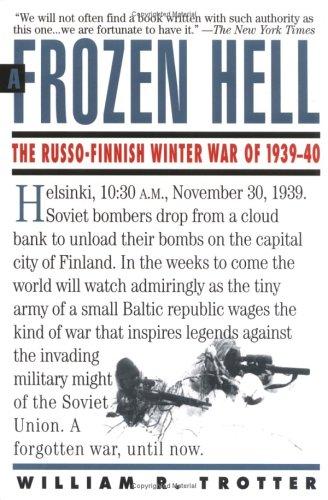
A Frozen Hell: The Russo-Finnish Winter War of 1939-1940

William R. Trotter

★★★★
Read Advanced intel Military history Technical warfare Cold War Guerrilla / COIN Russia / USSR ISBN 9781565122499

Algonquin Books of Chapel Hill, a division of Workman Publishing · January 2000

In 1939, tiny Finland waged war - the kind of war that spawns legends - against the mighty Soviet Union, and yet their epic struggle has been largely ignored. Guerrillas on skis, heroic single-handed attacks on tanks, unfathomable endurance, and the charismatic leadership of one of this century's true military geniuses - these are the elements of both the Finnish victory and a gripping tale of war.

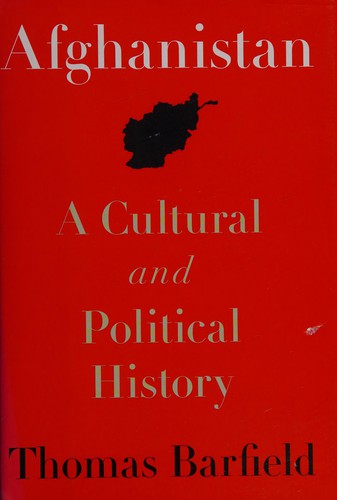
Afghanistan: A Cultural and Political History (Princeton Studies in Muslim Politics)

Thomas Barfield

★★★★
Read Advanced intel Military history Intel history GWOT Guerrilla / COIN Russia / USSR US Civil War ISBN 9780691145686

Princeton University Press · 2010

Afghanistan traces the historic struggles and the changing nature of political authority in this volatile region of the world, from the Mughal Empire in the sixteenth century to the Taliban resurgence today. Thomas Barfield introduces readers to the bewildering diversity of tribal and ethnic groups in Afghanistan, explaining what unites them as Afghans despite the regional, cultural, and political differences that divide them. He shows how governing these peoples was relatively easy when power was concentrated in a small dynastic elite, but how this delicate political order broke down in the nineteenth and twentieth centuries when Afghanistan's rulers mobilized rural militias to expel first the British and later the Soviets. Armed insurgency proved remarkably successful against the foreign occupiers, but it also undermined the Afghan government's authority and rendered the country ever more difficult to govern as time passed. Barfield vividly describes how Afghanistan's armed factions plunged the country into a civil war, giving rise to clerical rule by the Taliban and Afghanistan's isolation from the world. He examines why the American invasion in the wake of September 11 toppled the Taliban so quickly, and how this easy victory lulled the United States into falsely believing that a viable state could be built just as easily. Afghanistan is essential reading for anyone who wants to understand how a land conquered and ruled by foreign dynasties for more than a thousand years became the graveyard of empires for the British and Soviets, and what the United States must do to avoid a similar fate.

Between Silk and Cyanide: A Codemaker's War, 1941-1945

Leo Marks

★★★★
Read Advanced intel Cryptography WWII Espionage Special ops Intel history Biography ISBN 9780684867809

Free Press · September 12, 2000

In 1942, Leo Marks left his father's famous bookshop, 84 Charing Cross Road, and went off to fight the war. He was twenty-two. Soon recognized as a cryptographer of genius, he became head of communications at the Special Operations Executive (SOE), where he revolutionized the codemaking techniques of the Allies and trained some of the most famous agents dropped into occupied Europe, including "the White Rabbit" and Violette Szabo. As a top codemaker, Marks had a unique perspective on one of the most fascinating and, until now, little-known aspects of the Second World War. Writing with the narrative flair and vivid characterization of his famous screenplays, Marks gives free rein to his keen sense of the absurd and his wry wit, resulting in a thrilling and poignant memoir that celebrates individual courage and endeavor, without losing sight of the human cost and horror of war.

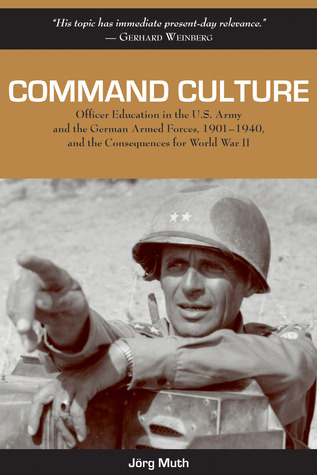
Command Culture: Officer Education in the U.S. Army and the German Armed Forces, 1901-1940, and the Consequences for World War II

Jörg Muth

★★★★
Read Advanced intel Military history WWII Special ops ISBN 9781574413038

University of North Texas Press · 2011

Selected by General Raymond Odierno, 38th Army Chief of Staff, for the U.S. Army Chief of Staff's Professional Reading List, for "The Army Profession," March 2012. Selected by General James F. Amos, Commandant of the U.S. Marine Corps, as required reading for all senior enlisted men and all Majors and Lieutenant-Colonels, January 2013.Selected by Major General H.R. McMaster at the Maneuver Center of Excellence, Fort Benning, for the Leader Development Study Program, December 2013.   Winner of the Army Historical Foundation Distinguished Writing Award, 2012.   In Command Culture, Jörg Muth examines the different paths the United States Army and the German Armed Forces traveled to select, educate, and promote their officers in the crucial time before World War II. Muth demonstrates that the military education system in Germany represented an organized effort where each school and examination provided the stepping stone for the next. But in the United States, there existed no communication about teaching contents or didactical matters among the various schools and academies, and they existed in a self chosen insular environment. American officers who finally made their way through an erratic selection process and past West Point to the important Command and General Staff School at Fort Leavenworth, Kansas, found themselves usually deeply disappointed, because they were faced again with a rather below average faculty who forced them after every exercise to accept the approved “school solution.” Command Culture explores the paradox that in Germany officers came from a closed authoritarian society but received an extremely open minded military education, whereas their counterparts in the United States came from one of the most democratic societies but received an outdated military education that harnessed their minds and limited their initiative. On the other hand, German officer candidates learned that in war everything is possible and a war of extermination acceptable. For American officers, raised in a democracy, certain boundaries could never be crossed. This work for the first time clearly explains the lack of audacity of many high ranking American officers during World War II, as well as the reason why so many German officers became perpetrators or accomplices of war crimes and atrocities or remained bystanders without speaking up. Those American officers who became outstanding leaders in World War II did so not so much because of their military education, but despite it.

Cry Havoc: How the Arms Race Drove the World to War, 1931-1941

Joseph A. Maiolo

★★★★
Read Advanced intel Military history Logistics WWII Nuclear Russia / USSR Logistics ISBN 9780465011148

Basic Books · 2010

Did the arms race of the 1930s cause the Second World War? In Cry Havoc , historian Joseph Maiolo shows, in rich and fascinating detail, how the deadly game of the arms race was played out in the decade prior to the outbreak of the Second World War. In this exhaustively researched account, he explores how nations reacted to the moves of their rivals, revealing the thinking of those making the key decisions—Hitler, Mussolini, Chamberlain, Stalin, Roosevelt—and the dilemmas of democratic leaders who seemed to be faced with a choice between defending their nations and preserving their democratic way of life. An unparalleled account of an era of extreme political tension, Cry Havoc shows how the interwar arms race shaped the outcome of World War II before the shooting even began.

No cover · Amazon

Enduring the Whirlwind: The German Army and the Russo-German War 1941-1943 (Wolverhampton Military Studies Book 21)

Gregory Liedtke

★★★★
Read Advanced intel Military history Logistics WWII Cold War Russia / USSR Logistics

Despite the best efforts of a number of historians, many aspects of the ferocious struggle between Nazi Germany and the Soviet Union during the Second World War remain obscure or shrouded in myth. One of the most persistent of these is the notion - largely created by many former members of its own officer corps in the immediate postwar period - that the German Army was a paragon of military professionalism and operational proficiency whose defeat on the Eastern Front was solely attributable to the amateurish meddling of a crazed former Corporal and the overwhelming numerical superiority of the Red Army. A key pillar upon which the argument of German numerical-weakness vis-à-vis the Red Army has been constructed is the assertion that Germany was simply incapable of providing its army with the necessary quantities of men and equipment needed to replace its losses. In consequence, as their losses outstripped the availability of replacements, German field formations became progressively weaker until they were incapable of securing their objectives or, eventually, of holding back the swelling might of the Red Army. This work seeks to address the notion of German numerical-weakness in terms of Germany's ability to replace its losses and regenerate its military strength, and assess just how accurate this argument was during the crucial first half of the Russo-German War (June 1941-June 1943). Employing a host of primary documents and secondary literature, it traces the development and many challenges of the German Army from the prewar period until the invasion of the Soviet Union in June 1941. It continues on to chart the first two years of the struggle between Germany and the Soviet Union, with a particular emphasis upon the scale of German personnel and equipment losses, and how well these were replaced. It also includes extensive examinations into the host of mitigating factors that both dictated the course of Germany's campaign in the East and its replacement and regeneration capabilities. In contrast to most accounts of the conflict, this study finds that numerical-weakness being the primary factor in the defeat of the Ostheer - specifically as it relates to the strength and condition of the German units involved - has been overemphasized and frequently exaggerated. In fact, Germany was actually able to regenerate its forces to a remarkable degree with a steady flow of fresh men and equipment, and German field divisions on the Eastern Front were usually far stronger than the accepted narratives of the war would have one believe.

Finland's War Of Choice: The Troubled German-Finnish Coalition in World War II

Henrik O. Lunde

★★★★
Read Advanced intel Military history Logistics WWII Cold War Russia / USSR Logistics ISBN 9781935149484

Casemate Publishers and Book Distributors · 2011

This book describes the odd coalition between Germany and Finland in World War II, and their joint military operations from 1941 to 1945. This is a topic often missing in English, though in stark contrast to the numerous books on the shorter and less bloody Winter War. That conflict represented a gallant fight of a democratic "David" against a totalitarian "Goliath" that caught the imagination of the world. The story of Finland fighting alongside a "Goliath" of its own has not brought pride to that nation and was a period many Finns would rather forget. The prologue of this book brings the reader up to speed by briefly examining the difficult history of Finland, from its separation from the Soviet Union in 1917 to its isolation after being bludgeoned in 1939-40. It then examines both Finnish and German motives for forming a coalition against the USSR, and how--as logical as a common enemy would seem--the lack of true planning and preparation would doom the alliance.

No cover · Amazon

Ghost on the Throne: The Death of Alexander the Great and the War for Crown and Empire

James Romm

★★★★
Read Advanced intel Intel history

Alexander the Great, perhaps the most commanding leader in history, united his empire and his army by the titanic force of his will. His death at the age of thirty-two spelled the end of that unity. The story of Alexander's conquest of the Persian empire is known to many readers, but the dramatic and consequential saga of the empire's collapse remains virtually untold. It is a tale of loss that begins with the greatest loss of all, the death of the Macedonian king who had held the empire together. With his demise, it was as if the sun had disappeared from the solar system, as if planets and moons began to spin crazily in new directions, crashing into one another with unimaginable force. Alexander bequeathed his power, legend has it, 'to the strongest,' leaving behind a mentally damaged half brother and a posthumously born son as his only heirs. In a strange compromise, both figures, Philip III and Alexander IV, were elevated to the kingship, quickly becoming prizes, pawns, fought over by a half-dozen Macedonian generals. Each successor could confer legitimacy on whichever general controlled him. At the book's center is the monarch's most vigorous defender; Alexander's former Greek secretary, now transformed into a general himself. He was a man both fascinating and entertaining, a man full of tricks and connivances, like the enthroned ghost of Alexander that gives the book its title, and becomes the determining factor in the precarious fortunes of the royal family. James Romm, brilliant classicist and storyteller, tells the galvanizing saga of the men who followed Alexander and found themselves incapable of preserving his empire. The result was the undoing of a world, formerly united in a single empire, now ripped apart into a nightmare of warring nation-states struggling for domination, the template of our own times.

No cover · Amazon

Harvest of Despair: Life and Death in Ukraine under Nazi Rule

Karel C. Berkhoff

★★★★
Read Advanced intel Military history Logistics WWII Guerrilla / COIN Russia / USSR Logistics Revolution

"If I find a Ukrainian who is worthy of sitting at the same table with me, I must have him shot," declared Nazi commissar Erich Koch. To the Nazi leaders, the Ukrainians were Untermenschen—subhumans. But the rich land was deemed prime territory for Lebensraum expansion. Once the Germans rid the country of Jews, Roma, and Bolsheviks, the Ukrainians would be used to harvest the land for the master race. Karel Berkhoff provides a searing portrait of life in the Third Reich's largest colony. Under the Nazis, a blend of German nationalism, anti-Semitism, and racist notions about the Slavs produced a reign of terror and genocide. But it is impossible to understand fully Ukraine's response to this assault without addressing the impact of decades of repressive Soviet rule. Berkhoff shows how a pervasive Soviet mentality worked against solidarity, which helps explain why the vast majority of the population did not resist the Germans. He also challenges standard views of wartime eastern Europe by treating in a more nuanced way issues of collaboration and local anti-Semitism. Berkhoff offers a multifaceted discussion that includes the brutal nature of the Nazi administration; the genocide of the Jews and Roma; the deliberate starving of Kiev; mass deportations within and beyond Ukraine; the role of ethnic Germans; religion and national culture; partisans and the German response; and the desperate struggle to stay alive. Harvest of Despair is a gripping depiction of ordinary people trying to survive extraordinary events.