S2 Search · Reading list

S2 Actual reading list

Books from S2 Actual on Goodreads, organized by his shelves and topic buckets (intel lists, military history, logistics, etc.). Metadata filled via Open Library.

Not official S2 Underground. Independent fan index — not affiliated with or endorsed by S2. Official hub: linktr.ee/S2_underground. S2 materials are CC BY-NC-SA 4.0.

S2 topic buckets (Goodreads)

Subjects & genres

71 books · Basic intel · page 3 of 3

No cover · Amazon

Extreme Ownership: How U.S. Navy SEALs Lead and Win

Jocko Willink

★★★☆☆
Read Basic intel Military history Special ops Naval Middle East Intel history

The #1 New York Times bestseller Sent to the most violent battlefield in Iraq, Jocko Willink and Leif Babin’s SEAL task unit faced a seemingly impossible help U.S. forces secure Ramadi, a city deemed “all but lost.” In gripping firsthand accounts of heroism, tragic loss, and hard-won victories in SEAL Team Three’s Task Unit Bruiser, they learned that leadership―at every level―is the most important factor in whether a team succeeds or fails.Willink and Babin returned home from deployment and instituted SEAL leadership training that helped forge the next generation of SEAL leaders. After departing the SEAL Teams, they launched Echelon Front, a company that teaches these same leadership principles to businesses and organizations. From promising startups to Fortune 500 companies, Babin and Willink have helped scores of clients across a broad range of industries build their own high-performance teams and dominate their battlefields. Now, detailing the mind-set and principles that enable SEAL units to accomplish the most difficult missions in combat, Extreme Ownership shows how to apply them to any team, family or organization. Each chapter focuses on a specific topic such as Cover and Move, Decentralized Command, and Leading Up the Chain, explaining what they are, why they are important, and how to implement them in any leadership environment. A compelling narrative with powerful instruction and direct application, Extreme Ownership revolutionizes business management and challenges leaders everywhere to fulfill their ultimate lead and win.
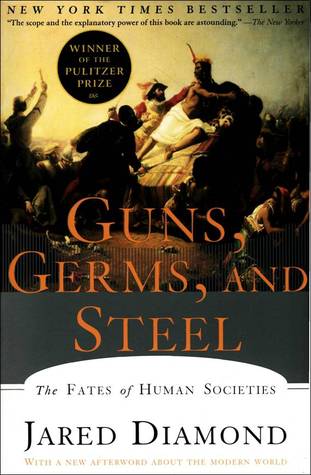

Guns, Germs, and Steel: The Fates of Human Societies

Jared Diamond

★★★☆☆
Read Basic intel ISBN 9780739467350

W.W. Norton and Company · 2005

"Diamond has written a book of remarkable scope ... one of the most important and readable works on the human past published in recent years." Winner of the Pulitzer Prize and a national bestseller: the global account of the rise of civilization that is also a stunning refutation of ideas of human development based on race. In this "artful, informative, and delightful" (William H. McNeill, New York Review of Books) book, Jared Diamond convincingly argues that geographical and environmental factors shaped the modern world. Societies that had a head start in food production advanced beyond the hunter-gatherer stage, and then developed writing, technology, government, and organized religion—as well as nasty germs and potent weapons of war—and adventured on sea and land to conquer and decimate preliterate cultures. A major advance in our understanding of human societies, Guns, Germs, and Steel chronicles the way that the modern world came to be and stunningly dismantles racially based theories of human history. Winner of the Pulitzer Prize, the Phi Beta Kappa Award in Science, the Rhone-Poulenc Prize, and the Commonwealth Club of California's Gold Medal

Open Source Intelligence Techniques: Resources for Searching and Analyzing Online Information

Michael Bazzell

★★★☆☆
Read Privacy Basic intel Cyber ISBN 9781481282208

CreateSpace Independent Publishing Platform · Jan 01, 2013

THIRD EDITION NOW AVAILABLE ON amazon.com/Open-Source-Intelligence-T... Details about this retired (2nd) Second Edition Sheds New Light on Open Source Intelligence Collection and Analysis. Author Michael Bazzell has been well known and respected in government circles for his ability to locate personal information about any target through Open Source Intelligence (OSINT). In this book, he shares his methods in great detail. Each step of his process is explained throughout sixteen chapters of specialized websites, application programming interfaces, and software solutions. Over 200 resources are identified with narrative tutorials and screen captures. This book will serve as a reference guide for anyone that is responsible for the collection of online content. It is written in a hands-on style that encourages the reader to execute the tutorials as they go. The search techniques offered will inspire analysts to "think outside the box" when scouring the internet for personal information. Much of the content of this book has never been discussed in any publication. Always thinking like a hacker, the author has identified new ways to use various technologies for an unintended purpose. This book will improve anyone's online investigative skills. Among other techniques, you will learn how to Twitter GPS & Account Data, Hidden Social Network Content, Cell Phone Owner Information, Hidden Photo GPS & Metadata, Deleted Websites & Posts, Website Owner Information, Alias Social Network Profiles, Additional User Accounts, Sensitive Documents & Photos, Live Streaming Social Content, Videos Uploaded by Location, Newspaper Archives & Scans, Social Content by Location, Text Transcripts of Videos, Historical Satellite Imagery, Duplicate Copies of Photos, Local Personal Radio Frequencies, Compromised Email Information, Wireless Routers by Location, Hidden Mapping Applications, Free Investigative Software, Alternative Search Engines, Stolen Items for Sale, Unlisted Addresses, Unlisted Phone Numbers, Public Government Records, Document Metadata, Voter Registration Records, Facebook Wall Posts, Online Criminal Activity

Taliban: Militant Islam, Oil and Fundamentalism in Central Asia

Ahmed Rashid

★★★☆☆
Read Basic intel Intel history GWOT Russia / USSR Middle East US Civil War ISBN 0300089023

Yale Nota Bene · 2001

Shrouding themselves and their aims in deepest secrecy, the leaders of the Taliban movement control Afghanistan with an inflexible, crushing fundamentalism. The most extreme and radical of all Islamic organizations, the Taliban inspires fascination, controversy, and especially fear in both the Muslim world and the West. Correspondent Ahmed Rashid brings the shadowy world of the Taliban into sharp focus in this enormously interesting and revealing book. It is the only authoritative account of the Taliban and modern day Afghanistan available to English language readers. Based on his experiences as a journalist covering the civil war in Afghanistan for twenty years, traveling and living with the Taliban, and interviewing most of the Taliban leaders since their emergence to power in 1994, Rashid offers unparalleled firsthand information. He explains how the growth of Taliban power has already created severe instability in Russia, Iran, Pakistan, and five Central Asian republics. He describes the Taliban's role as a major player in a new "Great Game"—a competition among Western countries and companies to build oil and gas pipelines from Central Asia to Western and Asian markets. The author also discusses the controversial changes in American attitudes toward the Taliban—from early support to recent bombings of Osama Bin Laden's hideaway and other Taliban-protected terrorist bases—and how they have influenced the stability of the region.

The Bottom Billion: Why the Poorest Countries Are Failing and What Can Be Done About It

Paul Collier

★★★☆☆
Read Basic intel Economics US Civil War ISBN 9780195311457

Oxford University Press · 2007

In the universally acclaimed and award-winning The Bottom Billion, Paul Collier reveals that fifty failed states--home to the poorest one billion people on Earth--pose the central challenge of the developing world in the twenty-first century. The book shines much-needed light on this group of small nations, largely unnoticed by the industrialized West, that are dropping further and further behind the majority of the world's people, often falling into an absolute decline in living standards. A struggle rages within each of these nations between reformers and corrupt leaders--and the corrupt are winning. Collier analyzes the causes of failure, pointing to a set of traps that ensnare these countries, including civil war, a dependence on the extraction and export of natural resources, and bad governance. Standard solutions do not work, he writes; aid is often ineffective, and globalization can actually make matters worse, driving development to more stable nations. What the bottom billion need, Collier argues, is a bold new plan supported by the Group of Eight industrialized nations. If failed states are ever to be helped, the G8 will have to adopt preferential trade policies, new laws against corruption, new international charters, and even conduct carefully calibrated military interventions. Collier has spent a lifetime working to end global poverty. In The Bottom Billion, he offers real hope for solving one of the great humanitarian crises facing the world today.

Why Nations Fail: The Origins of Power, Prosperity, and Poverty

Daron Acemoğlu

★★★☆☆
Read Basic intel Korea Cold War China Russia / USSR Economics ISBN 9780307719218

Crown Publishers · 2012

Brilliant and engagingly written, Why Nations Fail answers the question that has stumped the experts for centuries: Why are some nations rich and others poor, divided by wealth and poverty, health and sickness, food and famine? Is it culture, the weather, geography? Perhaps ignorance of what the right policies are? Simply, no. None of these factors is either definitive or destiny. Otherwise, how to explain why Botswana has become one of the fastest growing countries in the world, while other African nations, such as Zimbabwe, the Congo, and Sierra Leone, are mired in poverty and violence? Daron Acemoglu and James Robinson conclusively show that it is man-made political and economic institutions that underlie economic success (or lack of it). Korea, to take just one of their fascinating examples, is a remarkably homogeneous nation, yet the people of North Korea are among the poorest on earth while their brothers and sisters in South Korea are among the richest. The south forged a society that created incentives, rewarded innovation, and allowed everyone to participate in economic opportunities. The economic success thus spurred was sustained because the government became accountable and responsive to citizens and the great mass of people. Sadly, the people of the north have endured decades of famine, political repression, and very different economic institutions—with no end in sight. The differences between the Koreas is due to the politics that created these completely different institutional trajectories. Based on fifteen years of original research Acemoglu and Robinson marshall extraordinary historical evidence from the Roman Empire, the Mayan city-states, medieval Venice, the Soviet Union, Latin America, England, Europe, the United States, and Africa to build a new theory of political economy with great relevance for the big questions of today, including:    - China has built an authoritarian growth machine. Will it continue to grow at such high speed and overwhelm the West?    - Are America’s best days behind it? Are we moving from a virtuous circle in which efforts by elites to aggrandize power are resisted to a vicious one that enriches and empowers a small minority?    - What is the most effective way to help move billions of people from the rut of poverty to prosperity? More philanthropy from the wealthy nations of the West? Or learning the hard-won lessons of Acemoglu and Robinson’s breakthrough ideas on the interplay between inclusive political and economic institutions? Why Nations Fail will change the way you look at—and understand—the world.

Out of the Mountains: The Coming Age of the Urban Guerrilla

David Kilcullen

★★☆☆☆
Read Basic intel GWOT Guerrilla / COIN Middle East Intel history Strategy / theory ISBN 9780199737505

Oxford University Press · 2013

When Americans think of modern warfare, what comes to mind is the US army skirmishing with terrorists and insurgents in the mountains of Afghanistan. But the face of global conflict is ever-changing. In Out of the Mountains , David Kilcullen, one of the world's leading experts on current and future conflict, offers a groundbreaking look at what may happen after today's wars end. This is a book about future conflicts and future cities, and about the challenges and opportunities that four powerful megatrends--population, urbanization, coastal settlement, and connectedness--are creating across the planet. And it is about what cities, communities and businesses can do to prepare for a future in which all aspects of human society--including, but not limited to, conflict, crime and violence--are changing at an unprecedented pace. Kilcullen argues that conflict is increasingly likely to occur in sprawling coastal cities, in peri-urban slum settlements that are enveloping many regions of the Middle East, Africa, Latin America and Asia, and in highly connected, electronically networked settings. He suggests that cities, rather than countries, are the critical unit of analysis for future conflict and that resiliency, not stability, will be the key objective. Ranging across the globe--from Kingston to Mogadishu to Lagos to Benghazi to Mumbai--he offers a unified theory of "competitive control" that explains how non-state armed groups such as drug cartels, street gangs, and warlords draw their strength from local populations, providing useful ideas for dealing with these groups and with diffuse social conflicts in general. His extensive fieldwork on the ground in a series of urban conflicts suggests that there will be no military solution for many of the struggles we will face in the future. We will need to involve local people deeply to address problems that neither outsiders nor locals alone can solve, drawing on the insight only locals can bring, together with outsider knowledge from fields like urban planning, systems engineering, renewable energy, conflict resolution and mediation. This deeply researched and compellingly argued book provides an invaluable roadmap to a future that will increasingly be crowded, urban, coastal, connected--and dangerous.

Rhodesian SAS Combat Manual

Rhodesian Forces

★★☆☆☆
Read Basic intel Advanced intel Intel history Military history Logistics Special ops Guerrilla / COIN Logistics ISBN 9798610200842

Independently Published · 2020

The "Rhodesian SAS Combat Manual" is a significant historical look of the small unit tactics employed by the elite unit during the Rhodesian Bush War. Not only is it a glimpse back at how this unit operated, but a lot of the material is still relevant today fighting counter-insurgencies. This book covers tactical follow-ups, ambush tactics, infiltration methods and combat tracking and more!

Guerrilla Strategies: An Historical Anthology from the Long March to Afghanistan

Gérard Chaliand

unrated
Read Advanced intel Technical warfare Basic intel GWOT Guerrilla / COIN ISBN 0520044444

University of California Press · 1982

This unique anthology of writings on revolutionary warfare and counterinsurgency covers almost all the major struggles of the modern world. Chaliand, who has had firsthand experience with guerrilla movements in Afghanistan, Africa, and Latin America, provides a concise yet panoramic overview of political and military strategies in revolutionary warfare, noting their strengths, limitations, and pathologies.

No cover · Amazon

Huế 1968: A Turning Point of the American War in Vietnam

Mark Bowden

unrated
Read Advanced intel Basic intel Military history Intel history WWII Vietnam Intel history Strategy / theory

In the early hours of January 31, 1968, the North Vietnamese launched over one hundred attacks across South Vietnam in what would become known as the Tet Offensive. The lynchpin of Tet was the capture of Hue, Vietnam?s intellectual and cultural capital, by 10,000 National Liberation Front troops who descended from hidden camps and surged across the city of 140,000. Within hours the entire city was in their hands save for two small military outposts. American commanders refused to believe the size and scope of the Front?s presence, ordering small companies of marines against thousands of entrenched enemy troops. After several futile and deadly days, Lieutenant Colonel Ernie Cheatham would finally come up with a strategy to retake the city, block by block and building by building, in some of the most intense urban combat since World War II. With unprecedented access to war archives in the U.S. and Vietnam and interviews with participants from both sides, Bowden narrates each stage of this crucial battle through multiple viewpoints. Played out over 24 days and ultimately costing 10,000 lives, the Battle of Hue was by far the bloodiest of the entire war. When it ended, the American debate was never again about winning, only about how to leave. Hue 1968 is a gripping and moving account of this pivotal moment.

Invisible Armies: An Epic History of Guerrilla Warfare from Ancient Times to the Present

Max Boot

unrated
Read Basic intel Intel history Military history Vietnam GWOT Naval Guerrilla / COIN Middle East Strategy / theory ISBN 9780871404244

Liveright Pub. Corporation · 2012

As fitting for the twenty-first century as von Clausewitz’s On War was in its own time, Invisible Armies is a complete global history of guerrilla uprisings through the ages. Beginning with the first insurgencies in the ancient world―when Alexander the Great discovered that fleet nomads were harder to defeat than massive conventional armies―Max Boot, best-selling author and military advisor in Iraq and Afghanistan, masterfully guides us from the Jewish rebellion against the Roman Empire up through the horrors of the French-Indochina War and the shadowy, post-9/11 battlefields of today. Relying on a diverse cast of unforgettable characters―not only Mao and Che but also the legendary Italian nationalist Giuseppe Garibaldi, the archaeologist-turned–military commander T. E. Lawrence, and the “Quiet American” Edward Lansdale, among others―Boot explodes everything we thought we knew about unconventional combat. The result is both an enthralling read and our most important work on nontraditional warfare. 70 illustrations; 8 maps

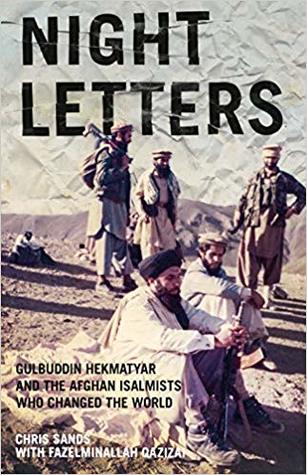
Night Letters: Gulbuddin Hekmatyar and the Afghan Islamists Who Changed the World

Chris Sands

unrated
Read Advanced intel Basic intel Biographies Intel history Military history GWOT Guerrilla / COIN Russia / USSR Intel history Biography Strategy / theory ISBN 9781787381964

C. Hurst and Company (Publishers) Limited · 2019

In 1969, several young men met on a rainy night in Kabul to form an Islamist student group. Their aim was laid out in a simple typewritten statement: to halt the spread of Soviet and American influence in Afghanistan. They went on to change the world. 'Night Letters' tells the extraordinary story of the group’s most notorious member, Gulbuddin Hekmatyar, and the guerrilla organisation he came to lead, Hizb-e Islami. By the late 1980s, tens of thousands were drawn to Hekmatyar’s vision of a radical Islamic state that would sow unrest from Kashmir to Jerusalem. His doctrine of violent global jihad culminated in 9/11 and the birth of ISIS, yet he never achieved his dream of ruling Afghanistan. The peace deal he signed with Kabul in 2016 was yet another controversial twist in an astonishing life. Sands and Qazizai delve into the secret history of Hekmatyar and Hizb-e Islami: their wars against Russian and American troops, and their bloody and bitter feuds with domestic enemies. Based on hundreds of exclusive interviews carried out across the region and beyond, this is the definitive account of the most important, yet poorly understood, international Islamist movement of the last fifty years.

On War

Carl von Clausewitz

unrated
Read Basic intel Intel history Military history Strategy / theory Revolution ISBN 0691018545

Princeton U.P. · 1992

Carl von Clausewitz’s On War is the most significant attempt in Western history to understand war, both in its internal dynamics and as an instrument of policy. Since the work’s first appearance in 1832, it has been read throughout the world, and has stimulated generations of soldiers, political leaders, and intellectuals. First published in 1976 and revised in 1984, Michael Howard and Peter Paret’s Princeton edition of Clausewitz’s classic work has itself achieved classic status and is widely regarded as the best translation and standard edition of On War in English. This feature-rich edition includes an essay by Paret on the genesis of Clausewitz’s book, an essay by Howard on Clausewitz’s influence, and an essay by Bernard Brodie on the continuing relevance of On War. In addition, Brodie provides a lengthy and detailed commentary on and guide to reading On War, and the edition also includes a comprehensive index.

Ostkrieg: Hitler's War of Extermination in the East

Stephen G. Fritz

unrated
Read Basic intel Advanced intel Military history Logistics WWII Cold War Russia / USSR Logistics Economics ISBN 9780813134161

University Press of Kentucky · 2011

On June 22, 1941, Germany launched the greatest land assault in history on the Soviet Union, an attack that Adolf Hitler deemed crucial to ensure German economic and political survival. As the key theater of the war for the Germans, the eastern front consumed enormous levels of resources and accounted for 75 percent of all German casualties. Despite the significance of this campaign to Germany and to the war as a whole, few English-language publications of the last thirty-five years have addressed these pivotal events. In Ostkrieg: Hitler's War of Extermination in the East , Stephen G. Fritz bridges the gap in scholarship by incorporating historical research from the last several decades into an accessible, comprehensive, and coherent narrative. His analysis of the Russo-German War from a German perspective covers all aspects of the eastern front, demonstrating the interrelation of military events, economic policy, resource exploitation, and racial policy that first motivated the invasion. This in-depth account challenges accepted notions about World War II and promotes greater understanding of a topic that has been neglected by historians.

Starship Troopers

Robert A. Heinlein

unrated
Read Advanced intel Basic intel ISBN 9780450005732

Buccaneer Books · 1959

The historians can’t seem to settle whether to call this one "The Third Space War" (or the fourth), or whether "The First Interstellar War" fits it better. We just call it “The Bug War." Everything up to then and still later were "incidents," "patrols," or "police actions." However, you are just as dead if you buy the farm in an "incident" as you are if you buy it in a declared war... In one of Robert A. Heinlein’s most controversial bestsellers, a recruit of the future goes through the toughest boot camp in the Universe—and into battle with the Terran Mobile Infantry against mankind’s most alarming enemy.

No cover · Amazon

Team of Rivals: The Political Genius of Abraham Lincoln

Doris Kearns Goodwin

unrated
Read Basic intel Military history Biographies Biography US Civil War

Winner of the Lincoln Prize Acclaimed historian Doris Kearns Goodwin illuminates Lincoln's political genius in this highly original work, as the one-term congressman and prairie lawyer rises from obscurity to prevail over three gifted rivals of national reputation to become president. On May 18, 1860, William H. Seward, Salmon P. Chase, Edward Bates, and Abraham Lincoln waited in their hometowns for the results from the Republican National Convention in Chicago. When Lincoln emerged as the victor, his rivals were dismayed and angry. Throughout the turbulent 1850s, each had energetically sought the presidency as the conflict over slavery was leading inexorably to secession and civil war. That Lincoln succeeded, Goodwin demonstrates, was the result of a character that had been forged by experiences that raised him above his more privileged and accomplished rivals. He won because he possessed an extraordinary ability to put himself in the place of other men, to experience what they were feeling, to understand their motives and desires. It was this capacity that enabled Lincoln as president to bring his disgruntled opponents together, create the most unusual cabinet in history, and marshal their talents to the task of preserving the Union and winning the war. We view the long, horrifying struggle from the vantage of the White House as Lincoln copes with incompetent generals, hostile congressmen, and his raucous cabinet. He overcomes these obstacles by winning the respect of his former competitors, and in the case of Seward, finds a loyal and crucial friend to see him through. This brilliant multiple biography is centered on Lincoln's mastery of men and how it shaped the most significant presidency in the nation's history.

The Art and Science of Military Deception (Artech House Intelligence and Information Operations)

Hy Rothstein

unrated
Read Basic intel Advanced intel Military history Intel history Technical warfare Strategy / theory ISBN 9781608075515

Artech House Publishers · 2013

It is said that deception among people in a civilized society is something to be loathed even though it seems to be part of human nature; but deception in war is a virtue. This title provides the reader with sufficient knowledge to pursue General Eisenhower's vision for the proper role of deception in support of the national interest.

The Art of Invisibility: The World's Most Famous Hacker Teaches You How to Be Safe in the Age of Big Brother and Big Data

Kevin D. Mitnick

unrated
Read Privacy Basic intel Cyber ISBN 9780316380508

Little, Brown and Company · 2017

Kevin Mitnick, the world's most famous hacker, teaches you easy cloaking and counter-measures for citizens and consumers in the age of Big Brother and Big Data. Like it or not, your every move is being watched and analyzed. Consumer's identities are being stolen, and a person's every step is being tracked and stored. What once might have been dismissed as paranoia is now a hard truth, and privacy is a luxury few can afford or understand. In this explosive yet practical book, Kevin Mitnick illustrates what is happening without your knowledge--and he teaches you "the art of invisibility." Mitnick is the world's most famous--and formerly the Most Wanted--computer hacker. He has hacked into some of the country's most powerful and seemingly impenetrable agencies and companies, and at one point he was on a three-year run from the FBI. Now, though, Mitnick is reformed and is widely regarded as the expert on the subject of computer security. He knows exactly how vulnerabilities can be exploited and just what to do to prevent that from happening. In THE ART OF INVISIBILITY Mitnick provides both online and real life tactics and inexpensive methods to protect you and your family, in easy step-by-step instructions. He even talks about more advanced "elite" techniques, which, if used properly, can maximize your privacy. Invisibility isn't just for superheroes--privacy is a power you deserve and need in this modern age.

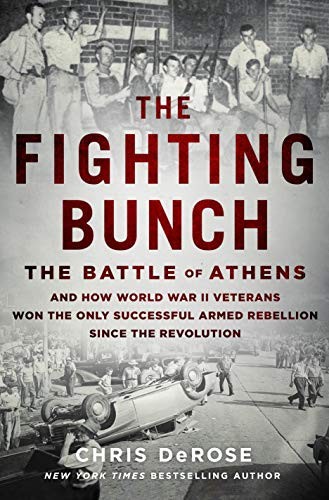
The Fighting Bunch: The Battle of Athens and How World War II Veterans Won the Only Successful Armed Rebellion Since the Revolution

Chris DeRose

unrated
Read Basic intel Military history Technical warfare WWII Guerrilla / COIN Intel history ISBN 9781250266194

St. Martin's Press · Nov 03, 2020

The incredible, untold story of the WWII veterans who destroyed a corrupt political machine―the only successful armed rebellion on US soil since the War of Independence. They fought for freedom abroad and returned to find that they had lost it at home. A corrupt political machine was in charge, kept in power by violence and stolen elections - the worst allegations of vote fraud ever brought to the attention of the Department of Justice, according to the Attorney General. The GIs formed a nonpartisan, all-veteran ticket. On Election Day, the GIs and their supporters found themselves assaulted, intimidated, arrested, and even shot. A small band of veterans - the Fighting Bunch - armed themselves and marched on the jail to demand an honest count. The sheriff and his men refused. These men who thought they had seen the last of war returned to the battlefield, one last time. This episode in U.S. history has never been more relevant, but has never been fully told. At the time of the rebellion, national news outlets jammed the phone lines into town, asking questions before the shooting had stopped. Journalists beat a path to Athens from across the country. Hollywood came calling, but the people of McMinn County had moved on. After years of research, including exclusive interviews with the remaining witnesses, archival radio broadcast and interview tapes, scrapbooks, letters, and diaries, author Chris DeRose has reconstructed one of the seminal―yet untold―events in American election history.

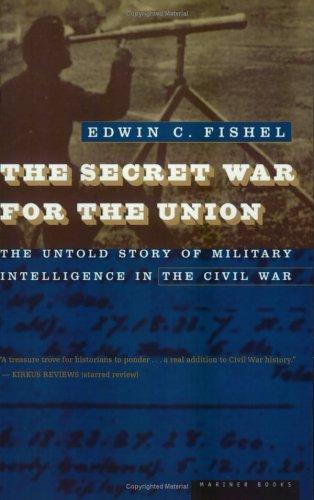
The Secret War For The Union: The Untold Story of Military Intelligence in the Civil War – How Intelligence Shaped Victory, Defeat, and the Decisions of Commanders

Edwin C. Fishel

unrated
Read Basic intel Intel history Espionage Intel history US Civil War ISBN 9780395901366

Mariner Books · June 22, 1998

Most histories of the Civil War explain victory and defeat in terms of the skill of commanders and their troops. Intelligence records disappeared after the war, and thus a critically important element has largely been ignored. Fishel has unearthed substantial collections of such records, and his "intelligence explanation" radically alters history's understanding of the campaigns. The Secret War for the Union is one of the most important Civil War works ever published.

Unmanned: Drones, Data, and the Illusion of Perfect Warfare

William M. Arkin

unrated
Read Basic intel Cryptography Intel history Espionage Intel history ISBN 9780316323352

Little, Brown and Company · 2015

Unmanned is an in-depth examination of why seemingly successful wars never seem to end. The problem centers on drones, now accumulated in the thousands, the front end of a spying and killing machine that is disconnected from either security or safety. Drones, however, are only part of the problem. William Arkin shows that security is actually undermined by an impulse to gather as much data as possible, the appetite and the theory both skewed towards the notion that no amount is too much. And yet the very endeavor of putting fewer human in potential danger places everyone in greater danger. Wars officially end, but the Data Machine lives on forever. Throughout his career, Arkin has exposed powerful secrets of so-called national security and intelligence. Now he continues that tradition. The most alarming book about warfare in years, Unmanned is essential reading for anyone who cares about the future of mankind.

Victims of Yalta

Nikolai Tolstoy

unrated
Read Intel history Military history Economics Logistics Basic intel WWII Russia / USSR Logistics Economics ISBN 0684156350

Gorgi Books · 1979

Stalinova "vojevůdcovská" nezpůsobilost vehnala v průběhu druhé světové války do německého zajetí miliony vojáků. Jeho nelítostná decimace všech vrstev národa, dokonce celých komunit, vedla generála Vlasova k rozhodnutí vytvořit armádu, která by ze dvou zel - Stalin a Hitler - porazila nejprve to větší, kterým se mu jevil Stalin. Stalin například po celou válku nepřistoupil k haagským konvencím o zacházení s válečnými zajatci a svým odmítavým postojem tak nepřímo způsobil tragický osud zajatců. Kromě vlasovců se proti bolševismu postavil také národ kozáků. Další skupinou stojící proti Stalinovi byli někteří příslušníci rozsáhlé bílé emigrace, jejichž potomci se mnohdy narodili již na Západě. Vedle nich se na konci války ocitlo v britském zajetí mnoho protikomunistických Jugoslávců. Více než dva miliony těchto lidí byly v letech 1944-1947 násilně navráceny do Sovětského svazu - podle dohod, jež Britové a Američané se Stalinem stvrdili na konferenci v Jaltě - v rozporu s řadou britských zákonů a ustanovení mezinárodního práva. Osudem těchto ubožáků byla buď okamžitá smrt zastřelením po návratu, či pomalejší umírání v táborech Gulagu. Vyvázli jen nemnozí......