S2 Search · Reading list

S2 Actual reading list

Books from S2 Actual on Goodreads, organized by his shelves and topic buckets (intel lists, military history, logistics, etc.). Metadata filled via Open Library.

Not official S2 Underground. Independent fan index — not affiliated with or endorsed by S2. Official hub: linktr.ee/S2_underground. S2 materials are CC BY-NC-SA 4.0.

S2 topic buckets (Goodreads)

Subjects & genres

210 books · Military history · page 3 of 9

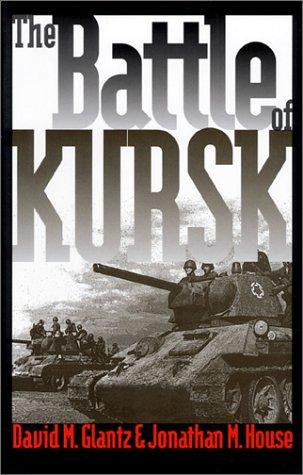
The Battle of Kursk (Modern War Studies)

David M. Glantz

★★★★★
Read Military history WWII Armor Russia / USSR ISBN 0700609784

University Press of Kansas · 1999

Immense in scope, ferocious in nature, and epic in consequence, the Battle of Kursk witnessed (at Prokhorovka) one of the largest tank engagements in world history and led to staggering losses-including nearly 200,000 Soviet and 50,000 German casualties-within the first ten days of fighting. Going well beyond all previous accounts, David Glantz and Jonathan House now offer the definitive work on arguably the greatest battle of World War II. Drawing on both German and Soviet sources, Glantz and House separate myth from fact to show what really happened at Kursk and how it affected the outcome of the war. Their access to newly released Soviet archival material adds unprecedented detail to what is known about this legendary conflict, enabling them to reconstruct events from both perspectives and describe combat down to the tactical level. The Battle of Kursk takes readers behind Soviet lines for the first time to discover what the Red Army knew about the plans for Hitler's offensive (Operation Citadel), relive tank warfare and hand-to-hand combat, and learn how the tide of battle turned. Its vivid portrayals of fighting in all critical sectors place the famous tank battle in its proper context. Prokhorovka here is not a well-organized set piece but a confused series of engagements and hasty attacks, with each side committing its forces piecemeal. Glantz and House's fresh interpretations demolish many of the myths that suggest Hitler might have triumphed if Operation Citadel had been conducted differently. Their account is the first to provide accurate figures of combat strengths and losses, and it includes 32 maps that clarify troop and tank movements. Shrouded in obscurity and speculation for more than half a century, the Battle of Kursk finally gets its due in this dramatic retelling of the confrontation that marked the turning point of the war on the Eastern Front and brought Hitler's blitzkrieg to a crashing halt.
The Black Book of Communism: Crimes, Terror, Repression

Stéphane Courtois

★★★★★
Read Military history Advanced intel Vietnam Korea Cold War GWOT Guerrilla / COIN China Russia / USSR Orthodox / theology ISBN 0674076087

Harvard University Press · 1999

Already famous throughout Europe, this international bestseller plumbs recently opened archives in the former Soviet bloc to reveal the actual, practical accomplishments of Communism around the terror, torture, famine, mass deportations, and massacres. Astonishing in the sheer detail it amasses, the book is the first comprehensive attempt to catalogue and analyze the crimes of Communism over seventy years. "Revolutions, like trees, must be judged by their fruit," Ignazio Silone wrote, and this is the standard the authors apply to the Communist experience―in the China of "the Great Helmsman," Kim Il Sung's Korea, Vietnam under "Uncle Ho" and Cuba under Castro, Ethiopia under Mengistu, Angola under Neto, and Afghanistan under Najibullah. The authors, all distinguished scholars based in Europe, document Communist crimes against humanity, but also crimes against national and universal culture, from Stalin's destruction of hundreds of churches in Moscow to Ceausescu's leveling of the historic heart of Bucharest to the widescale devastation visited on Chinese culture by Mao's Red Guards. As the death toll mounts―as many as 25 million in the former Soviet Union, 65 million in China, 1.7 million in Cambodia, and on and on―the authors systematically show how and why, wherever the millenarian ideology of Communism was established, it quickly led to crime, terror, and repression. An extraordinary accounting, this book amply documents the unparalleled position and significance of Communism in the hierarchy of violence that is the history of the twentieth century.

No cover · Amazon

The Bridge Busters : The First Dambusters and the Race to Save Britain

Mark Felton

★★★★★
Read Military history WWII Air power

August 1940. Britain faces German invasion. A race is on to wreck Hitler's plans led by RAF Bomber Command's No. 5 Group, commanded by the famous 'Bomber' Harris. Two aqueducts, huge water bridges on the Dortmund-Ems Canal, along which the Germans are bringing invasion barges and supplies to the Channel coast, are identified as crucial to stopping Hitler. Can they be destroyed? A motley collection of daredevil British and Australian airmen are ordered to try, including Guy Gibson of later Dambusters fame. They are in a race against time, for every day that the aqueducts remain standing, the Germans gather to invade. At the same time, the British race to develop a new kind of bomb that can be dropped on the aqueducts, and scientists face almost insurmountable technical and obstacles. By mid-August 1940 eleven aircrews, flying old, slow and poorly armed Hampden bombers, have completed training for the raid. On the night of 12 August they launch from Lincolnshire, split into an attacking and diversionary force. They face desperate odds against a huge concentration of German flak guns, enemy night fighters and searchlights, and must fly suicidally low, slow and level to release the new bombs. In a raid with many similarities in personnel, target and weapon to the much more famous Dambusters Raid of 1943, the plucky band of outnumbered and outgunned airmen press home their assault on the aqueducts. If they fail, the Germans will probably be landing on the coast of southern England within a few weeks, but if they succeed, they may change the course of history and help to save their country from invasion and occupation. This is the untold and completely forgotten story of 'The Bridge Busters', the first Dambusters and their suicide mission just before the Battle of Britain began.

No cover · Amazon

The Crucible of War Book 3: Montgomery and Alamein

Barrie Pitt

★★★★★
Read Advanced intel Intel history Military history Technical warfare Strategy / theory

The Crucible of War Book 3 ‘Masterly and lucid in its descriptions not only of the fighting and strategy, but of the political machinations’ Sunday Telegraph Throughout the first half of the Second World War, control of the inhospitable North African desert was strategically vital for the Allies. In the middle of 1942, the outcome hung in the balance. Rommel and his Afrika Korps had been fought to a standstill at the first battle of Alamein and were desperately short of fuel and equipment. But the British and Commonwealth forces were in little better shape. The next encounter between the two armies would however be decisive. Montgomery, the new Allied commander, set about rebuilding his weary army and establishing an overwhelming superiority in both men and material. The scene was set for a second, and bludgeoning, encounter at El Alamein in October. It was to prove Britain’s first decisive victory of the war. Montgomery and Alamein is the third volume of Barrie Pitt’s definitive history of the Desert War. The first and second volumes, Wavell’s Command and Auchinleck’s Command, are also published by Sharpe Books. Barrie Pitt is also the author of Zeebrugge, Coronel & Falkland the history of the Special Boat Squadron. Praise for the Crucible of War Trilogy: ‘Barrie Pitt tells this exciting history well. He has assembled a mass of information and organised it with admirable clarity. His narrative is scrupulously accurate in detail. The whole work will have great appeal for the general reader.’ Times Literary Supplement ‘The definitive work on the Desert War.’ Manchester Evening News ‘A magnificent book, Barrie Pitt has almost a novelist’s skill and perception of character.’ Daily Telegraph ‘Totally readable, Mr Pitt’s study depicts equally well the broad outlines of strategy, the confusions and hazards of the battlefield and the personalities of the generals or private soldiers fighting there.’ Oxford Times

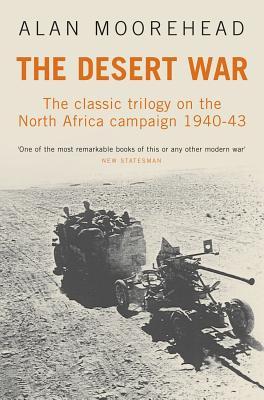
The Desert War Trilogy

Alan Moorehead

★★★★★
Read Advanced intel Intel history Military history Logistics Armor Logistics ISBN 9781845133917

Quarto Publishing Group UK · 2009

The seminal account of the battle between Montgomery’s Eighth Army and Rommel’s Afrika Corps, amidst the endless harsh wastes of the Western Desert. In 1940, Alan Moorehead was sent to cover the North Africa campaign by the Daily Express, and he followed its dramatic course all the way to 1943. The three books he subsequently wrote about the Desert War – later collected as his ‘African Trilogy’ – were swiftly acclaimed as a classic account of the tussle between Montgomery’s Eighth Army and Rommel’s Afrika Corps, under the beating sun of the Egyptian Sahara's Western Desert. Moorehead was responsible for the celebrated insight that tank battles in the desert are like battles at sea, the lumbering tanks like ships lost in a vast ocean of sand. The New Statesman could not have put it better when it described his achievement with this riveting book: ‘There is something of genius in the breadth and penetration of his vision , which encompasses the whole panorama of war and then narrows it down to the particular: the soldier stubbing out his cigarette before going into action, the expression on a tank commander’s face as he is hit… The story of the African campaigns will go down in history as one of the great epics of mankind, largely thanks to Mr Moorehead’s account.’

No cover · Amazon

The Diary of a U-boat Commander

R.N. Etienne

★★★★★
Read Military history Naval

The M.S. of this amazing diary of a German U-Boat Commander has fallen into our hands under somewhat unusual and mysterious circumstances, the name of the writer being withheld for reasons which will be readily apparent to all who read his astounding experiences. It is, however, a story so thrilling and sensational that we have no hesitation in offering it as it stands to the public, kept so long in ignorance by the necessary evil of a rigid censorship. A particularly human and intriguing touch is given to the book by the Author's very frank account of his mad infatuation for a beautiful girl of his own country who was inextricably involved in his incredible exploits and adventures on the high seas.

No cover · Amazon

The Emperor's Handbook

Marcus Aurelius

★★★★★
Read Advanced intel Military history

"Do not act as if thou were going to live ten thousand years. Death hangs over thee. While thoug livest, while it is in thy power, be good." Meditations contains the private wisdom of Marcus Aurelius, Roman Emperor from AD 161 to 180, and a great philosopher. His Meditations were never intended for publication. They were his personal thoughts and spiritual reflections, which he wrote down and referred to in order to help him manage the challenges of governing the Roman Empire while maintaining a peaceful private life. His philosophy articulated the need for inner peace and moral certainty in a world filled with chaos and suffering. The insights found in Meditations are just as helpful today as when Marcus Aurelius first wrote them nearly two millennia ago.

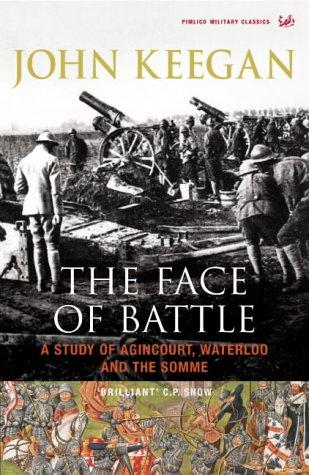
The Face of Battle: A Study of Agincourt, Waterloo and the Somme

John Keegan

★★★★★
Read Military history Intel history WWI Strategy / theory ISBN 9781844137480

Pimlico · 2004

The Face of Battle is military history from the battlefield: a look at the direct experience of individuals at 'the point of maximum danger'. It examines the physical conditions of fighting, the particular emotions and behaviour generated by battle, as well as the motives that impel soldiers to stand and fight rather than run away. In his scrupulous reassessment of three battles, John Keegan vividly conveys their reality for the participants, whether facing the arrow cloud of Agincourt, the levelled muskets of Waterloo or the steel rain of the Somme.

The Fall of Berlin 1945

Antony Beevor

★★★★★
Read Military history WWII Russia / USSR ISBN 9783570003695

ISIS Audio Books · 2002

"A tale drenched in drama and blood, heroism and cowardice, loyalty and betrayal."--Jonathan Yardley, The Washington Post The Red Army had much to avenge when it finally reached the frontiers of the Third Reich in January 1945. Frenzied by their terrible experiences with Wehrmacht and SS brutality, they wreaked havoc--tanks crushing refugee columns, mass rape, pillage, and unimaginable destruction. Hundreds of thousands of women and children froze to death or were massacred; more than seven million fled westward from the fury of the Red Army. It was the most terrifying example of fire and sword ever known. Antony Beevor, renowned author of D-Day and The Battle of Arnhem, has reconstructed the experiences of those millions caught up in the nightmare of the Third Reich's final collapse. The Fall of Berlin is a terrible story of pride, stupidity, fanaticism, revenge, and savagery, yet it is also one of astonishing endurance, self-sacrifice, and survival against all odds.

The Gulag Archipelago 1918–1956 (Abridged)

Aleksandr Solzhenitsyn

★★★★★
Read Military history WWII Cold War Russia / USSR Biography ISBN 0060007761

Perennial · 2002

Drawing on his own incarceration and exile, as well as on evidence from more than 200 fellow prisoners and Soviet archives, Aleksandr I. Solzhenitsyn reveals the entire apparatus of Soviet repression—the state within the state that ruled all-powerfully. Through truly Shakespearean portraits of its victims—men, women, and children—we encounter secret police operations, labor camps and prisons; the uprooting or extermination of whole populations, the welcome that awaited Russian soldiers who had been German prisoners of war. Yet we also witness the astounding moral courage of the incorruptible, who, defenseless, endured great brutality and degradation. The Gulag Archipelago 1918–1956—a grisly indictment of a regime, fashioned here into a veritable literary miracle—has now been updated with a new introduction that includes the fall of the Soviet Union and Solzhenitsyn's move back to Russia.

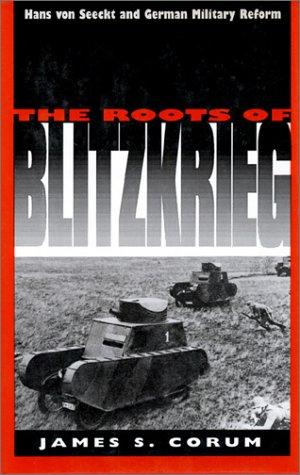
The Roots Of Blitzkrieg: Hans von Seeckt And German Military Reform

James S. Corum

★★★★★
Read Advanced intel Basic intel Military history Intel history Logistics WWII WWI Logistics Strategy / theory ISBN 9780700606283

University Press of Kansas · February 1994

Following Germany's defeat in World War I, the Germans signed the Versailles Treaty, superficially agreeing to limit their war powers. The Allies envisioned the future German army as a lightly armed border guard and international security force. The Germans had other plans. As early as 1919, James Corum contends, the tactical foundations were being laid for the Nazi Blitzkrieg. Between 1919 and 1933, German military leaders created and nurtured the Reichswehr, a new military organization built on the wreckage of the old Imperial Army. It was not being groomed for policing purposes. Focusing on Hans von Seeckt, General Staff Chief and Army Commander, Corum traces the crucial transformations in German military tactical doctrine, organization, and training that laid the foundations for fighting Germany's future wars. In doing so, he restores balance to prior assessment of von Seeckt's influence and demonstrates how the general, along with a few other "visionary" officers--including armor tactician Ernst Volckheim and air tactician Helmut Wilberg--collaborated to develop the core doctrine for what became the Blitzkrieg. The concepts of mobile war so essential to Germany's strength in World War II, Corum shows, were in place well before the tools became available. As an unforeseen consequence of the Versailles Treaty, the Germans were not saddled with a stockpile of outdated equipment as the Allies were. This, ironically, resulted in an advantage for the Germans, who were able to create doctrine first and design equipment to match it.

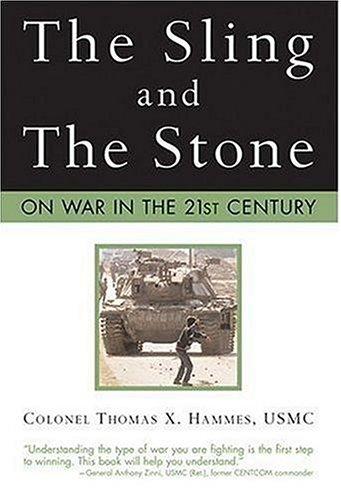
The Sling and the Stone: On War in the 21st Century

Thomas X. Hammes

★★★★★
Read Basic intel Advanced intel Military history Intel history Vietnam Cold War GWOT Guerrilla / COIN Russia / USSR Middle East Strategy / theory ISBN 9780760324073

Zenith Press · February 17, 2006

4GW (Fourth Generation Warfare) is the only kind of war America has ever lost. And we have done so three times - in Vietnam, Lebanon, and Somalia. This form of warfare has also defeated the French in Vietnam and Algeria, and the USSR in Afghanistan.As the only Goliath left in the world, we should be worried that the world's Davids have found a sling and stone that work." - Chapter 1, The Sling and the Stone: On War in the 21st Century. The War in Iraq. The War on Terror. These types of "asymmetrical" warfare are the conflicts of the 21st century - and show how difficult it is for the world's remaining superpower to battle insurgents and terrorists who will fight unconventionally in the face of superior military power. This change in military conflict may seem sudden.

The Winter War: Russia's Invasion Of Finland, 1939-40

Robert Edwards

★★★★★
Read Advanced intel Basic intel Military history Intel history Logistics WWII Cold War Russia / USSR Logistics Economics ISBN 9781933648507

Pegasus Books · December 30, 2007

On November 30, 1939, the Soviet Union's Red Army invaded the young nation-state of Finland, in the full expectation of routing the small, ill-equipped Finnish army and annexing the former Russian territory by the end of the year. But Finland held out for 105 bitterly cold, fiercely combative days, until March 15, 1940, when a peace agreement ended the short, savage Winter War. At the stirring center of the story lie the resourcefulness and resolve of the Finnish people, who against all military odds—in want of ammunition, food, sleep, and troops—fought a blundering, ineptly commanded Red Army to a standstill. On March 15, they ceded to the Soviet 11 percent of their territory and 30 percent of their economic assets, but none of their national pride. The Russians meanwhile had markedly damaged their international standing and effectively ruined their military reputation-to such an extent, as this probing chapter in World War II history demonstrates, that Germany, with proud-blooded Finland as an ally, dared to launch its 1940 invasion of Russia. At the same time, though, the fiasco of the Winter War forced Stalin to acknowledge the shortcomings of the Red Army and to reform it: Germany would fall at Stalingrad in 1941. With authority, this skillfully narrated military history unfolds its story of the four-month Soviet-Finnish war and explores its consequences from London to Moscow, from Helsinki to Paris, to Washington, DC.

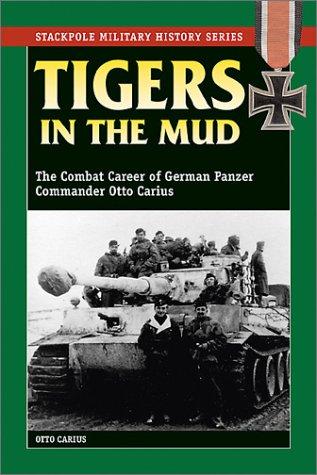
Tigers In The Mud: The Combat Career of German Panzer Commander Otto Carius

Otto Carius

★★★★★
Read Intel history Military history WWII Armor Intel history Biography ISBN 0811729117

Stackpole Books · 2003

WWII began with a metallic roar as the German Blitzkrieg raced across Europe, spearheaded by the most dreaded weapon of the 20th century: the Panzer. No German tank better represents that thundering power than the infamous Tiger, and Otto Carius was one of the most successful commanders to ever take a Tiger into battle, destroying well over 150 enemy tanks during his incredible career.

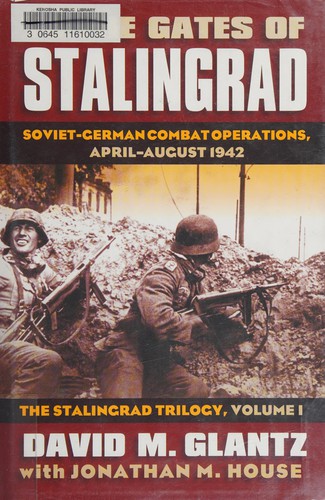
To the Gates of Stalingrad: Soviet-German Combat Operations, April-August 1942

David M. Glantz

★★★★★
Read Military history WWII Cold War Russia / USSR ISBN 9780700616305

University Press of Kansas · 2009

The confrontation between German and Soviet forces at Stalingrad was a titanic clash of armies on an unprecedented scale--a campaign that was both a turning point in the Second World War and a lasting symbol of that war's power and devastation. Yet despite the attention lavished on this epic battle by historians, much about it has been greatly misunderstood or hidden from view--as David Glantz, the world's foremost authority on the Red Army in World War II, now shows. This first volume in Glantz's masterly trilogy draws on previously unseen or neglected sources to provide the definitive account of the opening phase of this iconic Eastern Front campaign. Glantz has combed daily official records from both sides--including the Red Army General Staff, the People's Commissariat of Internal Affairs, the German Sixth Army, and the Soviet 62nd Army--to produce a work of unparalleled detail and fresh interpretations. Jonathan House, an authority on twentieth-century warfare, adds further insight and context. Hitler's original objective was not Stalingrad but the Caucasus oilfields to the south of the city. So he divided his Army Group South into two parts--one to secure the city on his flank, one to capture the oilfields. Glantz reveals for the first time how Stalin, in response, demanded that the Red Army stand and fight rather than withdraw, leading to the numerous little-known combat engagements that seriously eroded the Wehrmacht's strength before it even reached Stalingrad. He shows that, although advancing German forces essentially destroyed the armies of the Soviet Southwestern and Southern Fronts, the Soviets resisted the German advance much more vigorously than has been thought through constant counterattacks, ultimately halting the German offensive at the gates of Stalingrad. This fresh, eye-opening account and the subsequent companion volumes--on the actual battle for the city itself and the successful Soviet counteroffensive that followed--will dramatically revise and expand our understanding of what remains a military campaign for the ages.

Vietnam: An Epic Tragedy, 1945-1975

Max Hastings

★★★★★
Read Intel history Military history Vietnam Special ops Guerrilla / COIN Biography ISBN 9780062405661

Harper · 2018

An absorbing and definitive modern history of the Vietnam War from the acclaimed New York Times bestselling author of The Secret War. Vietnam became the Western world’s most divisive modern conflict, precipitating a battlefield humiliation for France in 1954, then a vastly greater one for the United States in 1975. Max Hastings has spent the past three years interviewing scores of participants on both sides, as well as researching a multitude of American and Vietnamese documents and memoirs, to create an epic narrative of an epic struggle. He portrays the set pieces of Dienbienphu, the 1968 Tet offensive, the air blitz of North Vietnam, and also much less familiar miniatures such as the bloodbath at Daido, where a US Marine battalion was almost wiped out, together with extraordinary recollections of Ho Chi Minh’s warriors. Here are the vivid realities of strife amid jungle and paddies that killed two million people. Many writers treat the war as a US tragedy, yet Hastings sees it as overwhelmingly that of the Vietnamese people, of whom forty died for every American. US blunders and atrocities were matched by those committed by their enemies. While all the world has seen the image of a screaming, naked girl seared by napalm, it forgets countless eviscerations, beheadings, and murders carried out by the communists. The people of both former Vietnams paid a bitter price for the Northerners’ victory in privation and oppression. Here is testimony from Vietcong guerrillas, Southern paratroopers, Saigon bargirls, and Hanoi students alongside that of infantrymen from South Dakota, Marines from North Carolina, and Huey pilots from Arkansas. No past volume has blended a political and military narrative of the entire conflict with heart-stopping personal experiences, in the fashion that Max Hastings’ readers know so well. The author suggests that neither side deserved to win this struggle with so many lessons for the twenty-first century about the misuse of military might to confront intractable political and cultural challenges. He marshals testimony from warlords and peasants, statesmen and soldiers, to create an extraordinary record.

No cover · Amazon

Weaving the Tangled Web: Military Deception in Large-Scale Combat Operations (Large-Scale Combat Operations Series Book 1)

Christopher M. Rein

★★★★★
Read Basic intel Military history Intel history WWII Korea Cold War GWOT Guerrilla / COIN China Russia / USSR Middle East Intel history Strategy / theory

This book is from Army University Press and is Volume 1 in it's Large-Scale Combat Operations Series. It has footnotes, maps, and pictures, and was originally published in 2018. “Since the Soviet Union’s fall in 1989, the specter of large-scale ground combat against a peer adversary was remote. During the years following, the US Army found itself increasingly called upon to lead multinational operations in the lower to middle tiers of the range of military operations and conflict continuum. The events of 11 September 2001 led to more than 15 years of intense focus on counterterrorism, counterinsurgency, and stability operations in Iraq and Afghanistan. An entire generation of Army leaders and Soldiers were culturally imprinted by this experience. We emerged as an Army more capable in limited contingency operations than at any time in our nation’s history, but the geopolitical landscape continues to shift and the risk of great power conflict is no longer a remote possibility. “While our Army focused on limited contingency operations in the Middle East and Southwest Asia, other regional and peer adversaries scrutinized US military processes and methods and adapted their own accordingly. As technology has proliferated and become accessible in even the most remote corners of the world, the US military’s competitive advantage is being challenged across all of the warfighting domains. In the last decade, we have witnessed an emergent China, a revanchist and aggressive Russia, a menacing North Korea, and a cavalier Iranian regime. Each of these adversaries seeks to change the world order in their favor and contest US strategic interests abroad. The chance for war against a peer or regional near-peer adversary has increased exponentially, and we must rapidly shift our focus to successfully compete in all domains and across the full range of military operations." Includes: Introduction: Multi-Domain Deception (Christopher M. Rein, General Editor); Chapter 1: The Belfort Ruse the American Deception plan for the battle of st. Mihiel, 1918 (Mark E. Grotelueschen); Chapter 2: From Beersheba To Megiddo British Deception Operations During The Palestine Campaign, 1917-1918; (Major Brian J. Drohan); Chapter 3: Operation Bertram British Deception At El Alamein (Gary W. Linhart); Chapter 4: Operations Barclay, Cascade, And Mincemeat Allied Deception In The Mediterranean, 1943 (Gregory S. Hospodor); Chapter 5: Operation Kreml German Strategic Deception On The Eastern Front In 1942 (Alan P. Donohue); Chapter 6: Red Star Resurgent Soviet Deception Operations At Stalingrad, 1942-1943 (First Lieutenant Kyle B. Vautrinot); Chapter 7: Operation Bagration Maskirovka At Its Height, Summer 1944 (Curtis S. King); Chapter 8: Deceive, Divert, And Delay Operation Fortitude In Support Of D-Day (Scott C. Farquhar); Chapter 9: Chinese Deception And The 1950 Intervention In The Korean War (Joseph G.D. Babb); Chapter 10: From Maneuvers To War The Egyptian Deception Plan On The Eve Of The Yom-Kippur War (Tal Tovy); Chapter 11: Target San Carlos British Deception During The Repossession Of The Falkland Islands (Steven Paget); Chapter 12: Deception In The Desert Deceiving Iraq In Operation Desert Storm (Donald P. Wright); Conclusion: The Future Of Military Deception Operations (Conrad C. Crane)

When Money Dies: The Nightmare of the Weimar Hyper-inflation

Adam Fergusson

★★★★★
Read Advanced intel Military history Logistics Logistics Economics ISBN 9781906964443

Old Street Publishing · Apr 23, 2010

When Money Dies is the classic history of what happens when a nation’s currency depreciates beyond recovery. In 1923, with its currency effectively worthless (the exchange rate in December of that year was one dollar to 4,200,000,000,000 marks), the German republic was all but reduced to a barter economy. Expensive cigars, artworks, and jewels were routinely exchanged for staples such as bread; a cinema ticket could be bought for a lump of coal; and a bottle of paraffin for a silk shirt. People watched helplessly as their life savings disappeared and their loved ones starved. Germany’s finances descended into chaos, with severe social unrest in its wake.Money may no longer be physically printed and distributed in the voluminous quantities of 1923. However, “quantitative easing,” that modern euphemism for surreptitious deficit financing in an electronic era, can no less become an assault on monetary discipline. Whatever the reason for a country’s deficit necessity or profligacy, unwillingness to tax or blindness to expenditure it is beguiling to suppose that if the day of reckoning is postponed economic recovery will come in time to prevent higher unemployment or deeper recession. What if it does not? Germany in 1923 provides a vivid, compelling, sobering moral tale.

When Titans Clashed: How the Red Army Stopped Hitler (Modern War Studies)

David M. Glantz

★★★★★
Read Military history WWII Cold War Russia / USSR Intel history Strategy / theory Economics ISBN 0700608990

University of Kansas · 1998

By the time Pearl Harbor had ripped apart America's peacetime pretensions, the German blitzkrieg had already blasted the Red Army back to the gates of Moscow. Yet, less than four years later, the Soviet hammer-and-sickle flew above the ruins of Berlin, stark symbol of a miraculous comeback that destroyed the German army and shattered Hitler's imperial designs. Told in swift stirring prose, When Titans Clashed provides the first full account of this epic struggle from the Soviet perspective. David Glantz, one of the world's foremost authorities on the Soviet military, and Jonathan House present a fundamentally new interpretation of what the Russians called the "Great Patriotic War." Based on unprecedented access to formerly classified Soviet sources, they counter the German perspective that has dominated previous accounts and radically revise our understanding of the Soviet experience during World War II. Placing the war within its wider political, economic, and social contexts, the authors recount how the determined Soviets overcame their initial disasters to defeat the most powerful army ever assembled. As they vividly show, this truly was war waged on a titanic scale, sweeping across a half-million square miles from Moscow to Berlin, featuring monumental offensives and counteroffensives, and ultimately costing both sides combined a staggering forty million casualties. Their work offers new revelations on Soviet strategy and tactics, Stalin's role as supreme commander of the Red Army, the emergence of innovative and courageous commanders in the crucible of combat, numerous previously concealed or neglected military operations, German miscalculations on the road to the Red capital, the effect of D-Day and the "second front" on the Soviet effort, and the war's devastating impact on the Soviet economy and civilian population. An essential volume for anyone interested in World War II or Soviet history, When Titans Clashed will change forever how we look at one of the greatest military confrontations in world history.

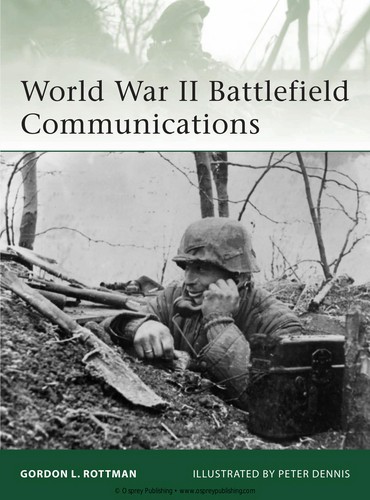
World War II Battlefield Communications (Elite, 181)

Gordon L. Rottman

★★★★★
Read Intel history Military history Technical warfare WWII ISBN 9781846038471

Osprey · 2010

Osprey's examination of technological advances in communications during World War II (1939-1945). Perhaps the biggest difference in the fighting between the two World Wars lay in the invention of the man-portable radio that allowed for a greater degree of tactical coordination than ever before. Gordon L. Rottman provides an informative study of the use of small radios, field telephones, signal flares and ground-to-air signaling that revolutionized the battlefield.

Zero Night: The Untold Story of World War Two's Greatest Escape: The Untold Story of World War Two's Greatest Escape

Mark Felton

★★★★★
Read Military history WWII ISBN 9781250073747

Thomas Dunne Books, St. Martin's Press · 2015

A thrilling, moment by moment account of an epic World War II escape and the real-life adventures that followed. On August 30, 1942 - 'Zero Night' - 40 Allied officers staged the most audacious mass escape of World War II. Months of meticulous planning and secret training hung in the balance during three minutes of mayhem as the officers boldly stormed the huge double fences at Oflag Prison. Employing wooden ladders and bridges previously disguised as bookshelves, the highly coordinated effort succeeded and set 36 men free into the German countryside. Later known as the 'Warburg Wire Job', fellow prisoner and fighter ace Douglas Bader once described the attempt as 'the most brilliant escape conception of this war'. The first author to tackle this remarkable story in detail, historian Mark Felton brilliantly evokes the suspense of the escape and the adventures of those escapees who managed to elude the Germans, as well as the courage of the civilians who risked their lives to help them in enemy territory. Fantastically intimate and told with a novelist's eye for drama and detail, this rip-roaring adventure is all the more thrilling because it really happened.