S2 Search · Reading list

S2 Actual reading list

Books from S2 Actual on Goodreads, organized by his shelves and topic buckets (intel lists, military history, logistics, etc.). Metadata filled via Open Library.

Not official S2 Underground. Independent fan index — not affiliated with or endorsed by S2. Official hub: linktr.ee/S2_underground. S2 materials are CC BY-NC-SA 4.0.

S2 topic buckets (Goodreads)

Subjects & genres

137 books · Advanced intel · page 5 of 6

No cover · Amazon

Bracketing the Enemy: Forward Observers in World War II

John R. Walker

unrated
Read Advanced intel Intel history Military history Technical warfare WWII US Civil War

After the end of World War II, General George Patton declared that artillery had won the war. Yet howitzers did not achieve victory on their own. Crucial to the success of these big guns were forward observers, artillerymen on the front lines who directed the artillery fire. Until now, the vital role of forward observers in ground combat has received little scholarly attention. In Bracketing the Enemy, John R. Walker remedies this oversight by offering the first full-length history of forward observer teams during World War II. As early as the U.S. Civil War, artillery fire could reach as far as two miles, but without an “FO” (forward observer) to report where the first shot had landed in relation to the target, and to direct subsequent fire by outlining or “bracketing” the targeted range, many of the advantages of longer-range fire were wasted. During World War II, FOs accompanied infantrymen on the front lines. Now, for the first time, gun crews could bring deadly accurate fire on enemy positions immediately as advancing riflemen encountered these enemy strongpoints. According to Walker, this transition from direct to indirect fire was one of the most important innovations to have occurred in ground combat in centuries. Using the 37th Division in the Pacific Theater and the 87th in Europe as case studies, Walker presents a vivid picture of the dangers involved in FO duty and shows how vitally important forward observers were to the success of ground operations in a variety of scenarios. FO personnel not only performed a vital support function as artillerymen but often transcended their combat role by fighting as infantrymen, sometimes even leading soldiers into battle. And yet, although forward observers lived, fought, and bled with the infantry, they were ineligible to wear the Combat Infantryman’s Badge awarded to the riflemen they supported. Forward observers are thus among the unsung heroes of World War II. Bracketing the Enemy signals a long-overdue recognition of their distinguished service.

Burma: The Longest War 1941-45

Louis Allen

unrated
Read Advanced intel Military history Logistics WWII Logistics ISBN 1842122606

Phoenix Press · 2000

Charting the whole Burma war, this book flows like a novel from the high command to the sharp end setting out a myriad of facts and considerations in a clear and coherent narrative. Ranging far beyond pure military history the story is multi-layered, combining objective analysis with a sensitive account of human reaction in the face of bitter, cruel warfare, disease and an inhospitable terrain. Military events are painstakingly detailed, and set in their political and cultural context. Equal attention is paid to both sides of the conflict and the insights made into Japanese plans and responses make the book uniquely informative, exciting and moving. 'If one had to select one book about the Burma War, this fine work is the best' Dekho, magazine of the Burma Star Association 'There will be few more thorough chronicles of World War Two's most dreaded front than Louis Allen's The Longest War' The Listener

No cover · Amazon

COUNTERINSURGENCY

David Kilcullen

unrated
Read Advanced intel GWOT Guerrilla / COIN Middle East Strategy / theory

David Kilcullen is one of the world's most influential experts on counterinsurgency and modern warfare, a ground-breaking theorist whose ideas "are revolutionizing military thinking throughout the west" ( Washington Post ). Indeed, his vision of modern warfare powerfully influenced the United States' decision to rethink its military strategy in Iraq and implement "the Surge," now recognized as a dramatic success. In Counterinsurgency , Kilcullen brings together his most salient writings on this vitally important topic. Here is a picture of modern warfare by someone who has had his boots on the ground in some of today's worst trouble spots-including Iraq and Afghanistan-and who has been studying counterinsurgency since 1985. Filled with down-to-earth, common-sense insights, this book is the definitive account of counterinsurgency, indispensable for all those interested in making sense of our world in an age of terror.

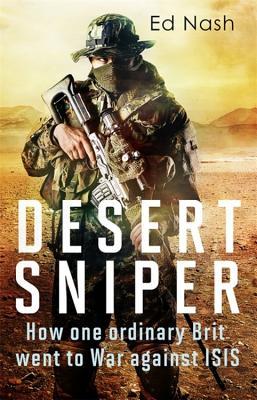
Desert Sniper: How One Ordinary Brit Went to War Against ISIS

Ed Nash

unrated
Read Advanced intel Military history Technical warfare Biographies GWOT Air power Middle East Intel history ISBN 9781408711330

Little, Brown Book Group Limited · 2018

What makes an ordinary but highly educated Englishman, with no previous military training, decide to travel and fight in one of the most brutal conflicts on the planet? Desert Sniper is an extraordinary, true account of one man's journey from well-meaning volunteer to battle-scarred combat sniper, placing himself daily in the line of fire to fight one of the greatest evils of this new century. Ed Nash has travelled across the globe, and is working with refugees in Burma, when he first becomes aware of the terrible atrocities being committed under ISIS's newly established 'Caliphate', covering vast tracts of Iraq and Syria. In June 2015, he chooses to undertake the hazardous journey, via Northern Iraq, to Syria, to join ill-equipped and poorly trained but battle-hardened Kurdish forces as they attempt to halt Daesh's relentless advance. Nash is an articulate, insightful and refreshingly honest companion as he unpacks the shifting complexities of the political and military situation in which he finds himself. As one of a motley band of foreign volunteer fighters - veterans of other conflicts, adventurers and misfits, from many different countries - we follow him through his rudimentary training and early combat operations as he and his companions slowly gain the trust and respect of their Kurdish colleagues. Nash shows us the realities of the war on the ground in Syria in fascinating detail; the privations of the ordinary Kurdish soldiers, the terrible price paid by civilians caught in the cross-fire, the ever-present danger of lethal suicide bombers and occasional moments of striking beauty in amongst the carnage. A modern classic in the making, Desert Sniper will prove to be one of the most unforgettable accounts to emerge from the war against ISIS.

Failed States and Fragile Societies: A New World Disorder? (Baker Series in Peace and Conflict Stud)

Ingo Trauschweizer

unrated
Read Advanced intel Cold War Middle East Economics ISBN 9780821420904

Ohio University Press · 2014

Since the end of the Cold War, a new dynamic has arisen within the international system, one that does not conform to established notions of the state’s monopoly on war. In this changing environment, the global community must decide how to respond to the challenges posed to the state by military threats, political and economic decline, and social fragmentation. This insightful work considers the phenomenon of state failure and asks how the international community might better detect signs of state decay at an early stage and devise legally and politically legitimate responses. This collection of essays brings military and social historians into conversation with political and social scientists and former military officers. In case studies from the former Yugoslavia, Somalia, Iraq, and Colombia, the distinguished contributors argue that early intervention to stabilize social, economic, and political systems offers the greatest promise, whereas military intervention at a later stage is both costlier and less likely to succeed. Contributors : David Carment, Yiagadeesen Samy, David Curp, Jonathan House, James Carter, Vanda Felbab-Brown, Robert Rotberg, and Ken Menkhaus.

From Troy to Entebbe

John Arquilla

unrated
Read Advanced intel Intel history Military history WWII WWI Special ops China Strategy / theory US Civil War ISBN 9780761801863

Univ.P.of America · 1996

Special operations, though most commonly associated with the period from the Second World War to the present, have played a key role throughout the history of conflict from the Trojan War to the great arms struggles of the 20th century. This volume introduces the reader to the broad sweep of the history of special operations, and also includes several excerpts from the classic literature on the subject. Contents: Origins: Robert Graves, 'The Wooden Horse', 'The Sack of Troy'; Raiding in the Age of Sail: G.M. Thomson, 'The Damage Done by this Corsair', 'The Wind Commands Me Away'; Ian Grimble, 'The Imp,^Rrieuse'; The Early American Tradition: Kenneth Roberts, 'The Raid on St. Francis'; Fred Cook, 'Struggle for the South'; R.E. Dupuy and W.H. Baumer, 'Wars With the Barbary Pirates'; 19th Century Colonial Warfare; Leo Tolstoy, The Raid; Wyatt Blassingame, 'How the Legion Began', 'The Legion Fights in Algeria'; The Civil War: Archer Hines, 'Military Means, Political Ends'; Bruce Catton, 'Total War and an Election'; World War I: Lowell Thomas, 'Trapped by a G-Ship..'; T.E. Lawrence, 'The Raid Upon the Bridges'; World War II in Western Europe and North Africa: Cajus Bekker, 'The Coup de Main at Eben Emael', 'The Blood-Bath of Crete'; Paul Carell, 'A British Commando Attempt to Capture Rommel', 'The British Raid on Tobruk', 'Brandenburgers in Action Behind the Front'; John Lodwick, Raiders from the Sea, Chapters 16-18; The Pacific War: Walter Lord, 'A Very Private War';Ronald Spector, 'The Road to Myitkyina'; Milton E. Miles, 'Chinese Pirates and the SACO Dragon'; Algeria, Round II: Jean Lart,^Rguy, 'The Leap of Leucadia'; The Ultimate Rescue: Chaim Herzog, 'Entebbe'; Bibliography; Index.

German Military Intelligence in World War II: The Abwehr

Lauran Paine

unrated
Read Advanced intel WWII Cold War Espionage Russia / USSR Intel history ISBN 0812829662

Stein and Day · 1984

The astonishing true story of the German military intelligence organization dedicated to Nazi victory - commanded by a man who was dedicated to Nazi defeat. It was primarily from the Abwehr that Hitler and his top generals got the information they used in planning the subjugation of Europe. But to this day few people know the full story of how the commander of that organization, Admiral Wilhelm Canaris, and some of his trusted subordinates, deliberately and secretly contributed to the downfall of Nazi Germany. high treason against Hitler's government originated within the Abwehr; at least three attempts on the Fuhrer's life were secretly planned, ordered, and carried out by its personnel. From 1938 until the last months of the war, Abwehr officers balanced on the sword's edge and did it so well that detection and terrible retribution came only when the armies of America and the Soviet Union were approaching Berlin. After peace came, strict orders were issued against revealing much that is now detailed in this book. Lauran Paine was associated with U.S. intelligence operations for over thirty years. He was also the author of "The CIA At Work" and several other books on intelligence matters.

Guerrilla Strategies: An Historical Anthology from the Long March to Afghanistan

Gérard Chaliand

unrated
Read Advanced intel Technical warfare Basic intel GWOT Guerrilla / COIN ISBN 0520044444

University of California Press · 1982

This unique anthology of writings on revolutionary warfare and counterinsurgency covers almost all the major struggles of the modern world. Chaliand, who has had firsthand experience with guerrilla movements in Afghanistan, Africa, and Latin America, provides a concise yet panoramic overview of political and military strategies in revolutionary warfare, noting their strengths, limitations, and pathologies.

No cover · Amazon

Hitler's Table Talk, 1941-1944

Norman Cameron

unrated
Read Military history Biographies Advanced intel WWII ISBN 1929631057

Enigma Books · 2000

This is a new edition of a major document from World War II with additional, previously unavailable texts assembled from the stenographic record of Hitler’s informal conversations ordered by Martin Bormann. These texts remain the classic collection of Hitler’s nighttime monologues with his entourage, covering mostly nonmilitary subjects and long-range plans. Hitler lets his thoughts wander, never failing to provide an opinion on every subject. Additional documents from various archives make this the most complete English-language edition in print.

No cover · Amazon

Huế 1968: A Turning Point of the American War in Vietnam

Mark Bowden

unrated
Read Advanced intel Basic intel Military history Intel history WWII Vietnam Intel history Strategy / theory

In the early hours of January 31, 1968, the North Vietnamese launched over one hundred attacks across South Vietnam in what would become known as the Tet Offensive. The lynchpin of Tet was the capture of Hue, Vietnam?s intellectual and cultural capital, by 10,000 National Liberation Front troops who descended from hidden camps and surged across the city of 140,000. Within hours the entire city was in their hands save for two small military outposts. American commanders refused to believe the size and scope of the Front?s presence, ordering small companies of marines against thousands of entrenched enemy troops. After several futile and deadly days, Lieutenant Colonel Ernie Cheatham would finally come up with a strategy to retake the city, block by block and building by building, in some of the most intense urban combat since World War II. With unprecedented access to war archives in the U.S. and Vietnam and interviews with participants from both sides, Bowden narrates each stage of this crucial battle through multiple viewpoints. Played out over 24 days and ultimately costing 10,000 lives, the Battle of Hue was by far the bloodiest of the entire war. When it ended, the American debate was never again about winning, only about how to leave. Hue 1968 is a gripping and moving account of this pivotal moment.

Japan's Gestapo: Murder, Mayhem and Torture in Wartime Asia

Mark Felton

unrated
Read Military history Logistics Technical warfare Advanced intel WWII Espionage Logistics ISBN 9781844159123

Pen & Sword Military · 2009

Japan's military and secret police, the Kempetai, carried out a reign of terror against captive Asian nations, Allied POWs, and Japanese citizens throughout World War II. This history explains the origins, command structure, and role of the Kempetai apparatus, revealing their criminal and collaborationist networks. It examines biological and chemical experiments on live subjects, the gulags for POWs, and slave labor, including the so-called "comfort women," as well as their campaign of revenge after the 1942 Doolittle raid on Tokyo. Calling their actions genocide on a grand scale, the author backs up his text with firsthand testimonies from survivors.

Japanese Intelligence in World War II (General Military)

Ken Kotani

unrated
Read Advanced intel Intel history WWII Espionage Naval China Russia / USSR Intel history ISBN 9781846034251

Osprey · 2009

In the eyes of history, Japanese intelligence in World War II has fared very poorly. However, these historians have most often concentrated on the later years of the war, when Japan was fighting a multi-front war against numerous opponents. In this groundbreaking new study, Japanese scholar Ken Kotani re-examines the Japanese Intelligence department, beginning with the early phase of the war. He points out that without the intelligence gathered by the Japanese Army and Navy they would have been unable to achieve their long string of victories against the forces of Russia, China, and Great Britain. Notable in these early campaigns were the successful strikes against both Singapore and Pearl Harbor. Yet as these victories expanded the sphere of Japanese control, they also made it harder for the intelligence services to gather accurate information about their growing list of adversaries. At the battle of Midway in 1942, Japanese intelligence suffered its worst mishap when the Americans broke their code and tricked the Japanese into revealing the target of their attack. It was a mistake from which they would never recover. As the military might of Japan was forced to retreat and her forces deteriorated, so too did her intelligence services.

Life and Death in Besieged Leningrad, 1941-1944 (Studies in Russian and East European History and Society)

John Barber

unrated
Read Advanced intel Military history Logistics Technical warfare WWII Cold War Russia / USSR Logistics ISBN 1403901422

Palgrave Macmillan · 2005

From 1941-1944 Leningrad saw by far the largest-scale famine ever to occur in a developed society. This book examines the nature and consequences of the extreme conditions created by the German blockade of Leningrad between September 1941 and January 1944. Using declassified documents from Party and State archives in Moscow and St Petersburg and interviews with survivors, the authors have produced the most informed and detailed analysis to date of the impact of the siege on the lives and health of the people of Leningrad.

Major General George H. Sharpe and the Creation of American Military Intelligence in the Civil War

Peter G. Tsouras

unrated
Read Advanced intel Intel history Intel history Biography US Civil War ISBN 9781612006482

Casemate Publishers & Book Distributors, LLC · 2018

This biography of the Civil War officer who established the Union’s intelligence network “is an absolute treasure trove of . . . operational information” (Military History Magazine).   In this biography of George H. Sharpe, acclaimed historian Peter Tsouras recounts the significance of Sharpe’s grand contribution to the Union war the creation of an all-source intelligence operation known as the Bureau of Military Information. Tsouras contends that, under Sharpe’s leadership, the BMI was the combat multiplier that ultimately brought the Union to victory.   By early 1863, in the two-and-half months before the Chancellorsville Campaign, Sharpe had compiled a thorough and accurate Intelligence Preparation of the Battlefield. His reports identified every brigade and its location in Lee’s army, provided an order-of-battle down to the regiment level, and a complete analysis of the railroad. Beyond this, Sharpe assembled a staff of thirty to fifty scouts and support personnel to run the military intelligence operation of the Army of the Potomac. He later supported Grant’s armies operating against Richmond during the Siege of Petersburg, where the BMI played a fundamental role in the victory.   After the war, Sharpe became one of the most powerful Republican politicians in New York State, had close friendships with presidents Grant and Arthur, and was a champion of African American civil rights. With a wealth of newly discovered primary documents, including the diaries of Sharpe’s deputy John C. Babcock, Tsouras sheds significant new light on the evolution of Civil War intelligence reporting.

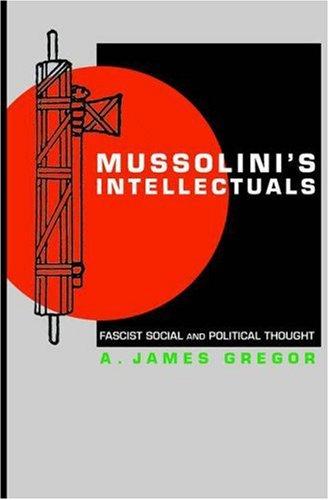
Mussolini's Intellectuals: Fascist Social and Political Thought

A. James Gregor

unrated
Read Advanced intel Military history ISBN 9780691127903

Princeton University Press · July 24, 2006

Fascism has traditionally been characterized as irrational and anti-intellectual, finding expression exclusively as a cluster of myths, emotions, instincts, and hatreds. This intellectual history of Italian Fascism--the product of four decades of work by one of the leading experts on the subject in the English-speaking world--provides an alternative account. A. James Gregor argues that Italian Fascism may have been a flawed system of belief, but it was neither more nor less irrational than other revolutionary ideologies of the twentieth century. Gregor makes this case by presenting for the first time a chronological account of the major intellectual figures of Italian Fascism, tracing how the movement's ideas evolved in response to social and political developments inside and outside of Italy. Gregor follows Fascist thought from its beginnings in socialist ideology about the time of the First World War--when Mussolini himself was a leader of revolutionary socialism--through its evolution into a separate body of thought and to its destruction in the Second World War. Along the way, Gregor offers extended accounts of some of Italian Fascism's major thinkers, including Sergio Panunzio and Ugo Spirito, Alfredo Rocco (Mussolini's Minister of Justice), and Julius Evola, a bizarre and sinister figure who has inspired much contemporary "neofascism." Gregor's account reveals the flaws and tensions that dogged Fascist thought from the beginning, but shows that if we want to come to grips with one of the most important political movements of the twentieth century, we nevertheless need to understand that Fascism had serious intellectual as well as visceral roots.

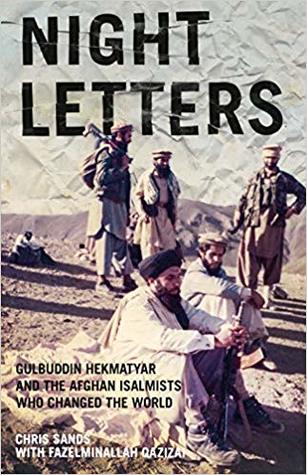
Night Letters: Gulbuddin Hekmatyar and the Afghan Islamists Who Changed the World

Chris Sands

unrated
Read Advanced intel Basic intel Biographies Intel history Military history GWOT Guerrilla / COIN Russia / USSR Intel history Biography Strategy / theory ISBN 9781787381964

C. Hurst and Company (Publishers) Limited · 2019

In 1969, several young men met on a rainy night in Kabul to form an Islamist student group. Their aim was laid out in a simple typewritten statement: to halt the spread of Soviet and American influence in Afghanistan. They went on to change the world. 'Night Letters' tells the extraordinary story of the group’s most notorious member, Gulbuddin Hekmatyar, and the guerrilla organisation he came to lead, Hizb-e Islami. By the late 1980s, tens of thousands were drawn to Hekmatyar’s vision of a radical Islamic state that would sow unrest from Kashmir to Jerusalem. His doctrine of violent global jihad culminated in 9/11 and the birth of ISIS, yet he never achieved his dream of ruling Afghanistan. The peace deal he signed with Kabul in 2016 was yet another controversial twist in an astonishing life. Sands and Qazizai delve into the secret history of Hekmatyar and Hizb-e Islami: their wars against Russian and American troops, and their bloody and bitter feuds with domestic enemies. Based on hundreds of exclusive interviews carried out across the region and beyond, this is the definitive account of the most important, yet poorly understood, international Islamist movement of the last fifty years.

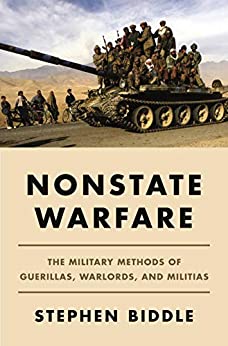
Nonstate Warfare: The Military Methods of Guerillas, Warlords, and Militias

Stephen D. Biddle

unrated
Read Advanced intel Military history Logistics Technical warfare GWOT Guerrilla / COIN Middle East Logistics ISBN 9780691207513

Princeton University Press · 2021

Since September 11th, 2001, armed nonstate actors have received increased attention and discussion from scholars, policymakers, and the military. Underlying debates about nonstate warfare and how it should be countered is one crucial assumption: that state and nonstate actors fight very differently. In Nonstate Warfare, Stephen Biddle upturns this distinction, arguing that there is actually nothing intrinsic separating state or nonstate military behavior. Through an in-depth look at nonstate military conduct, Biddle shows that many nonstate armies now fight more conventionally than many state armies. Biddle frames nonstate and state methods along a continuum, spanning Fabian-style irregular warfare to Napoleonic-style warfare involving massed armies, and he presents a systematic theory to explain any given nonstate actor's position on this spectrum. Showing that most warfare for at least a century has kept to the blended middle of the spectrum, Biddle argues that material and tribal culture explanations for nonstate warfare methods do not adequately explain observed patterns of warmaking. Investigating a range of historical examples from Lebanon and Iraq to Somalia, Croatia, and the Vietcong, Biddle demonstrates that viewing state and nonstate warfighting as mutually exclusive can lead to errors in policy and scholarship.

Origins and Doctrine of Fascism: With Selections from Other Works

Giovanni Gentile

unrated
Read Advanced intel Military history Strategy / theory ISBN 0765805774

2004

Giovanni Gentile (1875-1944) was the major theorist of Italian fascism, supplying its justification and rationale as a developmental form of dictatorship for status-deprived nations languishing on the margins of the Great Powers. Gentile's "actualism" (as his philosophy came to be called) absorbed many intellectual currents of the early twentieth century, including nationalism, syndicalism, and futurism. He called the individual to an idealistic ethic of obedience, work, self-sacrifi ce, and national community in a dynamic rebellion against the perceived impostures of imperialism. This volume makes available some of his more signifi cant writings produced shortly before and after the Fascist accession to power in Italy.

Ostkrieg: Hitler's War of Extermination in the East

Stephen G. Fritz

unrated
Read Basic intel Advanced intel Military history Logistics WWII Cold War Russia / USSR Logistics Economics ISBN 9780813134161

University Press of Kentucky · 2011

On June 22, 1941, Germany launched the greatest land assault in history on the Soviet Union, an attack that Adolf Hitler deemed crucial to ensure German economic and political survival. As the key theater of the war for the Germans, the eastern front consumed enormous levels of resources and accounted for 75 percent of all German casualties. Despite the significance of this campaign to Germany and to the war as a whole, few English-language publications of the last thirty-five years have addressed these pivotal events. In Ostkrieg: Hitler's War of Extermination in the East , Stephen G. Fritz bridges the gap in scholarship by incorporating historical research from the last several decades into an accessible, comprehensive, and coherent narrative. His analysis of the Russo-German War from a German perspective covers all aspects of the eastern front, demonstrating the interrelation of military events, economic policy, resource exploitation, and racial policy that first motivated the invasion. This in-depth account challenges accepted notions about World War II and promotes greater understanding of a topic that has been neglected by historians.

Paths to Victory: Lessons from Modern Insurgencies

Christopher Paul

unrated
Read Technical warfare Military history Intel history Advanced intel WWII GWOT Guerrilla / COIN Intel history ISBN 9780833080547

RAND CORPORATION · 2013

Building on a 2010 RAND study of the 30 insurgencies begun and completed between 1978 and 2008, this study added 41 new cases to the data set, allowing comparisons across all 71 insurgencies begun and completed worldwide since World War II to distill the paths to victory. With many more cases to compare, the study was able to more rigorously test the previous findings and address several critical questions that the earlier study could not.

Reset: Iran, Turkey, and America's Future

Stephen Kinzer

unrated
Read Advanced intel Military history Espionage Middle East Strategy / theory ISBN 9780805091274

Times Books · 2010

The bestselling author of Overthrow offers a new and surprising vision for rebuilding America's strategic partnerships in the Middle East What can the United States do to help realize its dream of a peaceful, democratic Middle East? Stephen Kinzer offers a surprising answer in this paradigm-shifting book. Two countries in the region, he argues, are America's logical partners in the twenty-first Turkey and Iran. Besides proposing this new "power triangle," Kinzer also recommends that the United States reshape relations with its two traditional Middle East allies, Israel and Saudi Arabia. This book provides a penetrating, timely critique of America's approach to the world's most volatile region, and offers a startling alternative. Kinzer is a master storyteller with an eye for grand characters and illuminating historical detail. In this book he introduces us to larger-than-life figures, like a Nebraska schoolteacher who became a martyr to democracy in Iran, a Turkish radical who transformed his country and Islam forever, and a colorful parade of princes, politicians, women of the world, spies, oppressors, liberators, and dreamers. Kinzer's provocative new view of the Middle East is the rare book that will richly entertain while moving a vital policy debate beyond the stale alternatives of the last fifty years.

Savage Continent: Europe in the Aftermath of World War II

Keith Lowe

unrated
Read Advanced intel Military history Logistics WWII Logistics Intel history Economics US Civil War ISBN 9781250000200

St. Martin's Press · 2012

The Second World War might have officially ended in May 1945, but in reality it rumbled on for another ten years... The end of the Second World War in Europe is one of the twentieth century’s most iconic moments.  It is fondly remembered as a time when cheering crowds filled the streets, danced, drank and made love until the small hours.  These images of victory and celebration are so strong in our minds that the period of anarchy and civil war that followed has been forgotten.  Across Europe, landscapes had been ravaged, entire cities razed and more than thirty million people had been killed in the war. The institutions that we now take for granted - such as the police, the media, transport, local and national government - were either entirely absent or hopelessly compromised. Crime rates were soaring, economies collapsing, and the European population was hovering on the brink of starvation.  In Savage Continent, Keith Lowe describes a continent still racked by violence, where large sections of the population had yet to accept that the war was over.  Individuals, communities and sometimes whole nations sought vengeance for the wrongs that had been done to them during the war. Germans and collaborators everywhere were rounded up, tormented and summarily executed.  Concentration camps were reopened and filled with new victims who were tortured and starved.  Violent anti-Semitism was reborn, sparking murders and new pogroms across Europe.  Massacres were an integral part of the chaos and in some places – particularly Greece, Yugoslavia and Poland, as well as parts of Italy and France – they led to brutal civil wars. In some of the greatest acts of ethnic cleansing the world has ever seen, tens of millions were expelled from their ancestral homelands, often with the implicit blessing of the Allied authorities. Savage Continent is the story of post WWII Europe, in all its ugly detail, from the end of the war right up until the establishment of an uneasy stability across Europe towards the end of the 1940s.  Based principally on primary sources from a dozen countries, Savage Continent is a frightening and thrilling chronicle of a world gone mad, the standard history of post WWII Europe for years to come.