ADP 3-90, page 17
Offense and Defense
Army Doctrine Publication: Offense and Defense
July 2019 public edition (supersedes Aug 2018); key terrain cited in S2 KOCOA
Searchable page text (OCR / PDF)
Tactical Fundamentals
31 July 2019
ADP 3-90
1-7
1-44. While each situation is different, commanders avoid undue caution or commitment of resources to
guard against every perceived threat. An unrealistic expectation of avoiding all risk is detrimental to mission
accomplishment. Waiting for perfect intelligence and synchronization increases risk or closes a window of
opportunity. Successful operations require commanders and subordinates to manage accepted risk, exercise
initiative, and act decisively even when the outcome is uncertain.
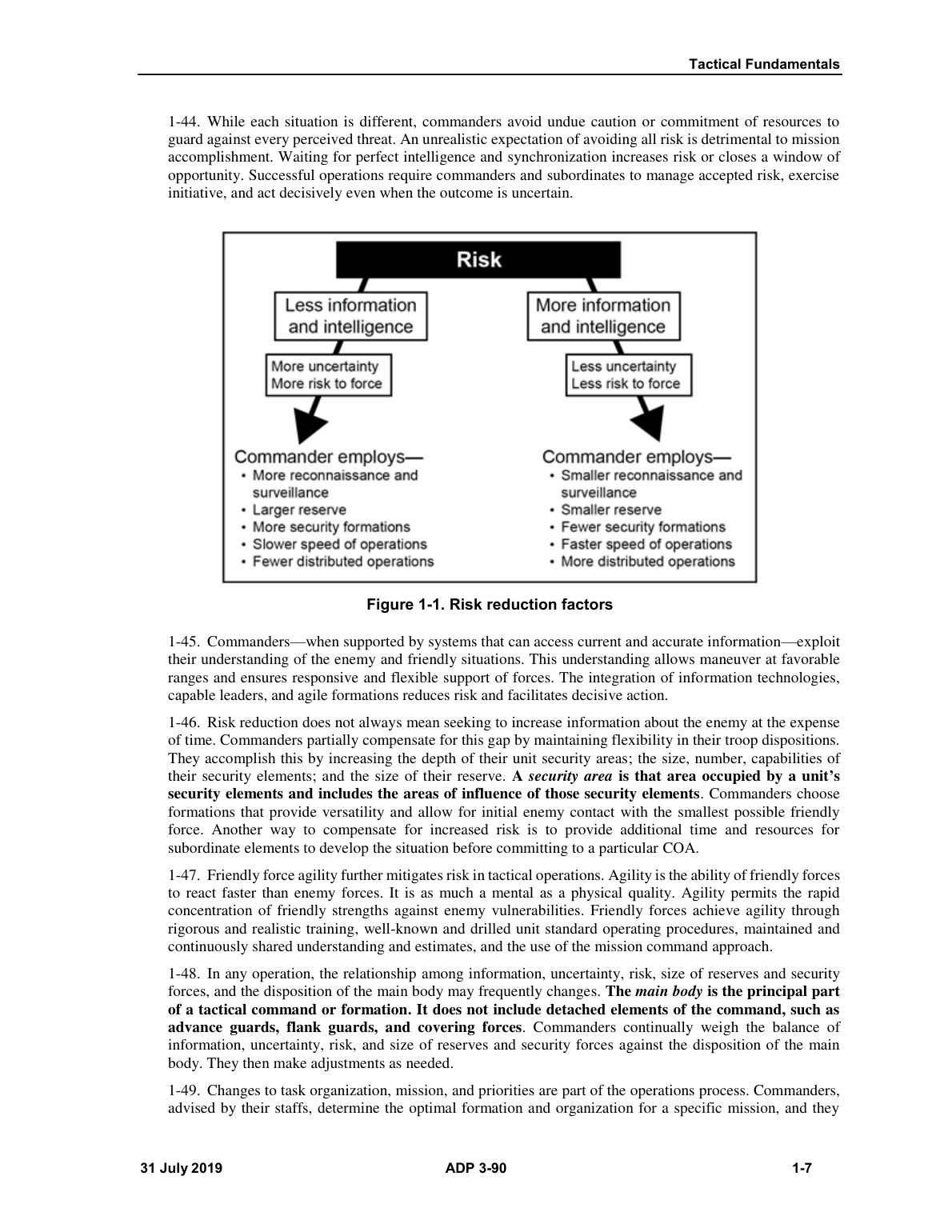
Figure 1-1. Risk reduction factors
1-45. Commanders—when supported by systems that can access current and accurate information—exploit
their understanding of the enemy and friendly situations. This understanding allows maneuver at favorable
ranges and ensures responsive and flexible support of forces. The integration of information technologies,
capable leaders, and agile formations reduces risk and facilitates decisive action.
1-46. Risk reduction does not always mean seeking to increase information about the enemy at the expense
of time. Commanders partially compensate for this gap by maintaining flexibility in their troop dispositions.
They accomplish this by increasing the depth of their unit security areas; the size, number, capabilities of
their security elements; and the size of their reserve. A security area is that area occupied by a unit’s
security elements and includes the areas of influence of those security elements. Commanders choose
formations that provide versatility and allow for initial enemy contact with the smallest possible friendly
force. Another way to compensate for increased risk is to provide additional time and resources for
subordinate elements to develop the situation before committing to a particular COA.
1-47. Friendly force agility further mitigates risk in tactical operations. Agility is the ability of friendly forces
to react faster than enemy forces. It is as much a mental as a physical quality. Agility permits the rapid
concentration of friendly strengths against enemy vulnerabilities. Friendly forces achieve agility through
rigorous and realistic training, well-known and drilled unit standard operating procedures, maintained and
continuously shared understanding and estimates, and the use of the mission command approach.
1-48. In any operation, the relationship among information, uncertainty, risk, size of reserves and security
forces, and the disposition of the main body may frequently changes. The main body is the principal part
of a tactical command or formation. It does not include detached elements of the command, such as
advance guards, flank guards, and covering forces. Commanders continually weigh the balance of
information, uncertainty, risk, and size of reserves and security forces against the disposition of the main
body. They then make adjustments as needed.
1-49. Changes to task organization, mission, and priorities are part of the operations process. Commanders,
advised by their staffs, determine the optimal formation and organization for a specific mission, and they