ADP 3-90, page 19
Offense and Defense
Army Doctrine Publication: Offense and Defense
July 2019 public edition (supersedes Aug 2018); key terrain cited in S2 KOCOA
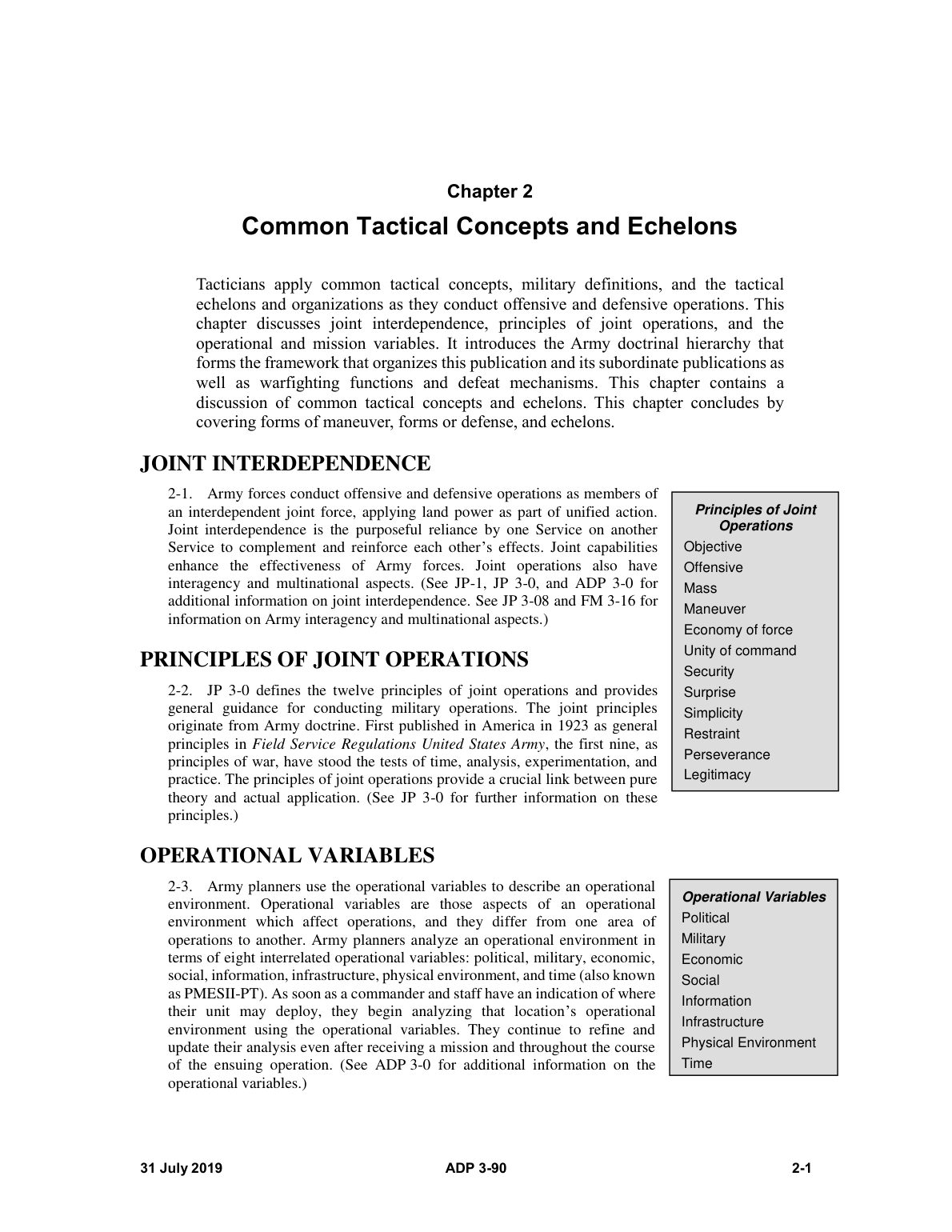
Searchable page text (OCR / PDF)
31 July 2019
ADP 3-90
2-1
Chapter 2
Common Tactical Concepts and Echelons
Tacticians apply common tactical concepts, military definitions, and the tactical
echelons and organizations as they conduct offensive and defensive operations. This
chapter discusses joint interdependence, principles of joint operations, and the
operational and mission variables. It introduces the Army doctrinal hierarchy that
forms the framework that organizes this publication and its subordinate publications as
well as warfighting functions and defeat mechanisms. This chapter contains a
discussion of common tactical concepts and echelons. This chapter concludes by
covering forms of maneuver, forms or defense, and echelons.
JOINT INTERDEPENDENCE
2-1. Army forces conduct offensive and defensive operations as members of
an interdependent joint force, applying land power as part of unified action.
Joint interdependence is the purposeful reliance by one Service on another
Service to complement and reinforce each other’s effects. Joint capabilities
enhance the effectiveness of Army forces. Joint operations also have
interagency and multinational aspects. (See JP-1, JP 3-0, and ADP 3-0 for
additional information on joint interdependence. See JP 3-08 and FM 3-16 for
information on Army interagency and multinational aspects.)
PRINCIPLES OF JOINT OPERATIONS
2-2. JP 3-0 defines the twelve principles of joint operations and provides
general guidance for conducting military operations. The joint principles
originate from Army doctrine. First published in America in 1923 as general
principles in Field Service Regulations United States Army, the first nine, as
principles of war, have stood the tests of time, analysis, experimentation, and
practice. The principles of joint operations provide a crucial link between pure
theory and actual application. (See JP 3-0 for further information on these
principles.)
OPERATIONAL VARIABLES
2-3. Army planners use the operational variables to describe an operational
environment. Operational variables are those aspects of an operational
environment which affect operations, and they differ from one area of
operations to another. Army planners analyze an operational environment in
terms of eight interrelated operational variables: political, military, economic,
social, information, infrastructure, physical environment, and time (also known
as PMESII-PT). As soon as a commander and staff have an indication of where
their unit may deploy, they begin analyzing that location’s operational
environment using the operational variables. They continue to refine and
update their analysis even after receiving a mission and throughout the course
of the ensuing operation. (See ADP 3-0 for additional information on the
operational variables.)
Principles of Joint
Operations
Objective
Offensive
Mass
Maneuver
Economy of force
Unity of command
Security
Surprise
Simplicity
Restraint
Perseverance
Legitimacy
Operational Variables
Political
Military
Economic
Social
Information
Infrastructure
Physical Environment
Time