ADP 3-90, page 20
Offense and Defense
Army Doctrine Publication: Offense and Defense
July 2019 public edition (supersedes Aug 2018); key terrain cited in S2 KOCOA
Searchable page text (OCR / PDF)
Chapter 2
2-2
ADP 3-90
31 July 2019
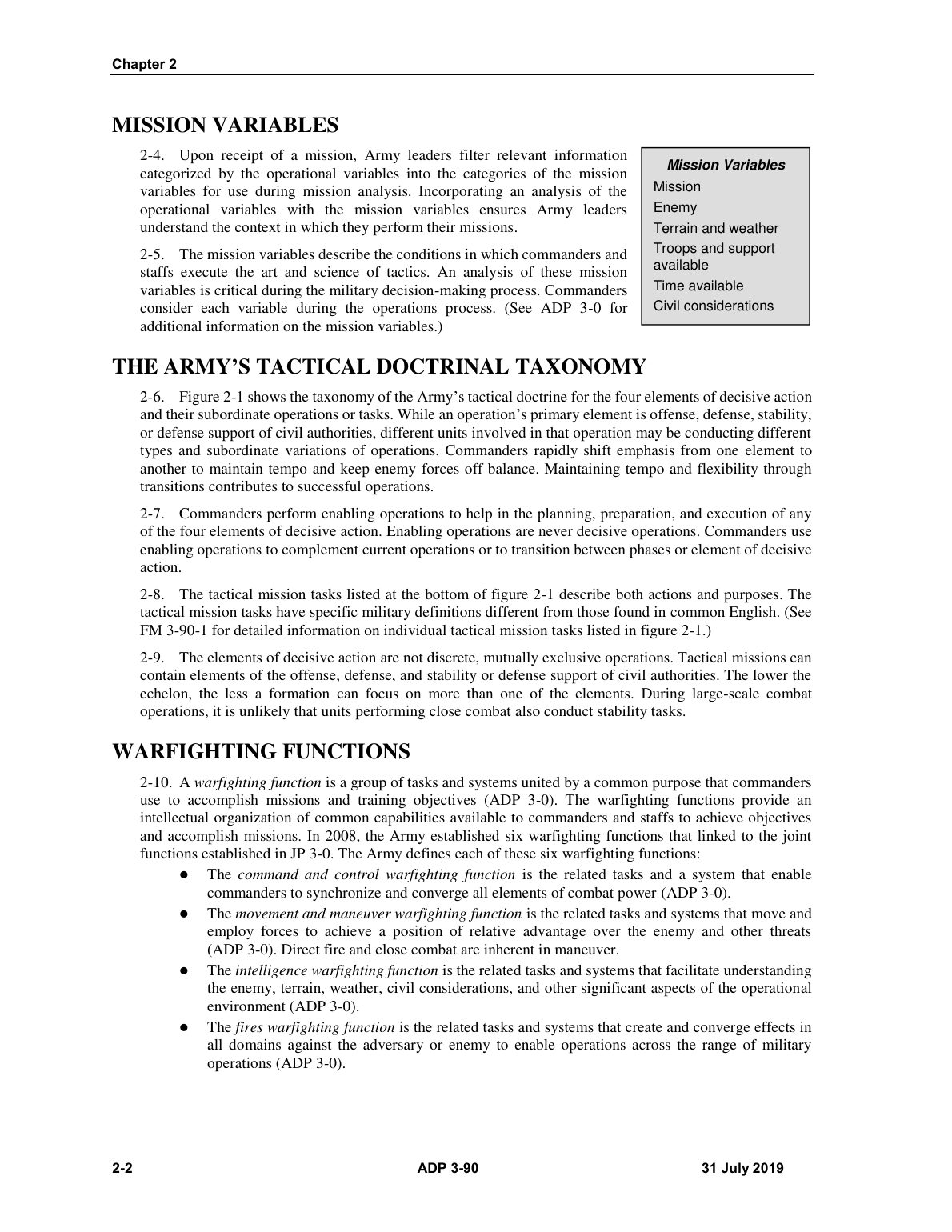
MISSION VARIABLES
2-4. Upon receipt of a mission, Army leaders filter relevant information
categorized by the operational variables into the categories of the mission
variables for use during mission analysis. Incorporating an analysis of the
operational variables with the mission variables ensures Army leaders
understand the context in which they perform their missions.
2-5. The mission variables describe the conditions in which commanders and
staffs execute the art and science of tactics. An analysis of these mission
variables is critical during the military decision-making process. Commanders
consider each variable during the operations process. (See ADP 3-0 for
additional information on the mission variables.)
THE ARMY’S TACTICAL DOCTRINAL TAXONOMY
2-6. Figure 2-1 shows the taxonomy of the Army’s tactical doctrine for the four elements of decisive action
and their subordinate operations or tasks. While an operation’s primary element is offense, defense, stability,
or defense support of civil authorities, different units involved in that operation may be conducting different
types and subordinate variations of operations. Commanders rapidly shift emphasis from one element to
another to maintain tempo and keep enemy forces off balance. Maintaining tempo and flexibility through
transitions contributes to successful operations.
2-7. Commanders perform enabling operations to help in the planning, preparation, and execution of any
of the four elements of decisive action. Enabling operations are never decisive operations. Commanders use
enabling operations to complement current operations or to transition between phases or element of decisive
action.
2-8. The tactical mission tasks listed at the bottom of figure 2-1 describe both actions and purposes. The
tactical mission tasks have specific military definitions different from those found in common English. (See
FM 3-90-1 for detailed information on individual tactical mission tasks listed in figure 2-1.)
2-9. The elements of decisive action are not discrete, mutually exclusive operations. Tactical missions can
contain elements of the offense, defense, and stability or defense support of civil authorities. The lower the
echelon, the less a formation can focus on more than one of the elements. During large-scale combat
operations, it is unlikely that units performing close combat also conduct stability tasks.
WARFIGHTING FUNCTIONS
2-10. A warfighting function is a group of tasks and systems united by a common purpose that commanders
use to accomplish missions and training objectives (ADP 3-0). The warfighting functions provide an
intellectual organization of common capabilities available to commanders and staffs to achieve objectives
and accomplish missions. In 2008, the Army established six warfighting functions that linked to the joint
functions established in JP 3-0. The Army defines each of these six warfighting functions:
The command and control warfighting function is the related tasks and a system that enable
commanders to synchronize and converge all elements of combat power (ADP 3-0).
The movement and maneuver warfighting function is the related tasks and systems that move and
employ forces to achieve a position of relative advantage over the enemy and other threats
(ADP 3-0). Direct fire and close combat are inherent in maneuver.
The intelligence warfighting function is the related tasks and systems that facilitate understanding
the enemy, terrain, weather, civil considerations, and other significant aspects of the operational
environment (ADP 3-0).
The fires warfighting function is the related tasks and systems that create and converge effects in
all domains against the adversary or enemy to enable operations across the range of military
operations (ADP 3-0).
Mission Variables
Mission
Enemy
Terrain and weather
Troops and support
available
Time available
Civil considerations