AFDP 3-60, page 32
Targeting
Air Force Doctrine Publication: Targeting
01 May 2026 (Wayback 2026-07-12; S2 Wire cited this URL as “JP 3-60”)
Searchable page text (OCR / PDF)
Air Force Doctrine Publication 3-60, Targeting
29
DYNAMIC TARGETING KILL CHAIN
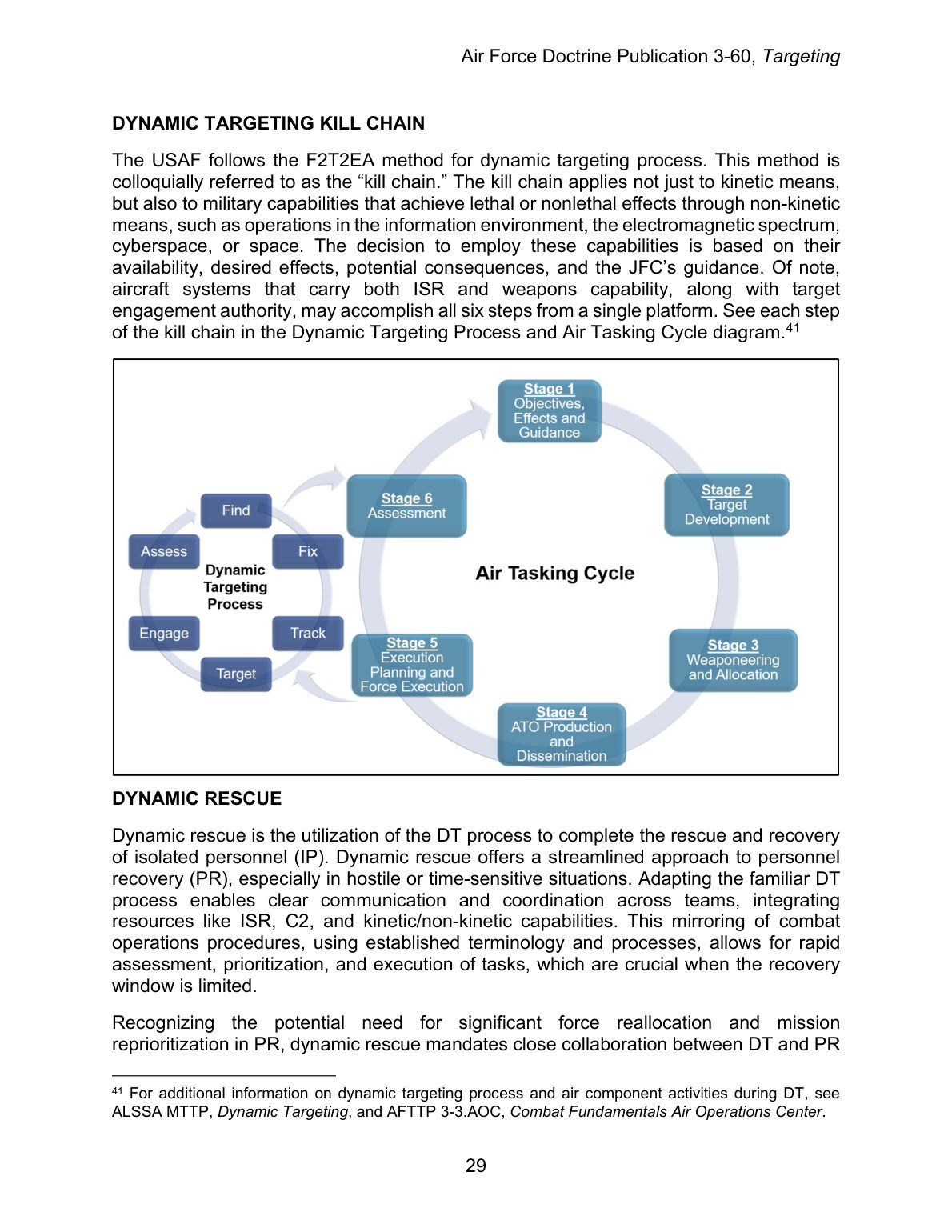
The USAF follows the F2T2EA method for dynamic targeting process. This method is
colloquially referred to as the “kill chain.” The kill chain applies not just to kinetic means,
but also to military capabilities that achieve lethal or nonlethal effects through non-kinetic
means, such as operations in the information environment, the electromagnetic spectrum,
cyberspace, or space. The decision to employ these capabilities is based on their
availability, desired effects, potential consequences, and the JFC’s guidance. Of note,
aircraft systems that carry both ISR and weapons capability, along with target
engagement authority, may accomplish all six steps from a single platform. See each step
of the kill chain in the Dynamic Targeting Process and Air Tasking Cycle diagram.41
DYNAMIC RESCUE
Dynamic rescue is the utilization of the DT process to complete the rescue and recovery
of isolated personnel (IP). Dynamic rescue offers a streamlined approach to personnel
recovery (PR), especially in hostile or time-sensitive situations. Adapting the familiar DT
process enables clear communication and coordination across teams, integrating
resources like ISR, C2, and kinetic/non-kinetic capabilities. This mirroring of combat
operations procedures, using established terminology and processes, allows for rapid
assessment, prioritization, and execution of tasks, which are crucial when the recovery
window is limited.
Recognizing the potential need for significant force reallocation and mission
reprioritization in PR, dynamic rescue mandates close collaboration between DT and PR
41 For additional information on dynamic targeting process and air component activities during DT, see
ALSSA MTTP, Dynamic Targeting, and AFTTP 3-3.AOC, Combat Fundamentals Air Operations Center.