ATP 2-33.4, page 77
Intelligence Analysis
Army Techniques Publication: Intelligence Analysis
2014 public edition (Archive.org)
Searchable page text (OCR / PDF)
Core Army Analytic Techniques
18 August 2014
ATP 2-33.4
5-23
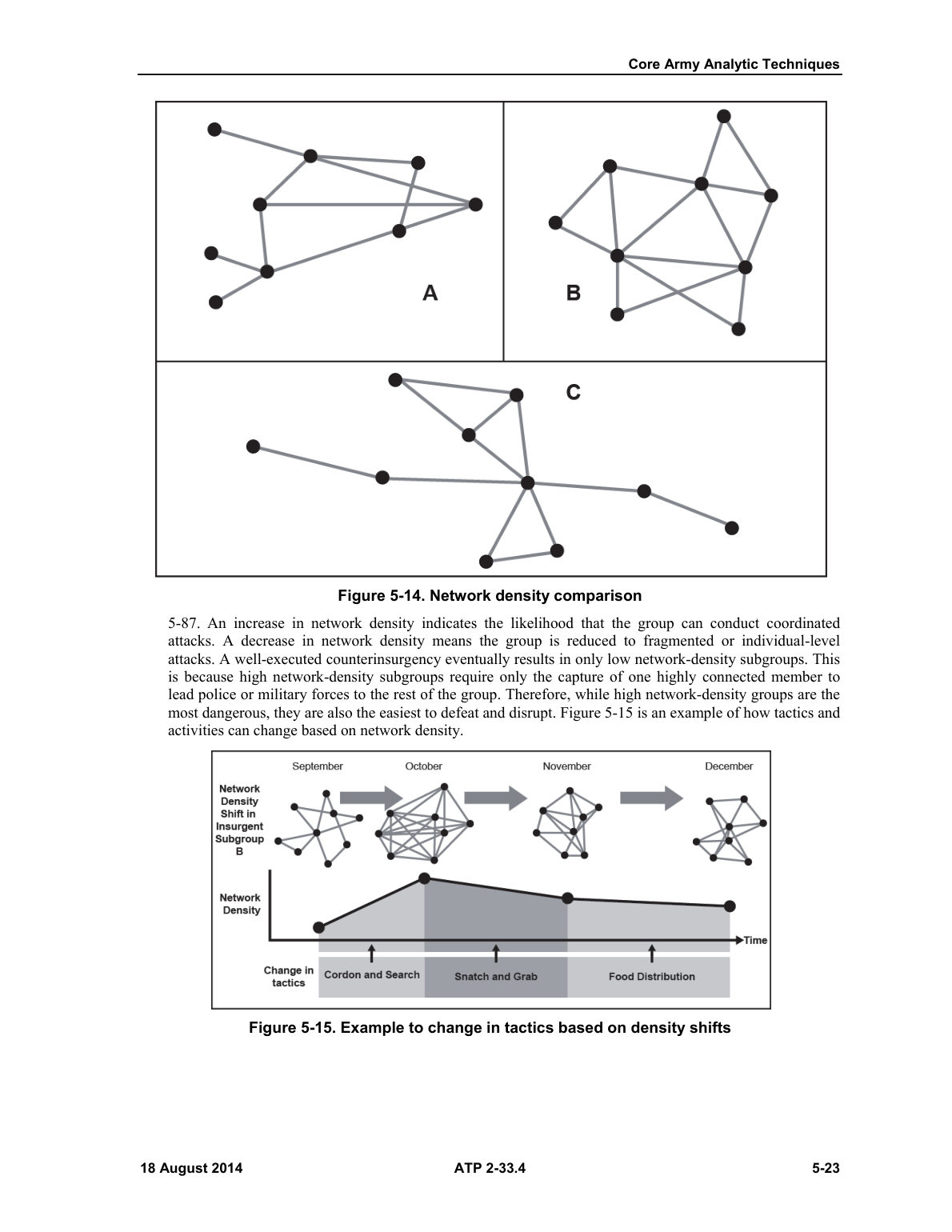
Figure 5-14. Network density comparison
5-87. An increase in network density indicates the likelihood that the group can conduct coordinated
attacks. A decrease in network density means the group is reduced to fragmented or individual-level
attacks. A well-executed counterinsurgency eventually results in only low network-density subgroups. This
is because high network-density subgroups require only the capture of one highly connected member to
lead police or military forces to the rest of the group. Therefore, while high network-density groups are the
most dangerous, they are also the easiest to defeat and disrupt. Figure 5-15 is an example of how tactics and
activities can change based on network density.
Figure 5-15. Example to change in tactics based on density shifts