ATP 2-33.4, page 92
Intelligence Analysis
Army Techniques Publication: Intelligence Analysis
2014 public edition (Archive.org)
Searchable page text (OCR / PDF)
Chapter 6
6-6
ATP 2-33.4
18 August 2014
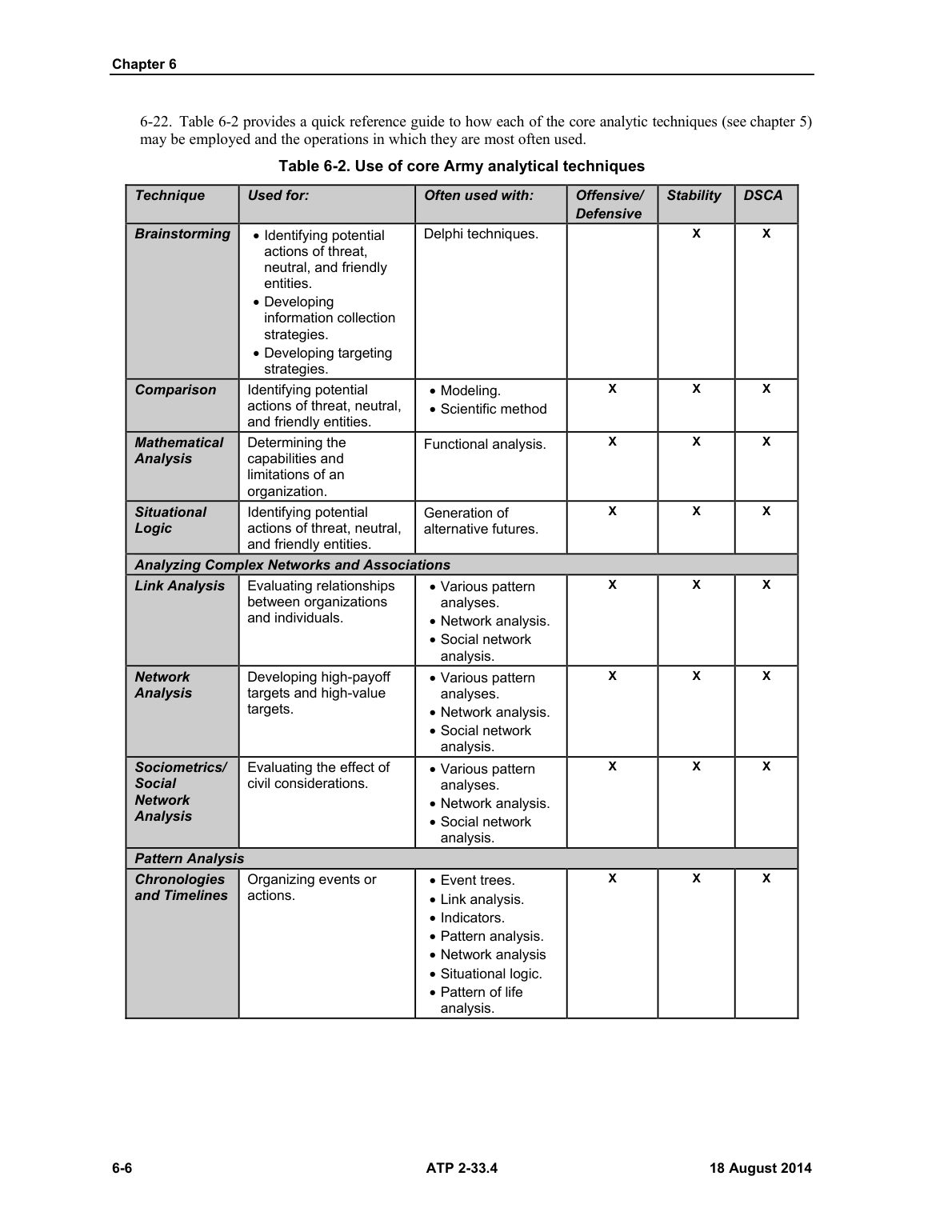
6-22. Table 6-2 provides a quick reference guide to how each of the core analytic techniques (see chapter 5)
may be employed and the operations in which they are most often used.
Table 6-2. Use of core Army analytical techniques
Technique
Used for:
Often used with:
Offensive/
Defensive
Stability
DSCA
Brainstorming
• Identifying potential
actions of threat,
neutral, and friendly
entities.
• Developing
information collection
strategies.
• Developing targeting
strategies.
Delphi techniques.
X
X
Comparison
Identifying potential
actions of threat, neutral,
and friendly entities.
• Modeling.
• Scientific method
X
X
X
Mathematical
Analysis
Determining the
capabilities and
limitations of an
organization.
Functional analysis.
X
X
X
Situational
Logic
Identifying potential
actions of threat, neutral,
and friendly entities.
Generation of
alternative futures.
X
X
X
Analyzing Complex Networks and Associations
Link Analysis
Evaluating relationships
between organizations
and individuals.
• Various pattern
analyses.
• Network analysis.
• Social network
analysis.
X
X
X
Network
Analysis
Developing high-payoff
targets and high-value
targets.
• Various pattern
analyses.
• Network analysis.
• Social network
analysis.
X
X
X
Sociometrics/
Social
Network
Analysis
Evaluating the effect of
civil considerations.
• Various pattern
analyses.
• Network analysis.
• Social network
analysis.
X
X
X
Pattern Analysis
Chronologies
and Timelines
Organizing events or
actions.
• Event trees.
• Link analysis.
• Indicators.
• Pattern analysis.
• Network analysis
• Situational logic.
• Pattern of life
analysis.
X
X
X