JP 3-0, page 26
Joint Operations
Joint Publication: Joint Operations
11 August 2011 public edition
Searchable page text (OCR / PDF)
Chapter I
I-2
JP 3-0
e. Joint Warfare is Team Warfare. The synergy that results from the integration and
synchronization of Service components’ capabilities under a single JFC maximizes the
effectiveness and efficiency of the force. The advantage of a joint team extends beyond the
operational environment and across the range of military operations. A joint operation does
not require that all forces participate in a particular operation merely because they are
available; the JFC has the authority and responsibility to tailor forces for the mission at hand.
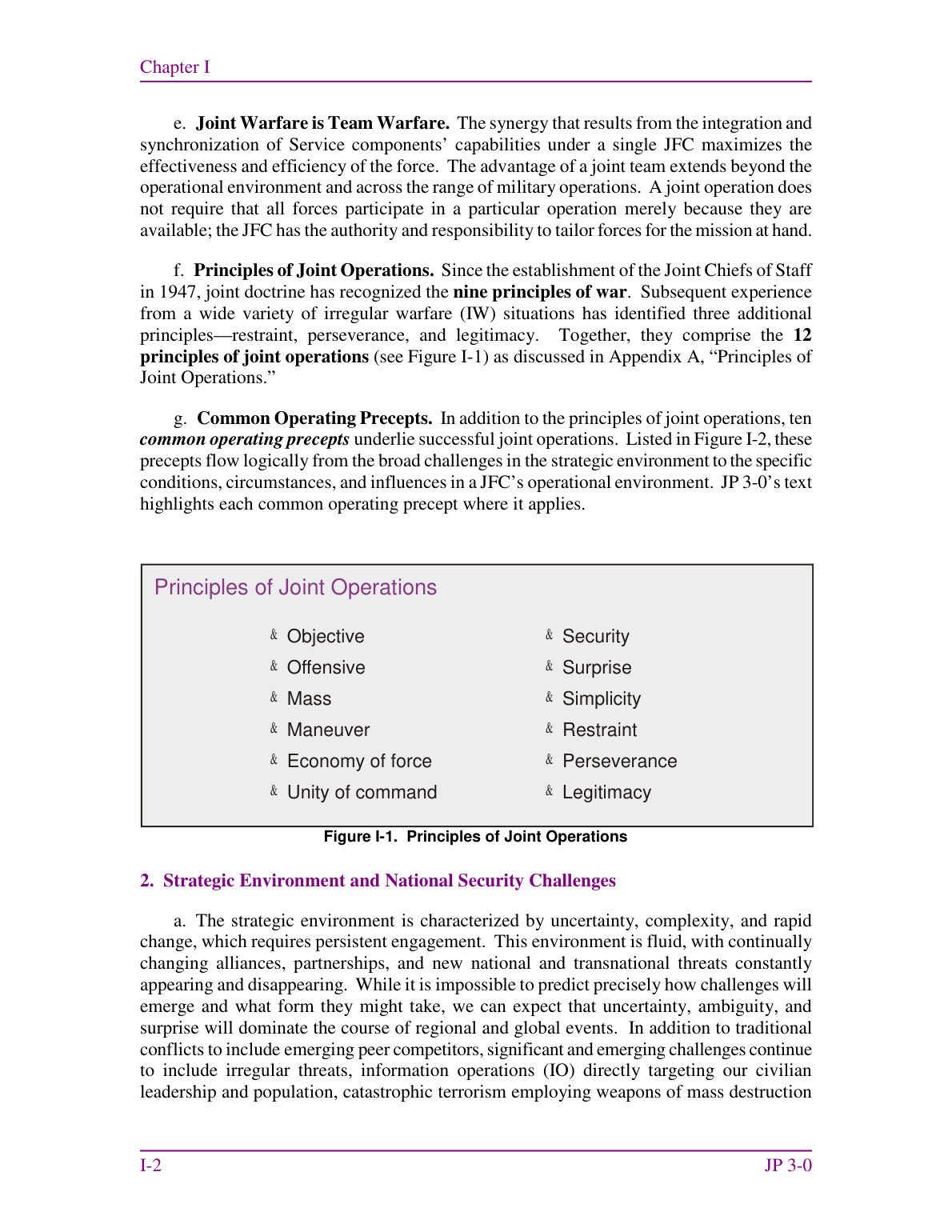
f. Principles of Joint Operations. Since the establishment of the Joint Chiefs of Staff
in 1947, joint doctrine has recognized the nine principles of war. Subsequent experience
from a wide variety of irregular warfare (IW) situations has identified three additional
principles—restraint, perseverance, and legitimacy. Together, they comprise the 12
principles of joint operations (see Figure I-1) as discussed in Appendix A, “Principles of
Joint Operations.”
g. Common Operating Precepts. In addition to the principles of joint operations, ten
common operating precepts underlie successful joint operations. Listed in Figure I-2, these
precepts flow logically from the broad challenges in the strategic environment to the specific
conditions, circumstances, and influences in a JFC’s operational environment. JP 3-0’s text
highlights each common operating precept where it applies.
2. Strategic Environment and National Security Challenges
a. The strategic environment is characterized by uncertainty, complexity, and rapid
change, which requires persistent engagement. This environment is fluid, with continually
changing alliances, partnerships, and new national and transnational threats constantly
appearing and disappearing. While it is impossible to predict precisely how challenges will
emerge and what form they might take, we can expect that uncertainty, ambiguity, and
surprise will dominate the course of regional and global events. In addition to traditional
conflicts to include emerging peer competitors, significant and emerging challenges continue
to include irregular threats, information operations (IO) directly targeting our civilian
leadership and population, catastrophic terrorism employing weapons of mass destruction
Figure I-1. Principles of Joint Operations
Principles of Joint Operations
&
&
&
&
&
&
Objective
Offensive
Mass
Maneuver
Economy of force
Unity of command
&
&
&
&
&
&
Security
Surprise
Simplicity
Restraint
Perseverance
Legitimacy