JP 3-0, page 27
Joint Operations
Joint Publication: Joint Operations
11 August 2011 public edition
Searchable page text (OCR / PDF)
Fundamentals of Joint Operations
I-3
(WMD), and other threats to disrupt the nation’s ability to project power and maintain its
qualitative edge.
b. The strategic environment presents broad national security challenges likely to
require the employment of joint forces in the future. These are not new challenges. They are
the natural products of the enduring human condition, but they will exhibit new features in
the future. None of these challenges is a purely military problem. Rather, all are national
problems calling for the application of all the instruments of national power.
(1) A secure US homeland is the Nation’s first priority.
(2) Deterring our adversaries is a US goal. However, winning the Nation’s wars
remains the preeminent justification for maintaining capable and credible military forces in
the event that deterrence should fail.
(3) Defending national interests requires not only being able to prevail in conflict,
but also taking preventive measures to deter potential adversaries who could threaten the
vital interests of the United States or its partners. These threats could range from direct
aggression to less openly belligerent actions that nonetheless threaten vital national interests.
(4) Establishing, maintaining, and enhancing security cooperation among our
alliances and partners is important to strengthen the global security framework of the United
States and its partners. Security cooperation allows us to proactively take advantage of
opportunities and not just react to threats.
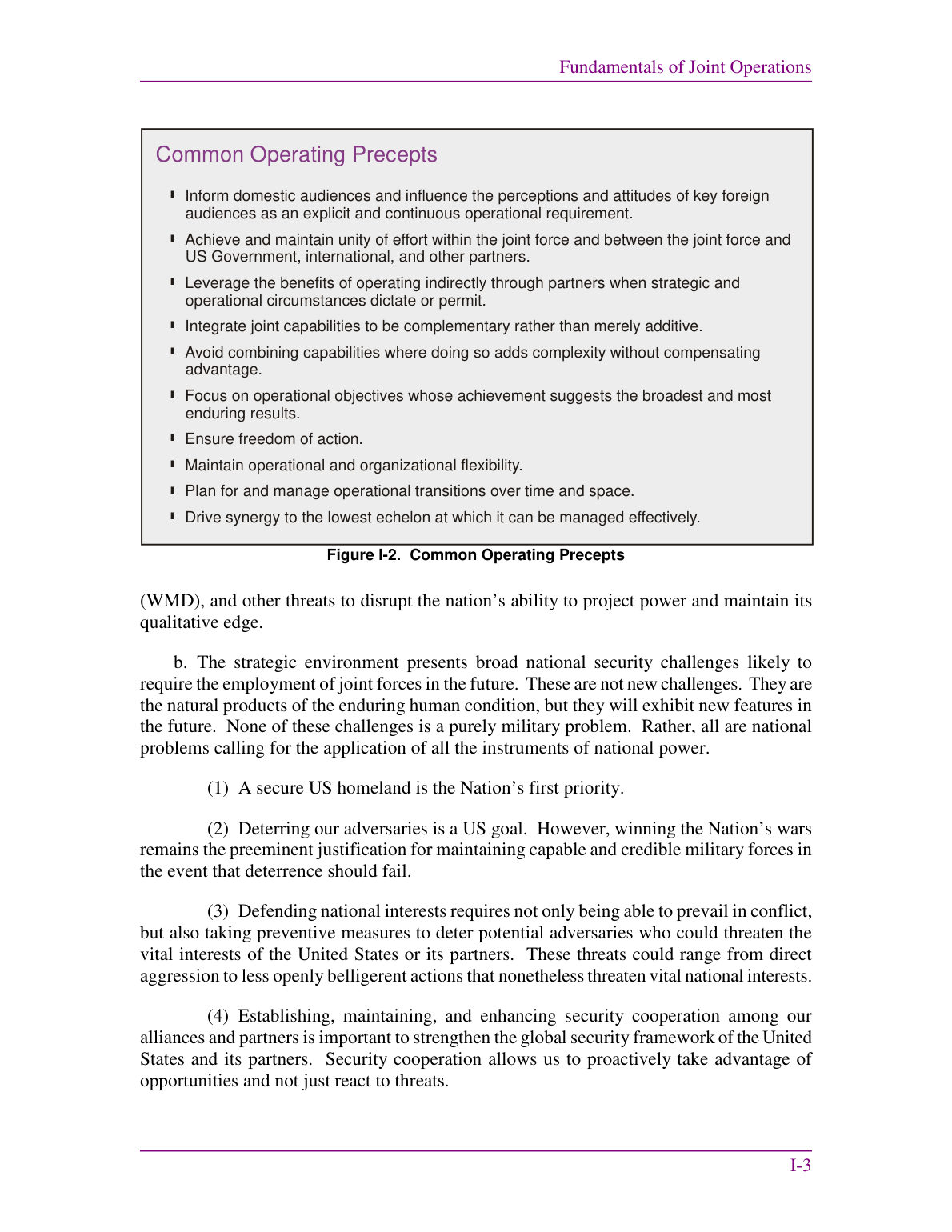
Figure I-2. Common Operating Precepts
Common Operating Precepts
l
l
l
l
l
l
l
l
l
l
Inform domestic audiences and influence the perceptions and attitudes of key foreign
audiences as an explicit and continuous operational requirement.
Achieve and maintain unity of effort within the joint force and between the joint force and
US Government, international, and other partners.
Leverage the benefits of operating indirectly through partners when strategic and
operational circumstances dictate or permit.
Integrate joint capabilities to be complementary rather than merely additive.
Avoid combining capabilities where doing so adds complexity without compensating
advantage.
Focus on operational objectives whose achievement suggests the broadest and most
enduring results.
Ensure freedom of action.
Maintain operational and organizational flexibility.
Plan for and manage operational transitions over time and space.
Drive synergy to the lowest echelon at which it can be managed effectively.