JP 3-0, page 57
Joint Operations
Joint Publication: Joint Operations
11 August 2011 public edition
Searchable page text (OCR / PDF)
Joint Functions
III-5
(SOF), functional component commanders typically exercise TACON over military
capabilities or forces made available for tasking.
(4) Support. Establishing support relationships between components (as described
in JP 1, Doctrine for the Armed Forces of the United States), is a useful option to accomplish
needed tasks. The JFC can establish support relationships among all functional and
Service component commanders, such as for the coordination of operations in depth
involving the joint force land component commander (JFLCC) and the joint force air
component commander (JFACC). Within a joint force, the JFC may designate more than
one supported commander simultaneously, and components may simultaneously receive and
provide support for different missions, functions, or operations. For instance, a joint force
special operations component commander (JFSOCC) may be supported for a direct-action
mission while simultaneously supporting a JFLCC for a raid. Similarly, a joint force
maritime component commander (JFMCC) may be supported for a sea control mission while
simultaneously supporting a JFACC to achieve air superiority over the operational area.
(5) Other authorities granted to commanders, and to subordinates as required,
include administrative control, coordinating authority, and direct liaison authorized. JP 1,
Doctrine for the Armed Forces of the United States, outlines the specific details for each
command relationship.
(6) The perceived benefits of “jointness” do not occur naturally just by virtue of C2
relationships. The integration necessary for effective joint operations requires explicit effort,
can increase operational complexity, and will require additional training, technical and
technological interoperability, liaison, and planning. Although effectiveness typically is
more important than efficiency in joint operations, the JFC and component commanders
must determine when the potential benefits of joint integration cannot compensate for the
additional complicating factors. Synergy is a means to greater operational effectiveness, not
an end in itself. The joint operations principle simplicity is always a key consideration.
d. Control is inherent in command. To control is to manage and direct forces and
functions consistent with a commander’s command authority. Control of forces and
functions helps commanders and staffs compute requirements, allocate means, and integrate
efforts. Control is necessary to determine the status of organizational effectiveness, identify
variance from set standards, and correct deviations from these standards. Control permits
commanders to acquire and apply means to support the mission and develop specific
instructions from general guidance. Control provides the means for commanders to maintain
freedom of action, delegate authority, direct operations from any location, and integrate and
synchronize actions throughout the operational area. Ultimately, it provides commanders a
means to measure, report, and correct performance.
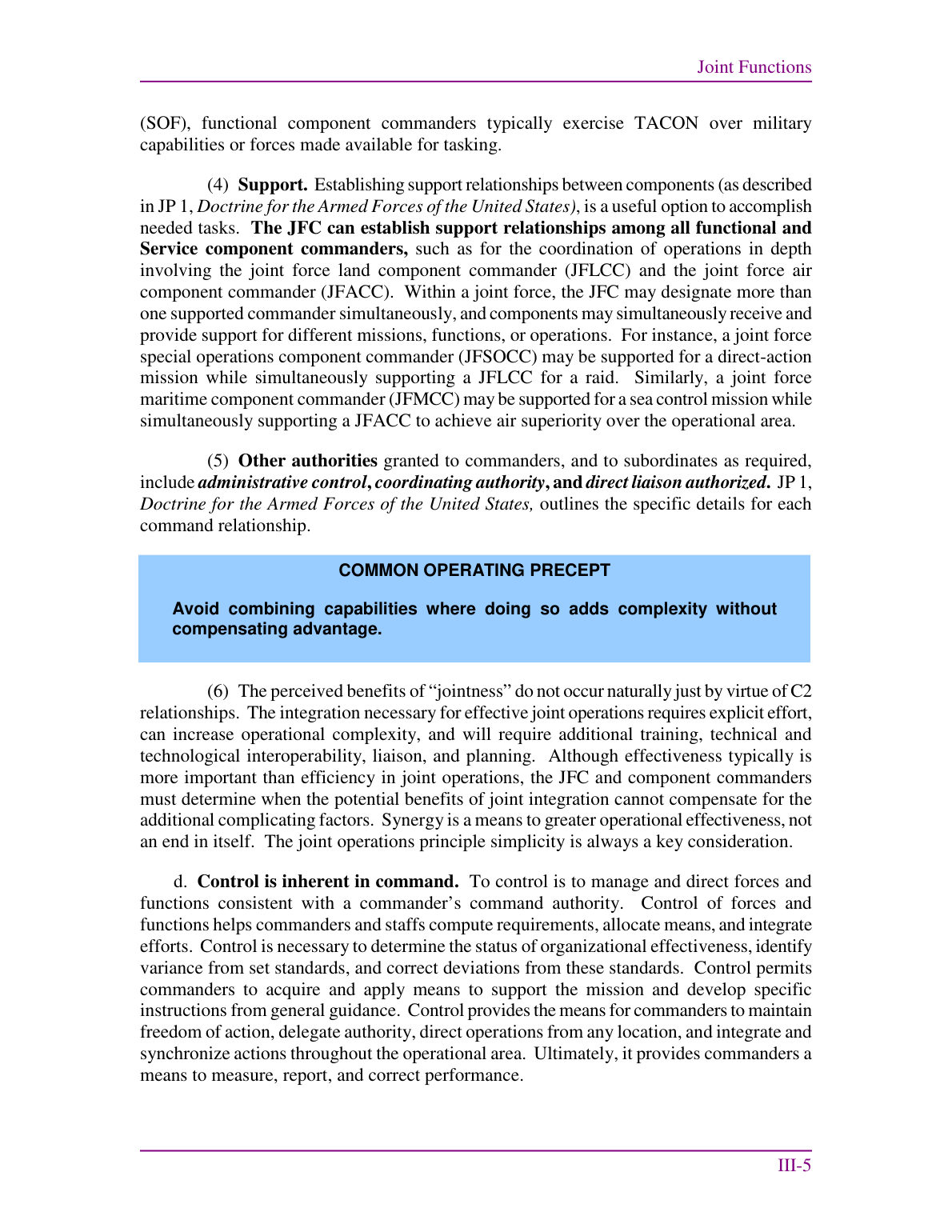
COMMON OPERATING PRECEPT
Avoid combining capabilities where doing so adds complexity without
compensating advantage.