JP 3-0, page 58
Joint Operations
Joint Publication: Joint Operations
11 August 2011 public edition
Searchable page text (OCR / PDF)
Chapter III
III-6
JP 3-0
e. Area of Operations and Functional Considerations
(1) Command and Control in an Area of Operations. The land and maritime
force commanders are the supported commanders within their designated areas of
operations (AOs). Through C2, JFLCCs and JFMCCs integrate and synchronize movement
and maneuver with intelligence, fires, protection, and sustainment and the supporting IO
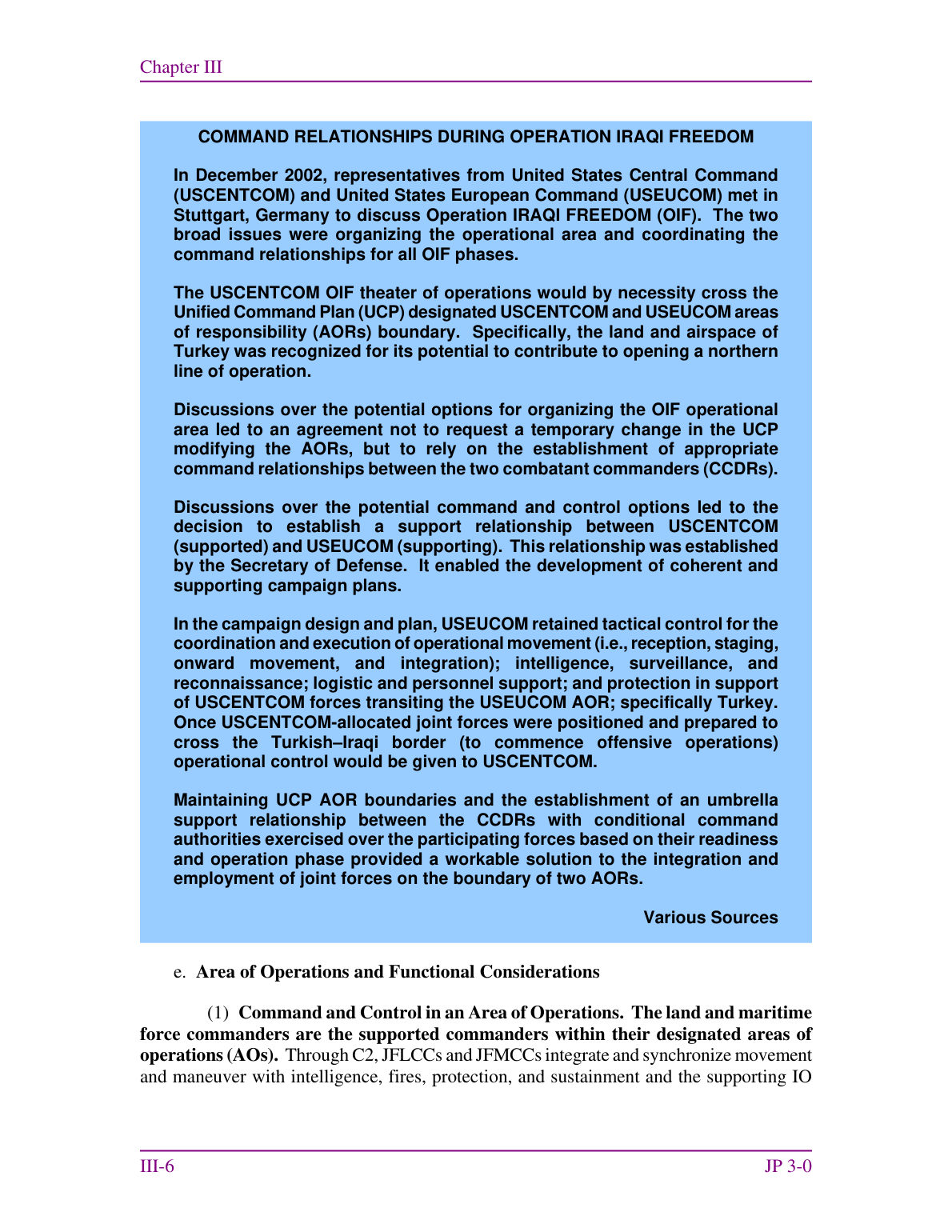
COMMAND RELATIONSHIPS DURING OPERATION IRAQI FREEDOM
In December 2002, representatives from United States Central Command
(USCENTCOM) and United States European Command (USEUCOM) met in
Stuttgart, Germany to discuss Operation IRAQI FREEDOM (OIF). The two
broad issues were organizing the operational area and coordinating the
command relationships for all OIF phases.
The USCENTCOM OIF theater of operations would by necessity cross the
Unified Command Plan (UCP) designated USCENTCOM and USEUCOM areas
of responsibility (AORs) boundary. Specifically, the land and airspace of
Turkey was recognized for its potential to contribute to opening a northern
line of operation.
Discussions over the potential options for organizing the OIF operational
area led to an agreement not to request a temporary change in the UCP
modifying the AORs, but to rely on the establishment of appropriate
command relationships between the two combatant commanders (CCDRs).
Discussions over the potential command and control options led to the
decision to establish a support relationship between USCENTCOM
(supported) and USEUCOM (supporting). This relationship was established
by the Secretary of Defense. It enabled the development of coherent and
supporting campaign plans.
In the campaign design and plan, USEUCOM retained tactical control for the
coordination and execution of operational movement (i.e., reception, staging,
onward movement, and integration); intelligence, surveillance, and
reconnaissance; logistic and personnel support; and protection in support
of USCENTCOM forces transiting the USEUCOM AOR; specifically Turkey.
Once USCENTCOM-allocated joint forces were positioned and prepared to
cross the Turkish–Iraqi border (to commence offensive operations)
operational control would be given to USCENTCOM.
Maintaining UCP AOR boundaries and the establishment of an umbrella
support relationship between the CCDRs with conditional command
authorities exercised over the participating forces based on their readiness
and operation phase provided a workable solution to the integration and
employment of joint forces on the boundary of two AORs.
Various Sources