JP 3-28, page 23
Defense Support of Civil Authorities
Joint Publication: Defense Support of Civil Authorities
29 October 2018 public edition (Wayback JCS copy; S2 cited as JP 328 / JP 3-28 DSCA)
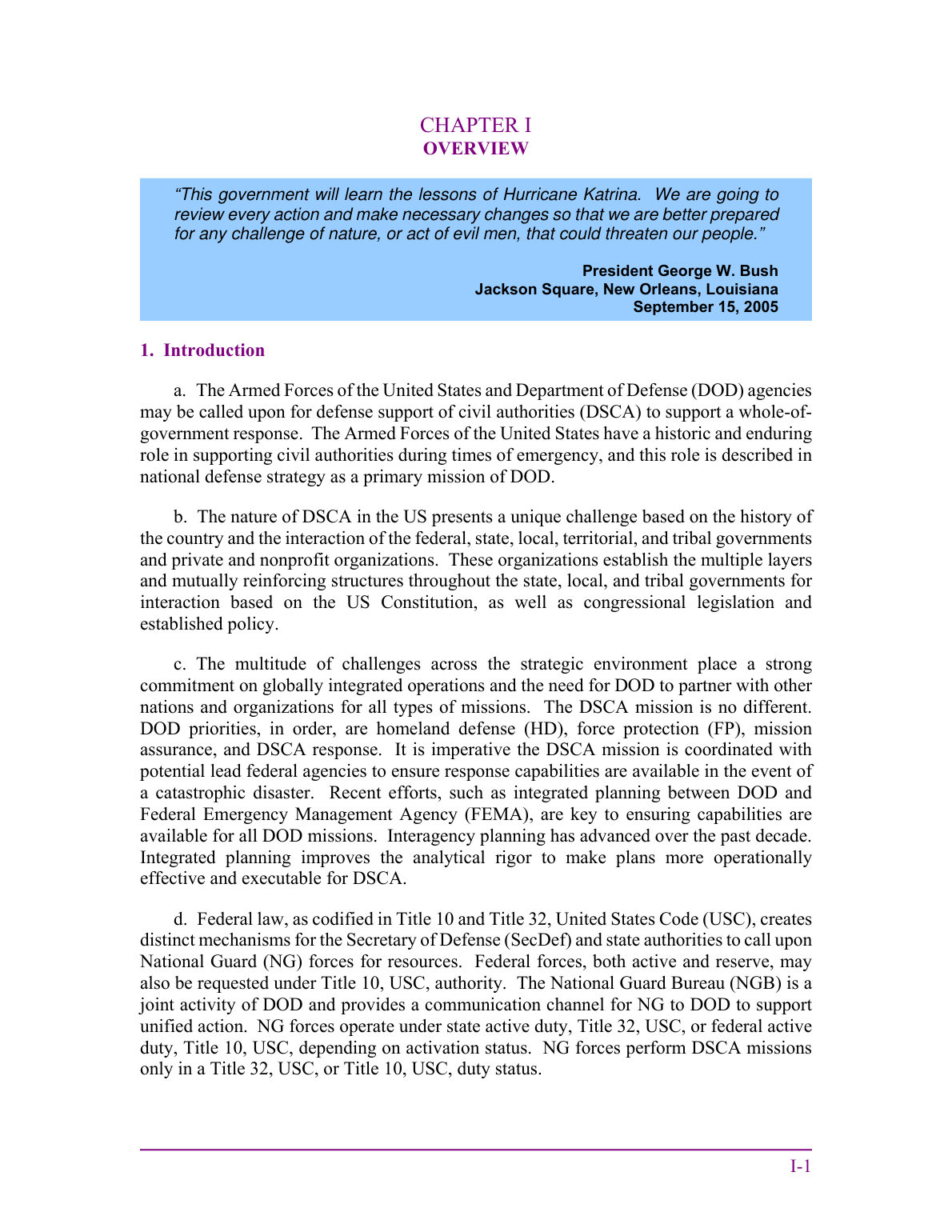
Searchable page text (OCR / PDF)
I-1
CHAPTER I
OVERVIEW
1. Introduction
a. The Armed Forces of the United States and Department of Defense (DOD) agencies
may be called upon for defense support of civil authorities (DSCA) to support a whole-of-
government response. The Armed Forces of the United States have a historic and enduring
role in supporting civil authorities during times of emergency, and this role is described in
national defense strategy as a primary mission of DOD.
b. The nature of DSCA in the US presents a unique challenge based on the history of
the country and the interaction of the federal, state, local, territorial, and tribal governments
and private and nonprofit organizations. These organizations establish the multiple layers
and mutually reinforcing structures throughout the state, local, and tribal governments for
interaction based on the US Constitution, as well as congressional legislation and
established policy.
c. The multitude of challenges across the strategic environment place a strong
commitment on globally integrated operations and the need for DOD to partner with other
nations and organizations for all types of missions. The DSCA mission is no different.
DOD priorities, in order, are homeland defense (HD), force protection (FP), mission
assurance, and DSCA response. It is imperative the DSCA mission is coordinated with
potential lead federal agencies to ensure response capabilities are available in the event of
a catastrophic disaster. Recent efforts, such as integrated planning between DOD and
Federal Emergency Management Agency (FEMA), are key to ensuring capabilities are
available for all DOD missions. Interagency planning has advanced over the past decade.
Integrated planning improves the analytical rigor to make plans more operationally
effective and executable for DSCA.
d. Federal law, as codified in Title 10 and Title 32, United States Code (USC), creates
distinct mechanisms for the Secretary of Defense (SecDef) and state authorities to call upon
National Guard (NG) forces for resources. Federal forces, both active and reserve, may
also be requested under Title 10, USC, authority. The National Guard Bureau (NGB) is a
joint activity of DOD and provides a communication channel for NG to DOD to support
unified action. NG forces operate under state active duty, Title 32, USC, or federal active
duty, Title 10, USC, depending on activation status. NG forces perform DSCA missions
only in a Title 32, USC, or Title 10, USC, duty status.
“This government will learn the lessons of Hurricane Katrina. We are going to
review every action and make necessary changes so that we are better prepared
for any challenge of nature, or act of evil men, that could threaten our people.”
President George W. Bush
Jackson Square, New Orleans, Louisiana
September 15, 2005