JP 3-28, page 45
Defense Support of Civil Authorities
Joint Publication: Defense Support of Civil Authorities
29 October 2018 public edition (Wayback JCS copy; S2 cited as JP 328 / JP 3-28 DSCA)
Searchable page text (OCR / PDF)
Supporting a Comprehensive All Hazards Response
II-11
For further reference, see JP 3-08, Interorganizational Cooperation, and the NRF.
7. Unity of Effort
The diplomatic, informational, military, and economic power of the US are applied in
unified action to attain desired end states.
a. Responsibilities. Incidents are managed at the lowest level possible. Federal
support is provided in response to requests from state or local officials through the state
coordinating officer to the federal coordinating officer. The federal coordinating officer
coordinates for DOD support through the defense coordinating officer (DCO) in the JFO.
DOD may provide support to the LFA, which has the lead in managing the federal response
to a domestic incident. DHS is responsible for domestic incident management and the
framework for federal interaction with state, local, territorial, and tribal governments; the
private sector; and NGOs in the context of incident preparedness, response, and recovery
activities. DOD support to this response will be initiated through a formal RFA or mission
assignment process or provided as directed by the President or SecDef. The integrity and
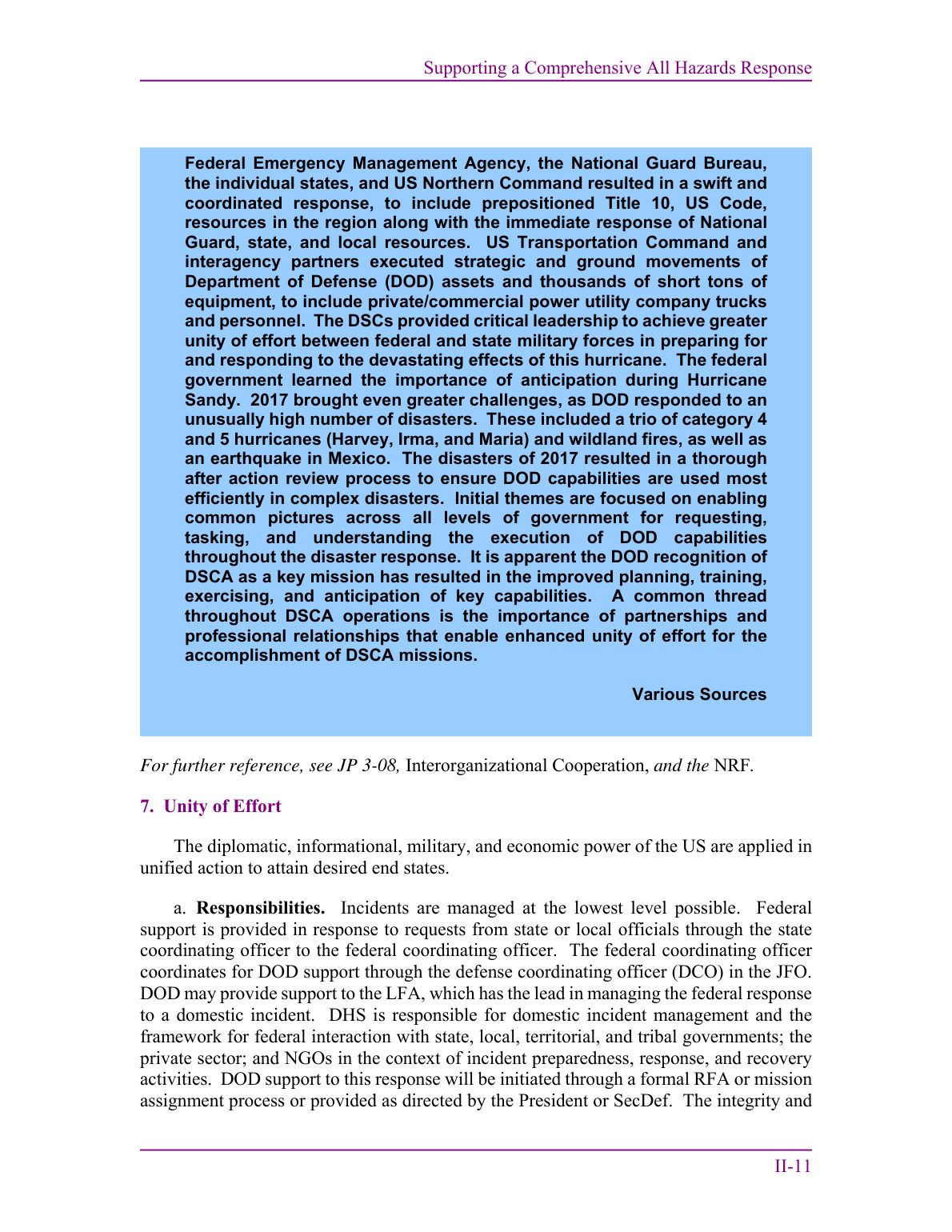
Federal Emergency Management Agency, the National Guard Bureau,
the individual states, and US Northern Command resulted in a swift and
coordinated response, to include prepositioned Title 10, US Code,
resources in the region along with the immediate response of National
Guard, state, and local resources. US Transportation Command and
interagency partners executed strategic and ground movements of
Department of Defense (DOD) assets and thousands of short tons of
equipment, to include private/commercial power utility company trucks
and personnel. The DSCs provided critical leadership to achieve greater
unity of effort between federal and state military forces in preparing for
and responding to the devastating effects of this hurricane. The federal
government learned the importance of anticipation during Hurricane
Sandy. 2017 brought even greater challenges, as DOD responded to an
unusually high number of disasters. These included a trio of category 4
and 5 hurricanes (Harvey, Irma, and Maria) and wildland fires, as well as
an earthquake in Mexico. The disasters of 2017 resulted in a thorough
after action review process to ensure DOD capabilities are used most
efficiently in complex disasters. Initial themes are focused on enabling
common pictures across all levels of government for requesting,
tasking, and understanding the execution of DOD capabilities
throughout the disaster response. It is apparent the DOD recognition of
DSCA as a key mission has resulted in the improved planning, training,
exercising, and anticipation of key capabilities. A common thread
throughout DSCA operations is the importance of partnerships and
professional relationships that enable enhanced unity of effort for the
accomplishment of DSCA missions.
Various Sources