JP 3-60, page 24
Joint Targeting
Joint Publication: Joint Targeting
31 January 2013 public edition
Searchable page text (OCR / PDF)
Chapter I
I-6
JP 3-60
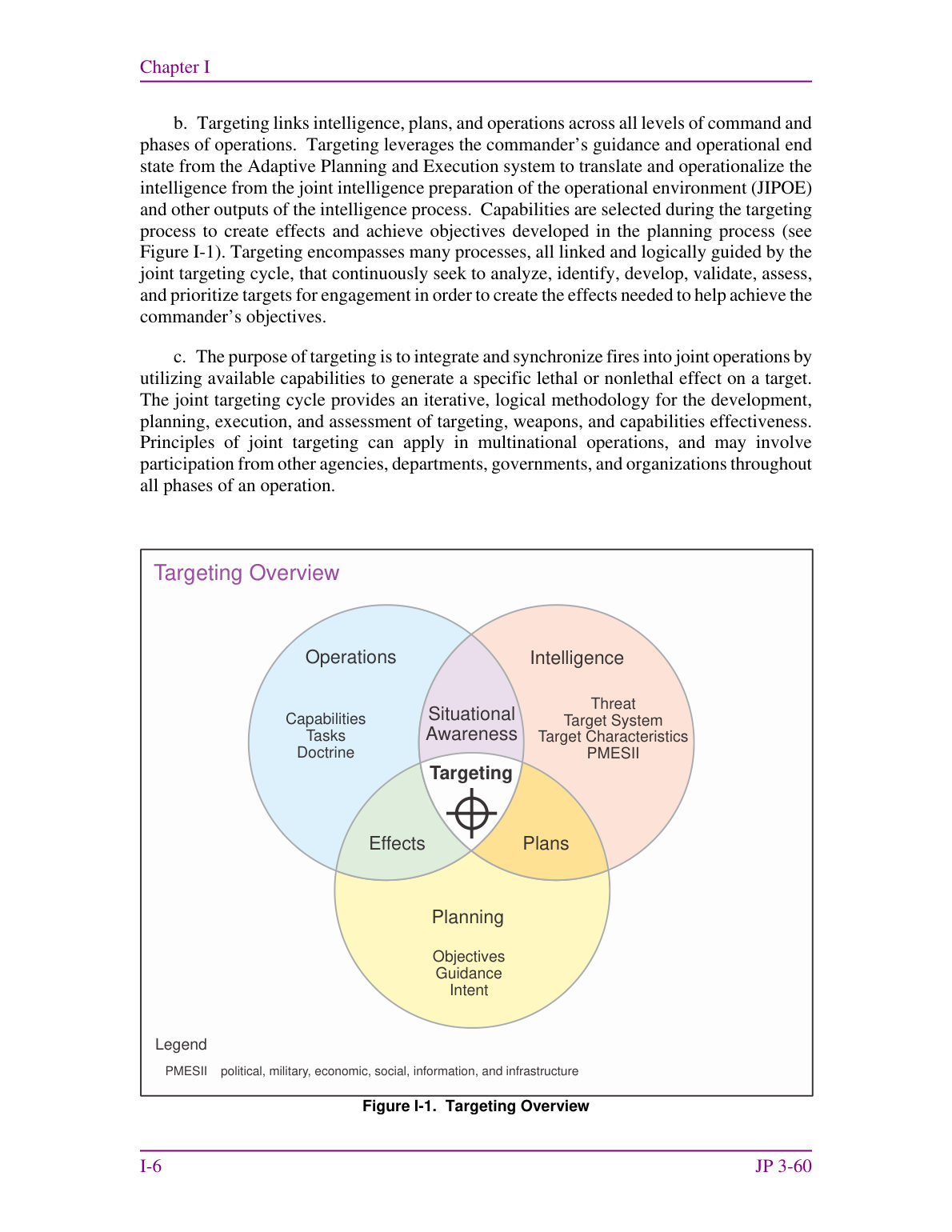
b. Targeting links intelligence, plans, and operations across all levels of command and
phases of operations. Targeting leverages the commander’s guidance and operational end
state from the Adaptive Planning and Execution system to translate and operationalize the
intelligence from the joint intelligence preparation of the operational environment (JIPOE)
and other outputs of the intelligence process. Capabilities are selected during the targeting
process to create effects and achieve objectives developed in the planning process (see
Figure I-1). Targeting encompasses many processes, all linked and logically guided by the
joint targeting cycle, that continuously seek to analyze, identify, develop, validate, assess,
and prioritize targets for engagement in order to create the effects needed to help achieve the
commander’s objectives.
c. The purpose of targeting is to integrate and synchronize fires into joint operations by
utilizing available capabilities to generate a specific lethal or nonlethal effect on a target.
The joint targeting cycle provides an iterative, logical methodology for the development,
planning, execution, and assessment of targeting, weapons, and capabilities effectiveness.
Principles of joint targeting can apply in multinational operations, and may involve
participation from other agencies, departments, governments, and organizations throughout
all phases of an operation.
Figure I-1. Targeting Overview
Targeting Overview
PMESII
political, military, economic, social, information, and infrastructure
Legend
Targeting
Operations
Situational
Awareness
Plans
Effects
Capabilities
Tasks
Doctrine
Threat
Target System
Target Characteristics
PMESII
Objectives
Guidance
Intent
Planning
Intelligence