JP 3-60, page 39
Joint Targeting
Joint Publication: Joint Targeting
31 January 2013 public edition
Searchable page text (OCR / PDF)
The Joint Targeting Cycle
II-9
(b) Target system components are a related group of entities within a target
system that performs or contributes toward a similar function. The emphasis in component
identification shifts from the system to the specific activities, such as industries and basic
utilities involved in producing parts of an end product. The same general analytic process
applies for nonindustrial target systems. For example, the components of a ballistic missile
target system might include missile transporter erector launchers, resupply vehicles, C2 links
and nodes, meteorological radars, missile fuel storage sites and/or shelters, deployment
areas, and the supporting road transportation network; while an insurgency’s components
may include its core leadership, its military and political arms, its international political and
financial network, and the active or passive support of the population. The purpose of a TSA
is to identify targeting strategies that enable a JFC to use targeting to accomplish objectives
and to identify high value and high payoff targets that underpin those strategies. Targeteers
should consider a target’s criticality and vulnerability when evaluating its value or payoff,
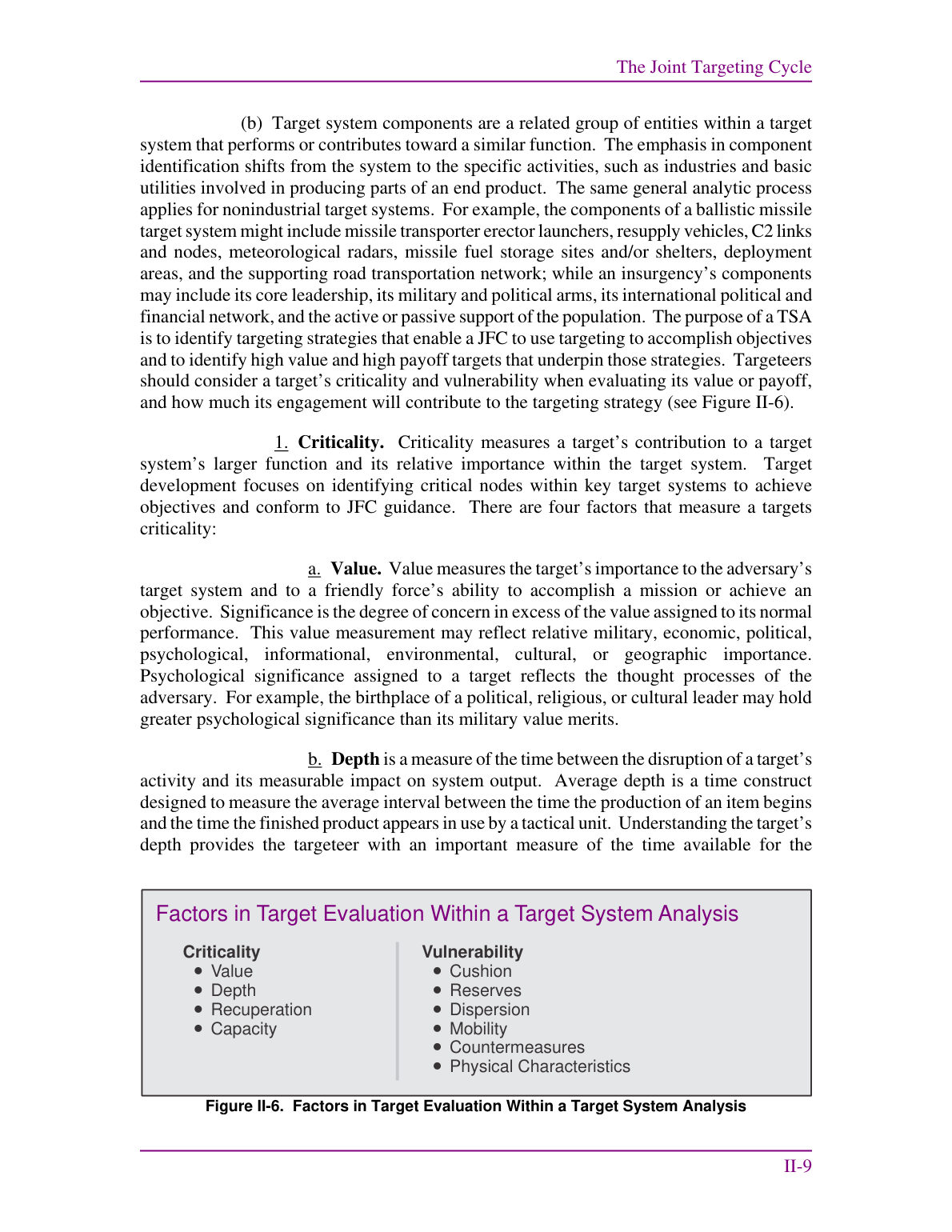
and how much its engagement will contribute to the targeting strategy (see Figure II-6).
1. Criticality. Criticality measures a target’s contribution to a target
system’s larger function and its relative importance within the target system. Target
development focuses on identifying critical nodes within key target systems to achieve
objectives and conform to JFC guidance. There are four factors that measure a targets
criticality:
a. Value. Value measures the target’s importance to the adversary’s
target system and to a friendly force’s ability to accomplish a mission or achieve an
objective. Significance is the degree of concern in excess of the value assigned to its normal
performance. This value measurement may reflect relative military, economic, political,
psychological, informational, environmental, cultural, or geographic importance.
Psychological significance assigned to a target reflects the thought processes of the
adversary. For example, the birthplace of a political, religious, or cultural leader may hold
greater psychological significance than its military value merits.
b. Depth is a measure of the time between the disruption of a target’s
activity and its measurable impact on system output. Average depth is a time construct
designed to measure the average interval between the time the production of an item begins
and the time the finished product appears in use by a tactical unit. Understanding the target’s
depth provides the targeteer with an important measure of the time available for the
Figure II-6. Factors in Target Evaluation Within a Target System Analysis
Factors in Target Evaluation Within a Target System Analysis
Criticality
Value
Depth
Recuperation
Capacity
Vulnerability
Cushion
Reserves
Dispersion
Mobility
Countermeasures
Physical Characteristics