JP 3-60, page 47
Joint Targeting
Joint Publication: Joint Targeting
31 January 2013 public edition
Searchable page text (OCR / PDF)
The Joint Targeting Cycle
II-17
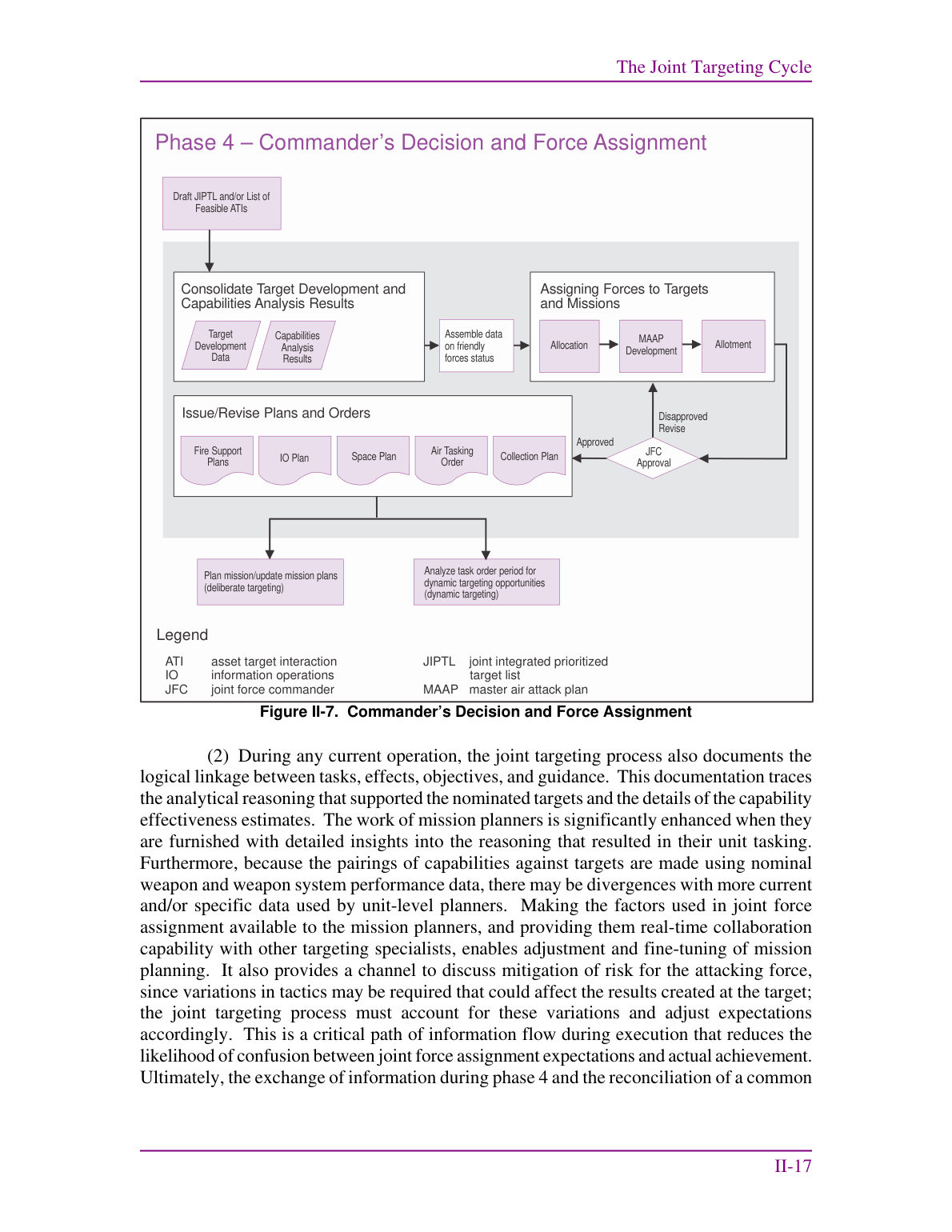
(2) During any current operation, the joint targeting process also documents the
logical linkage between tasks, effects, objectives, and guidance. This documentation traces
the analytical reasoning that supported the nominated targets and the details of the capability
effectiveness estimates. The work of mission planners is significantly enhanced when they
are furnished with detailed insights into the reasoning that resulted in their unit tasking.
Furthermore, because the pairings of capabilities against targets are made using nominal
weapon and weapon system performance data, there may be divergences with more current
and/or specific data used by unit-level planners. Making the factors used in joint force
assignment available to the mission planners, and providing them real-time collaboration
capability with other targeting specialists, enables adjustment and fine-tuning of mission
planning. It also provides a channel to discuss mitigation of risk for the attacking force,
since variations in tactics may be required that could affect the results created at the target;
the joint targeting process must account for these variations and adjust expectations
accordingly. This is a critical path of information flow during execution that reduces the
likelihood of confusion between joint force assignment expectations and actual achievement.
Ultimately, the exchange of information during phase 4 and the reconciliation of a common
Figure II-7. Commander’s Decision and Force Assignment
Phase 4 – Commander’s Decision and Force Assignment
Legend
Draft JIPTL and/or List of
Feasible ATIs
Plan mission/update mission plans
(deliberate targeting)
Analyze task order period for
dynamic targeting opportunities
(dynamic targeting)
Consolidate Target Development and
Capabilities Analysis Results
Target
Development
Data
Capabilities
Analysis
Results
Assemble data
on friendly
forces status
Assigning Forces to Targets
and Missions
Allocation
MAAP
Development
Allotment
Disapproved
Revise
JFC
Approval
Approved
Issue/Revise Plans and Orders
Air Tasking
Order
IO Plan
Space Plan
Fire Support
Plans
Collection Plan
ATI
asset target interaction
IO
information operations
JFC
joint force commander
JIPTL
joint integrated prioritized
target list
MAAP
master air attack plan