JP 3-60, page 53
Joint Targeting
Joint Publication: Joint Targeting
31 January 2013 public edition
Searchable page text (OCR / PDF)
The Joint Targeting Cycle
II-23
4. The term “emerging target” is used to describe a detection that meets
sufficient criteria to be evaluated as a potential target. The criticality and time-sensitivity of
an emerging target, and its probability of being a potential target, is initially undetermined.
Emerging targets normally require further ISR and/or analysis to develop, confirm, and
continue the targeting process. During the find step (see Figure II-12), an emerging target
will be:
a. Validated, confirming planned actions; continue the mission,
retarget, divert, re-role, or cancel.
b. Designated a potential target or TST; continuing dynamic targeting.
c. Designated a potential target not requiring dynamic targeting and
passed to deliberate targeting.
d. Continued to be examined or analyzed by sensors as a potential
target (that is, continuing the find step).
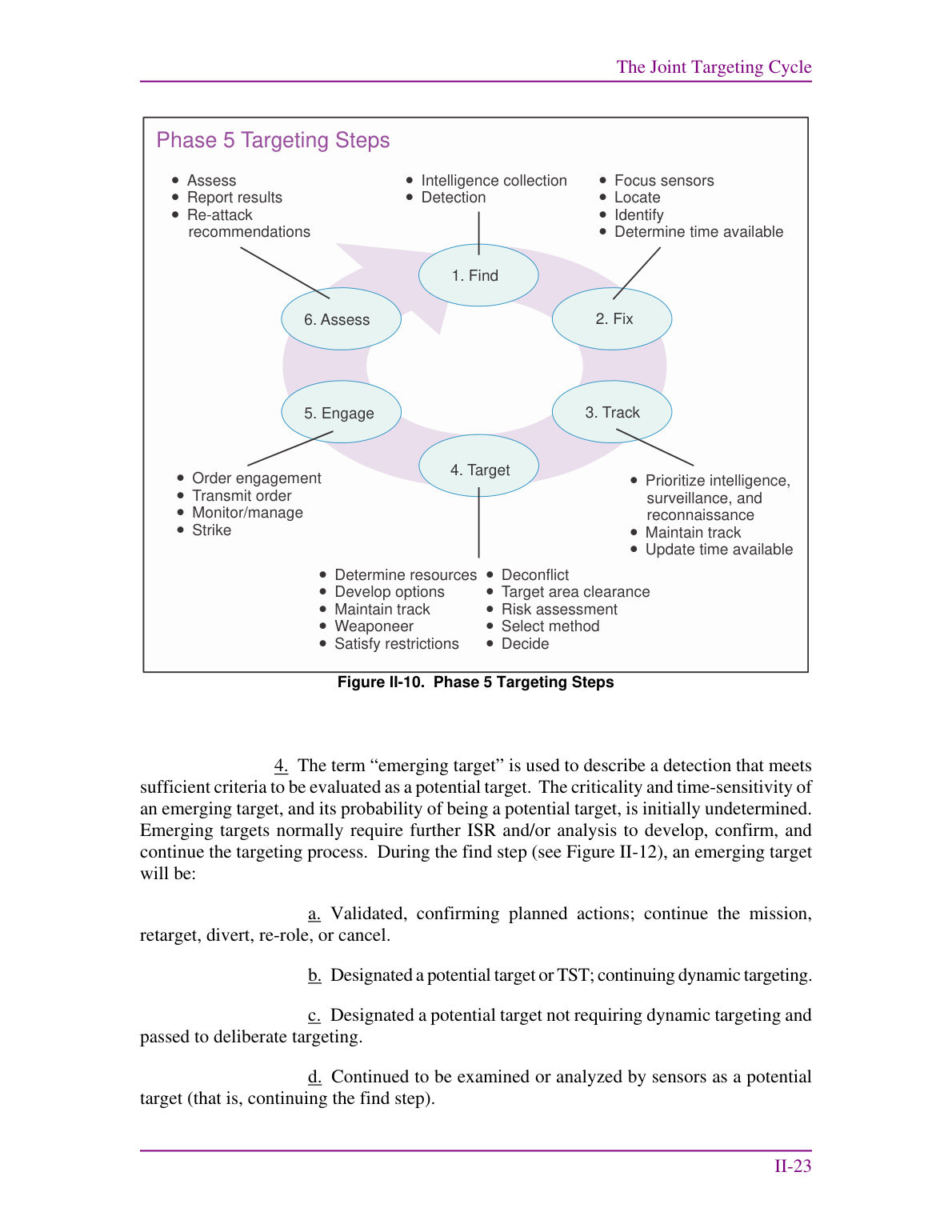
Figure II-10. Phase 5 Targeting Steps
Phase 5 Targeting Steps
1. Find
2. Fix
3. Track
4. Target
5. Engage
6. Assess
Assess
Report results
Re-attack
recommendations
Order engagement
Transmit order
Monitor/manage
Strike
Prioritize intelligence,
surveillance, and
reconnaissance
Maintain track
Update time available
Intelligence collection
Detection
Determine resources
Develop options
Maintain track
Weaponeer
Satisfy restrictions
Deconflict
Target area clearance
Risk assessment
Select method
Decide
Focus sensors
Locate
Identify
Determine time available