MCRP 12-10B.1, page 268
Military Operations on Urbanized Terrain (MOUT)
Marine Corps Reference Publication: Military Operations on Urbanized Terrain (MOUT)
Public distribution statement A; S2 KOCOA cited as MCRP 12-10 b.1
Searchable page text (OCR / PDF)
12. Mortars. The urban environment greatly restricts low-angle indirect fires because of overhead
masking. While all indirect-fire weapons are subject to overhead masking, mortars are less
affected than field artillery weapons because of the mortar’s higher trajectory. For low-angle
artillery fire, dead space is about five times the height of the building behind which the target sits.
For mortar fire, dead space is only about one-half the height of the building. Because of these
advantages, mortars are even more important than field artillery to the infantry during combat in
built-up areas.
a. Employment. Not only can mortars fire into the deep defilade created by tall buildings,
but they can also fire out of it. Mortars emplaced behind buildings are difficult for the enemy
to accurately locate and even harder to hit with counterfire. Because of their light weight,
even heavy mortars can be hand-carried to firing positions that may not be accessible to
vehicles.
(1) The 60-mm and 81-mm mortars have limited effects on structural targets. Even with
delay fuzes, they seldom penetrate more than the upper stories of light buildings.
However, their wide area coverage and multioption fuzes make them useful against an
enemy force advancing through streets, through other open areas, or over rubble.
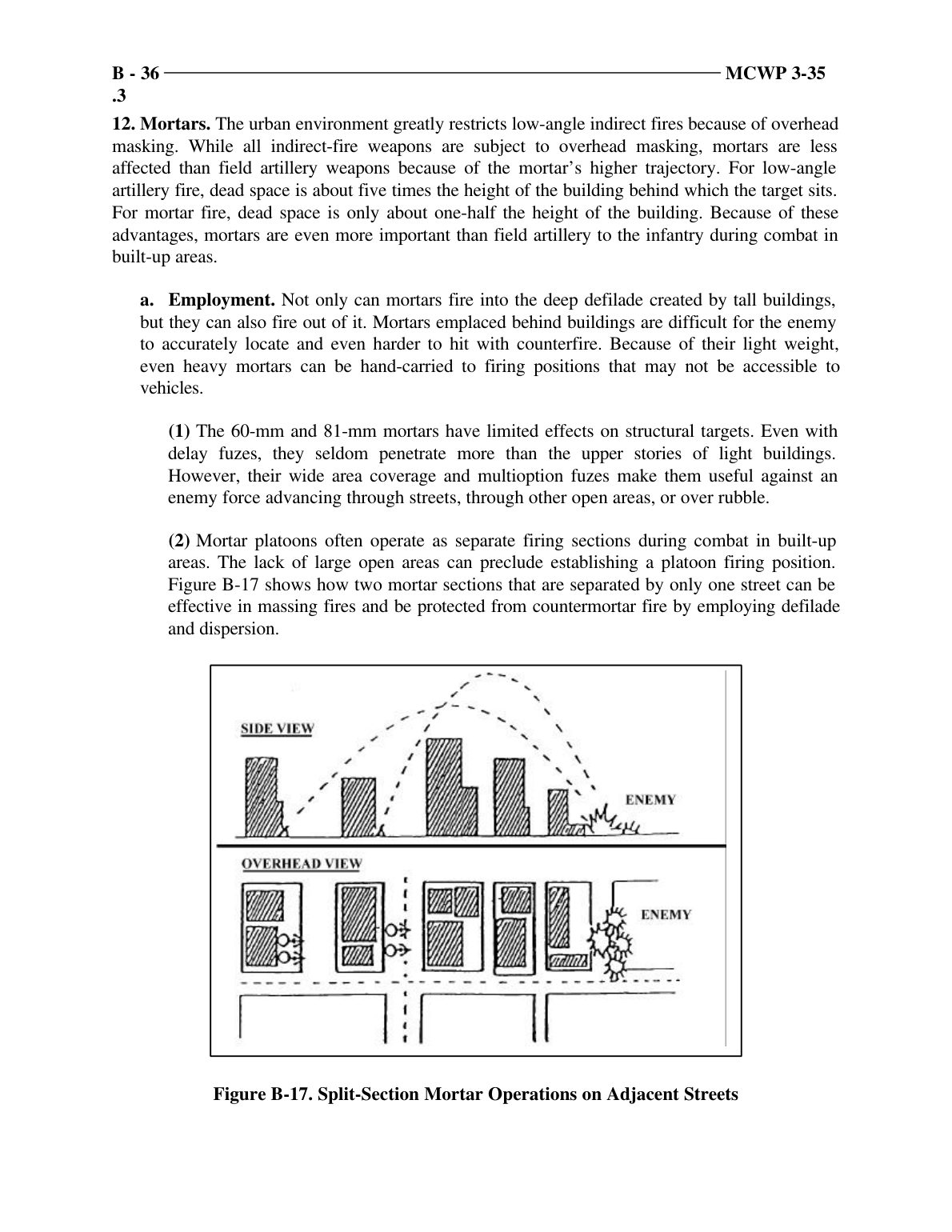
(2) Mortar platoons often operate as separate firing sections during combat in built-up
areas. The lack of large open areas can preclude establishing a platoon firing position.
Figure B-17 shows how two mortar sections that are separated by only one street can be
effective in massing fires and be protected from countermortar fire by employing defilade
and dispersion.
Figure B-17. Split-Section Mortar Operations on Adjacent Streets
B - 36
MCWP 3-35
.3