MCRP 12-10B.1, page 267
Military Operations on Urbanized Terrain (MOUT)
Marine Corps Reference Publication: Military Operations on Urbanized Terrain (MOUT)
Public distribution statement A; S2 KOCOA cited as MCRP 12-10 b.1
Searchable page text (OCR / PDF)
Organization for
Combat
Movement/Positioning
Delivery of Fire
Security
Command and Control
Centralized control
is required during
initial phases;
decentralized
control is required
during later phases
to support
semi-independent
actions of small
units.
Movement should occur
during night or periods of
reduced visibility when
possible.
There are few displacements,
often by platoon or section.
Positions should be selected
that minimize masking,
provide several routes of
escape, and afford as much
cover and concealment as
possible. Use of existing
structures (garages, office
buildings, highway
overpasses) is recommended.
Special techniques for
emplacing howitzers, such as
spades against a curb when
the ground is not suitable for
emplacement, may be
required. Explosives may be
required to soften
emplacement of howitzers.
Reconnaissance, selection,
and occupation of position
(RSOP) elements should be
well armed because they may
have to clear areas to be
occupied. Extensive route
reconnaissance is required.
Target acquisition devices are
somewhat degraded. Radars
should be emplaced to cover
likely areas of enemy
indirect-fire weapon
employment. Radars should
not be placed in the midst of
an urban area because of
masking.
Both direct and
indirect fires are
delivered for supported
units.
Destruction of
fortifications may
require assault fire
techniques.
High-angle fires may
be required.
Need for accurate
meteorological (MET)
and survey data
increases because most
targets are point
targets.
Improved conventional
munition and variable
time (fuze) effects are
reduced by structures,
although they are
effective against
personnel on rooftops.
HE delay is used for
penetration effects.
Illumination, chemical
incendiary
ammunition, and
smoke are effective.
Ammunition
expenditures will be
heavy.
Lasers and PGMs
permit destruction of
targets with minimal
rubbling of adjacent
buildings. Tall
buildings may hamper
laser use.
Batteries must be
prepared for hasty
survey techniques.
Magnetic instruments
are impaired.
Positions must
be fortified.
Radio communications are
impaired by buildings.
Wire can usually be run
overhead.
Make use of civilian
communications.
A greater use of messengers
and prearranged audio and
visual signals is required.
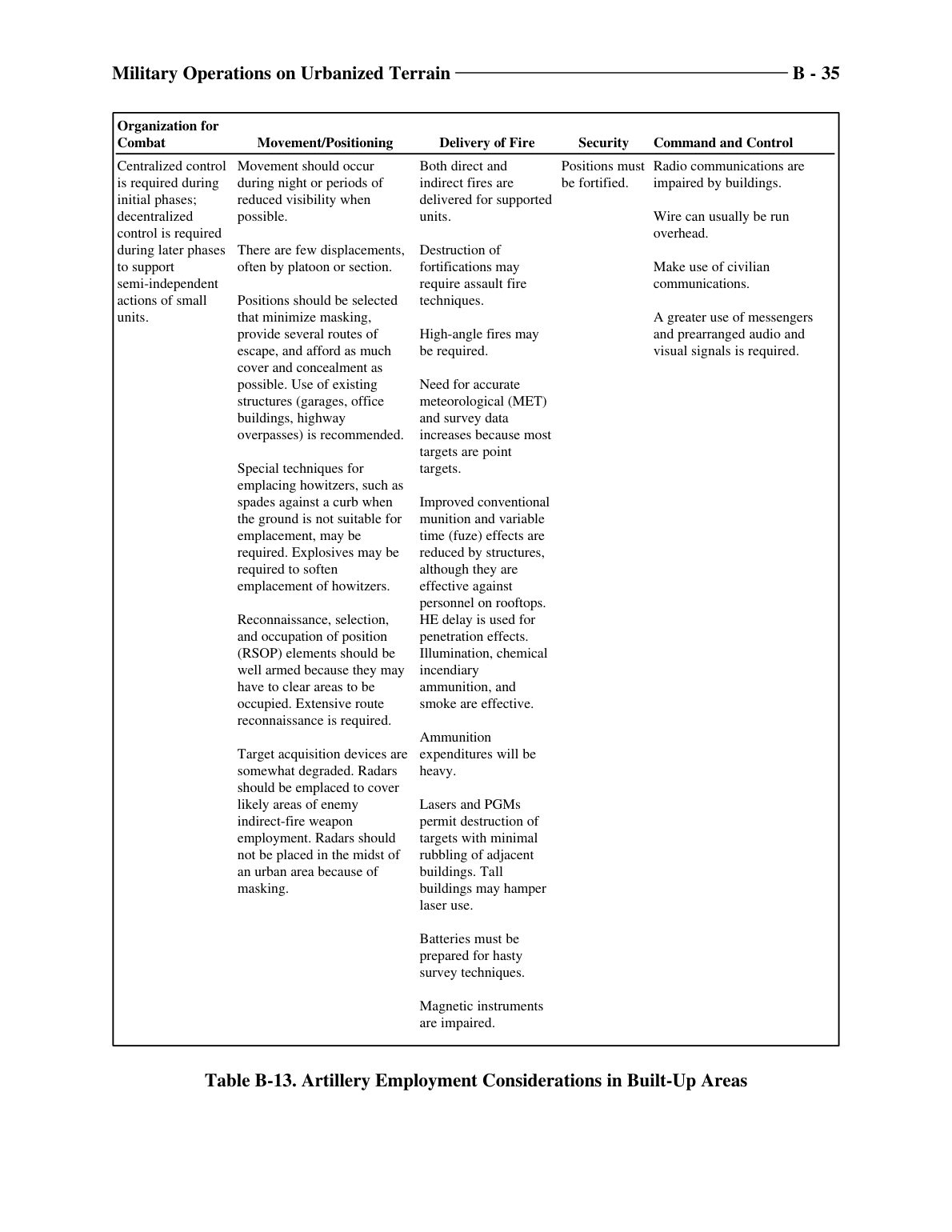
Table B-13. Artillery Employment Considerations in Built-Up Areas
Military Operations on Urbanized Terrain
B - 35