MCRP 12-10B.1, page 266
Military Operations on Urbanized Terrain (MOUT)
Marine Corps Reference Publication: Military Operations on Urbanized Terrain (MOUT)
Public distribution statement A; S2 KOCOA cited as MCRP 12-10 b.1
Searchable page text (OCR / PDF)
Weapons of at least 155 mm are required against thick reinforced concrete, stone, or brick
walls. Even with heavy artillery, large expenditures of ammunition are required to knock
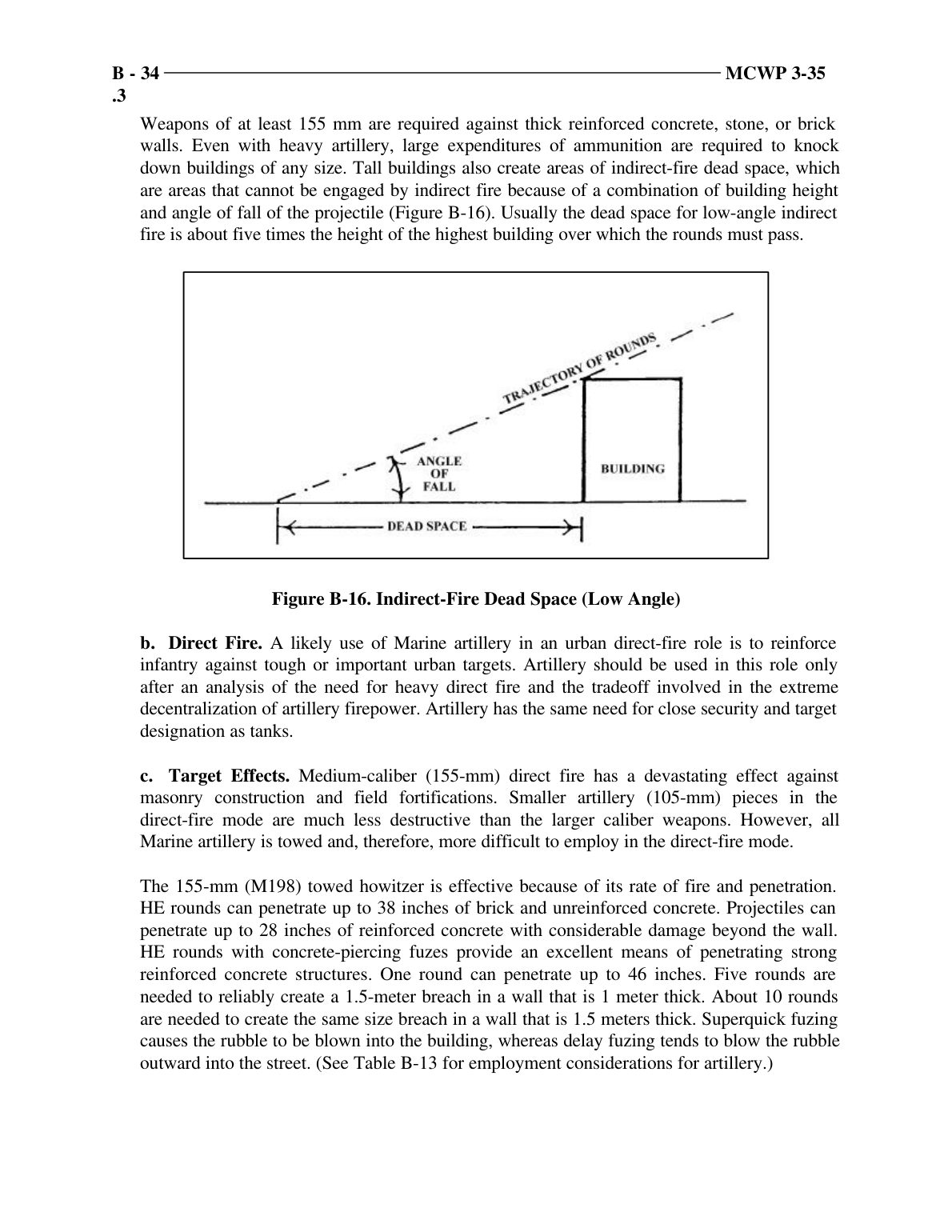
down buildings of any size. Tall buildings also create areas of indirect-fire dead space, which
are areas that cannot be engaged by indirect fire because of a combination of building height
and angle of fall of the projectile (Figure B-16). Usually the dead space for low-angle indirect
fire is about five times the height of the highest building over which the rounds must pass.
Figure B-16. Indirect-Fire Dead Space (Low Angle)
b. Direct Fire. A likely use of Marine artillery in an urban direct-fire role is to reinforce
infantry against tough or important urban targets. Artillery should be used in this role only
after an analysis of the need for heavy direct fire and the tradeoff involved in the extreme
decentralization of artillery firepower. Artillery has the same need for close security and target
designation as tanks.
c.
Target Effects. Medium-caliber (155-mm) direct fire has a devastating effect against
masonry construction and field fortifications. Smaller artillery (105-mm) pieces in the
direct-fire mode are much less destructive than the larger caliber weapons. However, all
Marine artillery is towed and, therefore, more difficult to employ in the direct-fire mode.
The 155-mm (M198) towed howitzer is effective because of its rate of fire and penetration.
HE rounds can penetrate up to 38 inches of brick and unreinforced concrete. Projectiles can
penetrate up to 28 inches of reinforced concrete with considerable damage beyond the wall.
HE rounds with concrete-piercing fuzes provide an excellent means of penetrating strong
reinforced concrete structures. One round can penetrate up to 46 inches. Five rounds are
needed to reliably create a 1.5-meter breach in a wall that is 1 meter thick. About 10 rounds
are needed to create the same size breach in a wall that is 1.5 meters thick. Superquick fuzing
causes the rubble to be blown into the building, whereas delay fuzing tends to blow the rubble
outward into the street. (See Table B-13 for employment considerations for artillery.)
B - 34
MCWP 3-35
.3