MCRP 12-10B.1, page 319
Military Operations on Urbanized Terrain (MOUT)
Marine Corps Reference Publication: Military Operations on Urbanized Terrain (MOUT)
Public distribution statement A; S2 KOCOA cited as MCRP 12-10 b.1
Searchable page text (OCR / PDF)
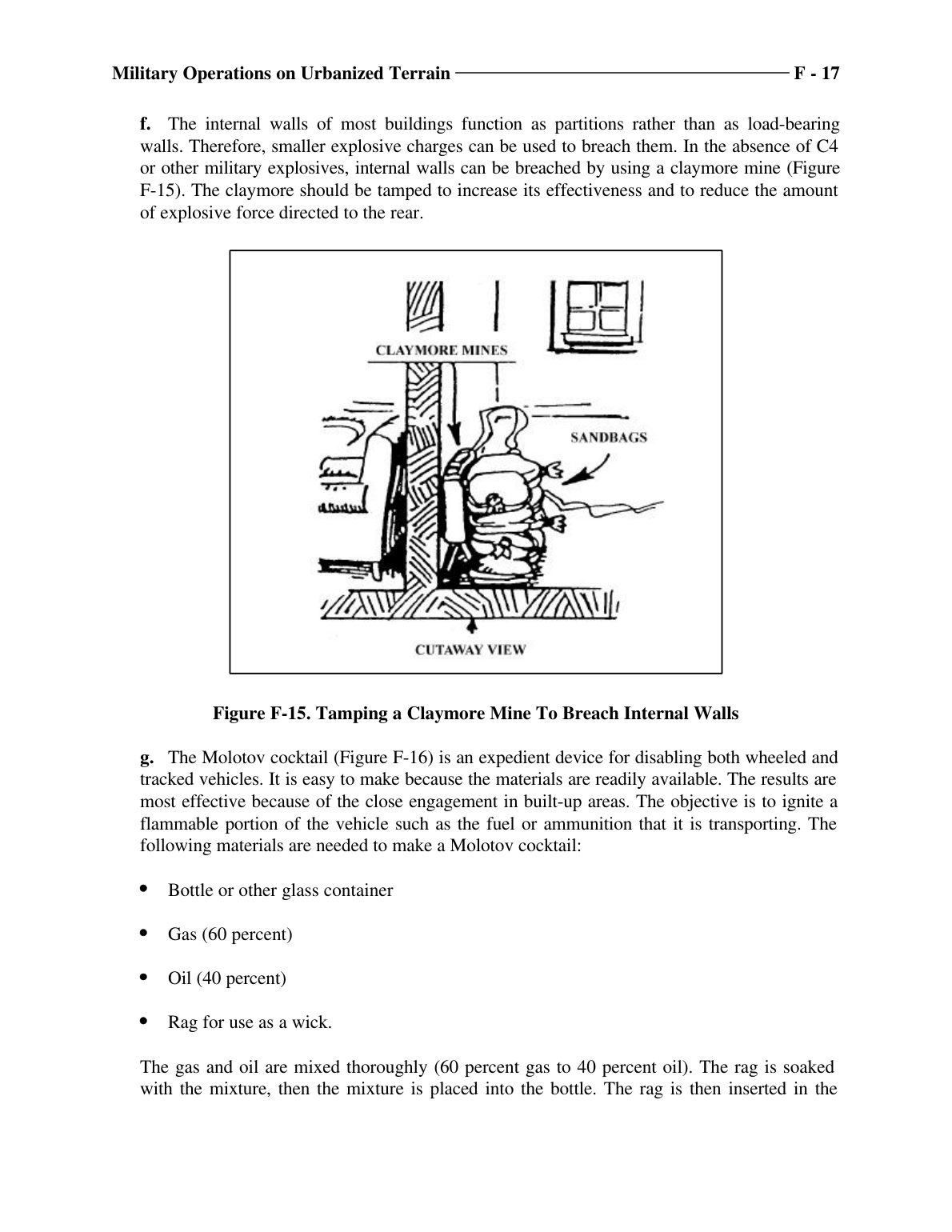
f.
The internal walls of most buildings function as partitions rather than as load-bearing
walls. Therefore, smaller explosive charges can be used to breach them. In the absence of C4
or other military explosives, internal walls can be breached by using a claymore mine (Figure
F-15). The claymore should be tamped to increase its effectiveness and to reduce the amount
of explosive force directed to the rear.
Figure F-15. Tamping a Claymore Mine To Breach Internal Walls
g. The Molotov cocktail (Figure F-16) is an expedient device for disabling both wheeled and
tracked vehicles. It is easy to make because the materials are readily available. The results are
most effective because of the close engagement in built-up areas. The objective is to ignite a
flammable portion of the vehicle such as the fuel or ammunition that it is transporting. The
following materials are needed to make a Molotov cocktail:
Bottle or other glass container
Gas (60 percent)
Oil (40 percent)
Rag for use as a wick.
The gas and oil are mixed thoroughly (60 percent gas to 40 percent oil). The rag is soaked
with the mixture, then the mixture is placed into the bottle. The rag is then inserted in the
Military Operations on Urbanized Terrain
F - 17