MCRP 12-10B.1, page 338
Military Operations on Urbanized Terrain (MOUT)
Marine Corps Reference Publication: Military Operations on Urbanized Terrain (MOUT)
Public distribution statement A; S2 KOCOA cited as MCRP 12-10 b.1
Searchable page text (OCR / PDF)
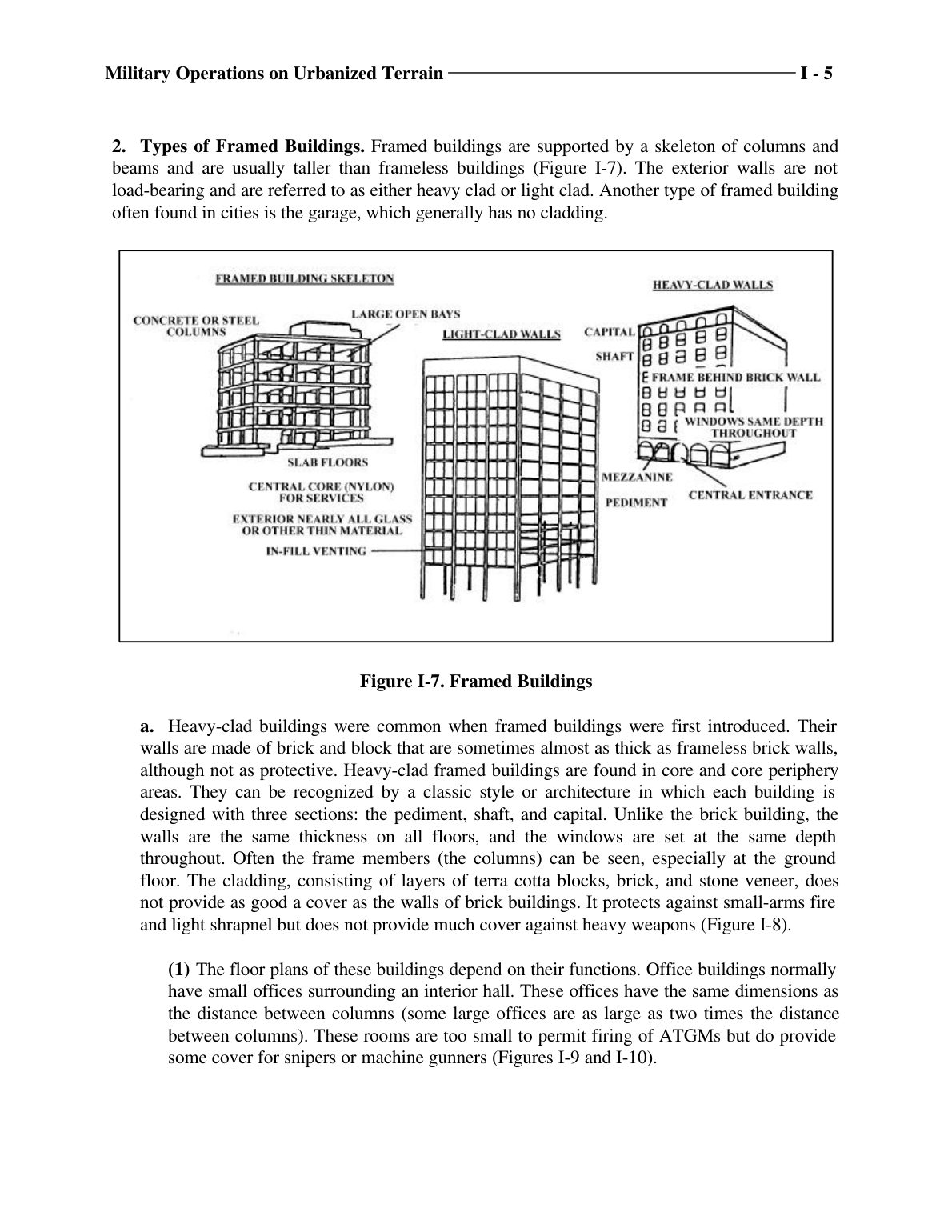
2. Types of Framed Buildings. Framed buildings are supported by a skeleton of columns and
beams and are usually taller than frameless buildings (Figure I-7). The exterior walls are not
load-bearing and are referred to as either heavy clad or light clad. Another type of framed building
often found in cities is the garage, which generally has no cladding.
Figure I-7. Framed Buildings
a. Heavy-clad buildings were common when framed buildings were first introduced. Their
walls are made of brick and block that are sometimes almost as thick as frameless brick walls,
although not as protective. Heavy-clad framed buildings are found in core and core periphery
areas. They can be recognized by a classic style or architecture in which each building is
designed with three sections: the pediment, shaft, and capital. Unlike the brick building, the
walls are the same thickness on all floors, and the windows are set at the same depth
throughout. Often the frame members (the columns) can be seen, especially at the ground
floor. The cladding, consisting of layers of terra cotta blocks, brick, and stone veneer, does
not provide as good a cover as the walls of brick buildings. It protects against small-arms fire
and light shrapnel but does not provide much cover against heavy weapons (Figure I-8).
(1) The floor plans of these buildings depend on their functions. Office buildings normally
have small offices surrounding an interior hall. These offices have the same dimensions as
the distance between columns (some large offices are as large as two times the distance
between columns). These rooms are too small to permit firing of ATGMs but do provide
some cover for snipers or machine gunners (Figures I-9 and I-10).
Military Operations on Urbanized Terrain
I - 5