AFDP 3-60, page 21
Targeting
Air Force Doctrine Publication: Targeting
01 May 2026 (Wayback 2026-07-12; S2 Wire cited this URL as “JP 3-60”)
Searchable page text (OCR / PDF)
Air Force Doctrine Publication 3-60, Targeting
18
CHAPTER 3: THE TARGETING PROCESS
The targeting process is both a joint- and component-level process. The overall joint
process is complicated by the need to deconflict target nominations across components
and to integrate the engagement of those targets into the entire joint force. An effective
joint targeting cycle framework, coupled with the separate yet related air tasking cycle, is
essential for the air component commander to plan and execute joint air operations.
AIR COMPONENT CONTRIBUTION TO THE JOINT TARGETING CYCLE
Joint targeting requires extensive
planning and support to enable
military
operations
across
the
competition continuum. The joint
targeting cycle described in joint
doctrine is a framework to conduct the
joint
targeting
process.29
It
is
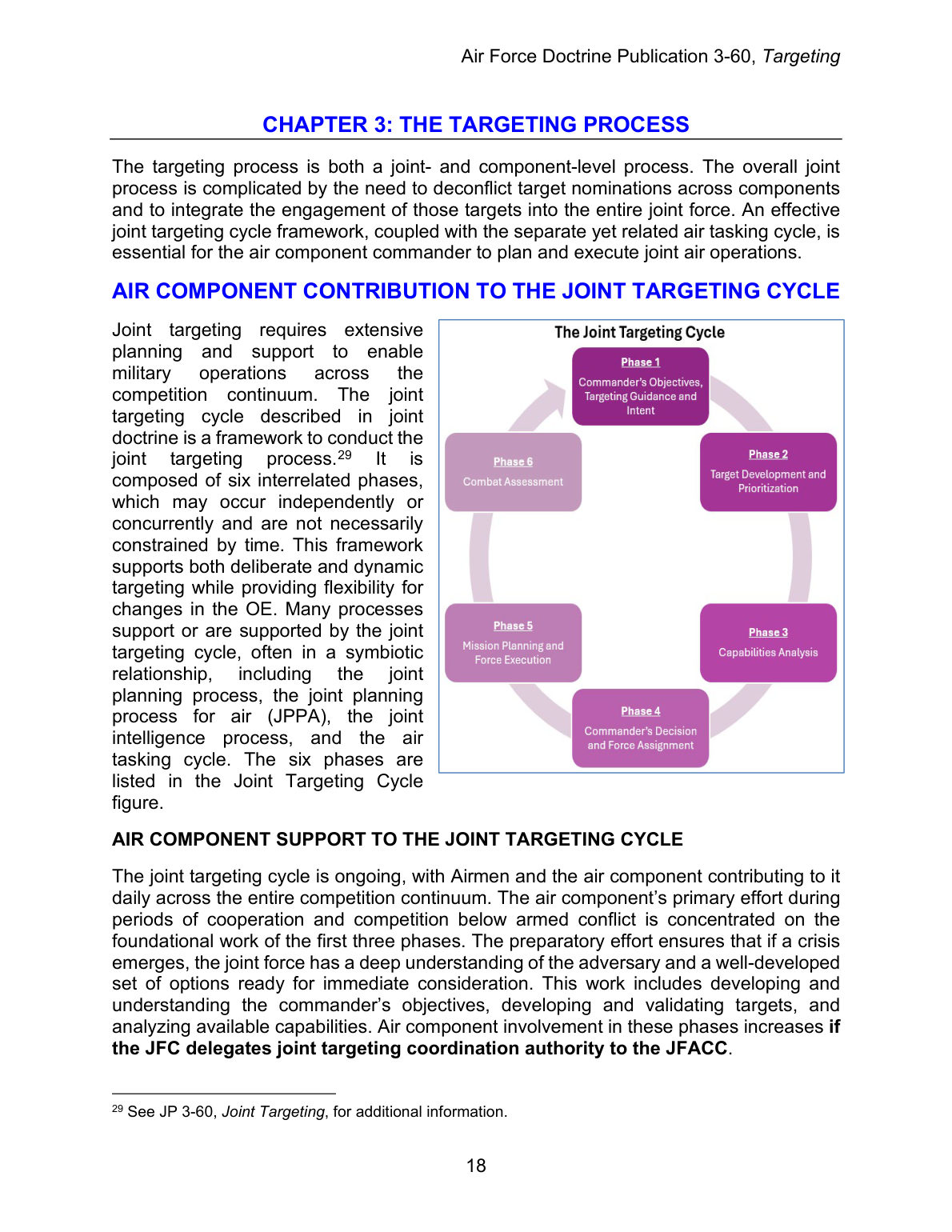
composed of six interrelated phases,
which may occur independently or
concurrently and are not necessarily
constrained by time. This framework
supports both deliberate and dynamic
targeting while providing flexibility for
changes in the OE. Many processes
support or are supported by the joint
targeting cycle, often in a symbiotic
relationship,
including
the
joint
planning process, the joint planning
process for air (JPPA), the joint
intelligence process, and the air
tasking cycle. The six phases are
listed in the Joint Targeting Cycle
figure.
AIR COMPONENT SUPPORT TO THE JOINT TARGETING CYCLE
The joint targeting cycle is ongoing, with Airmen and the air component contributing to it
daily across the entire competition continuum. The air component’s primary effort during
periods of cooperation and competition below armed conflict is concentrated on the
foundational work of the first three phases. The preparatory effort ensures that if a crisis
emerges, the joint force has a deep understanding of the adversary and a well-developed
set of options ready for immediate consideration. This work includes developing and
understanding the commander’s objectives, developing and validating targets, and
analyzing available capabilities. Air component involvement in these phases increases if
the JFC delegates joint targeting coordination authority to the JFACC.
29 See JP 3-60, Joint Targeting, for additional information.