AFDP 3-60, page 26
Targeting
Air Force Doctrine Publication: Targeting
01 May 2026 (Wayback 2026-07-12; S2 Wire cited this URL as “JP 3-60”)
Searchable page text (OCR / PDF)
Air Force Doctrine Publication 3-60, Targeting
23
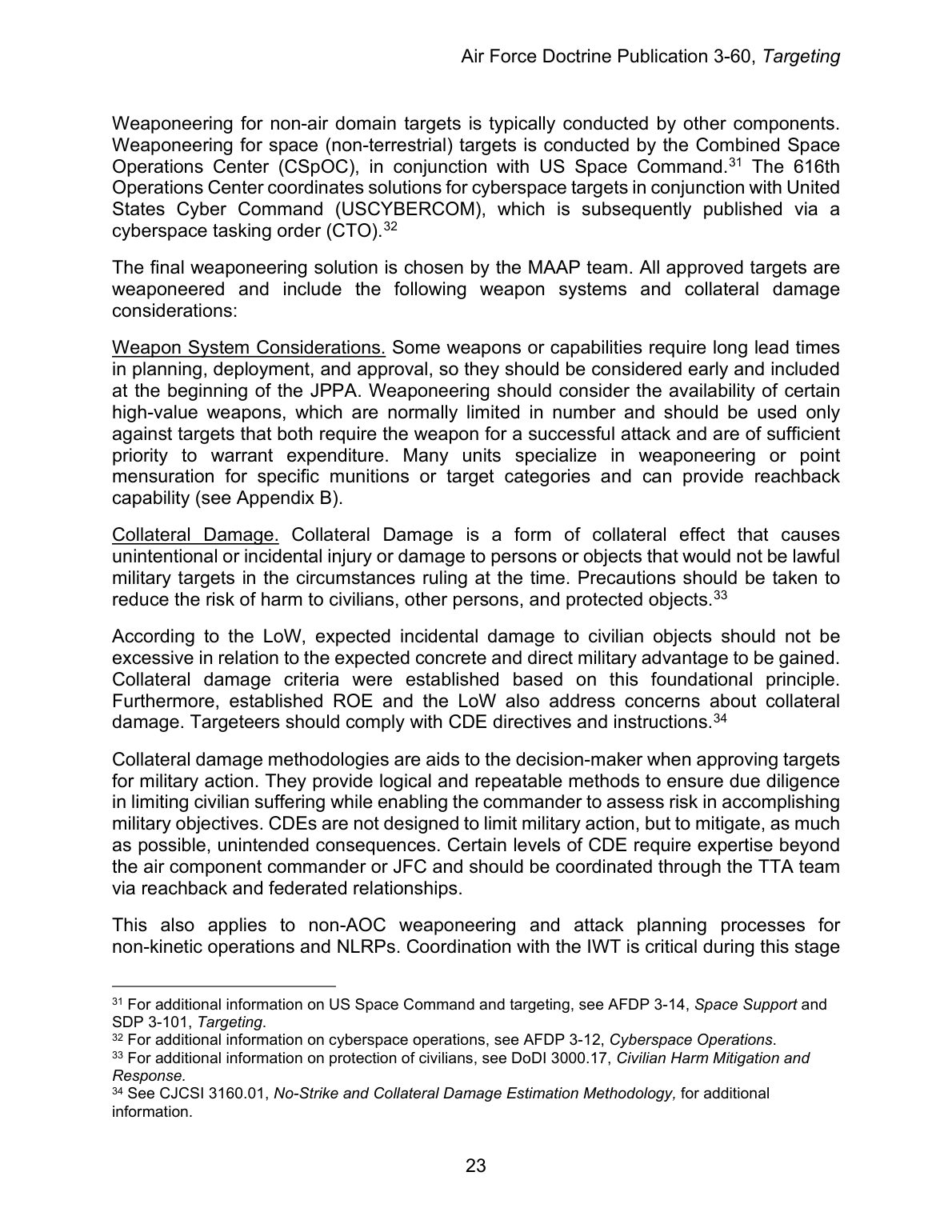
Weaponeering for non-air domain targets is typically conducted by other components.
Weaponeering for space (non-terrestrial) targets is conducted by the Combined Space
Operations Center (CSpOC), in conjunction with US Space Command.31 The 616th
Operations Center coordinates solutions for cyberspace targets in conjunction with United
States Cyber Command (USCYBERCOM), which is subsequently published via a
cyberspace tasking order (CTO).32
The final weaponeering solution is chosen by the MAAP team. All approved targets are
weaponeered and include the following weapon systems and collateral damage
considerations:
Weapon System Considerations. Some weapons or capabilities require long lead times
in planning, deployment, and approval, so they should be considered early and included
at the beginning of the JPPA. Weaponeering should consider the availability of certain
high-value weapons, which are normally limited in number and should be used only
against targets that both require the weapon for a successful attack and are of sufficient
priority to warrant expenditure. Many units specialize in weaponeering or point
mensuration for specific munitions or target categories and can provide reachback
capability (see Appendix B).
Collateral Damage. Collateral Damage is a form of collateral effect that causes
unintentional or incidental injury or damage to persons or objects that would not be lawful
military targets in the circumstances ruling at the time. Precautions should be taken to
reduce the risk of harm to civilians, other persons, and protected objects.33
According to the LoW, expected incidental damage to civilian objects should not be
excessive in relation to the expected concrete and direct military advantage to be gained.
Collateral damage criteria were established based on this foundational principle.
Furthermore, established ROE and the LoW also address concerns about collateral
damage. Targeteers should comply with CDE directives and instructions.34
Collateral damage methodologies are aids to the decision-maker when approving targets
for military action. They provide logical and repeatable methods to ensure due diligence
in limiting civilian suffering while enabling the commander to assess risk in accomplishing
military objectives. CDEs are not designed to limit military action, but to mitigate, as much
as possible, unintended consequences. Certain levels of CDE require expertise beyond
the air component commander or JFC and should be coordinated through the TTA team
via reachback and federated relationships.
This also applies to non-AOC weaponeering and attack planning processes for
non-kinetic operations and NLRPs. Coordination with the IWT is critical during this stage
31 For additional information on US Space Command and targeting, see AFDP 3-14, Space Support and
SDP 3-101, Targeting.
32 For additional information on cyberspace operations, see AFDP 3-12, Cyberspace Operations.
33 For additional information on protection of civilians, see DoDI 3000.17, Civilian Harm Mitigation and
Response.
34 See CJCSI 3160.01, No-Strike and Collateral Damage Estimation Methodology, for additional
information.