ATP 2-33.4, page 121
Intelligence Analysis
Army Techniques Publication: Intelligence Analysis
2014 public edition (Archive.org)
Searchable page text (OCR / PDF)
Emerging Analytic Techniques
18 August 2014
ATP 2-33.4
A-17
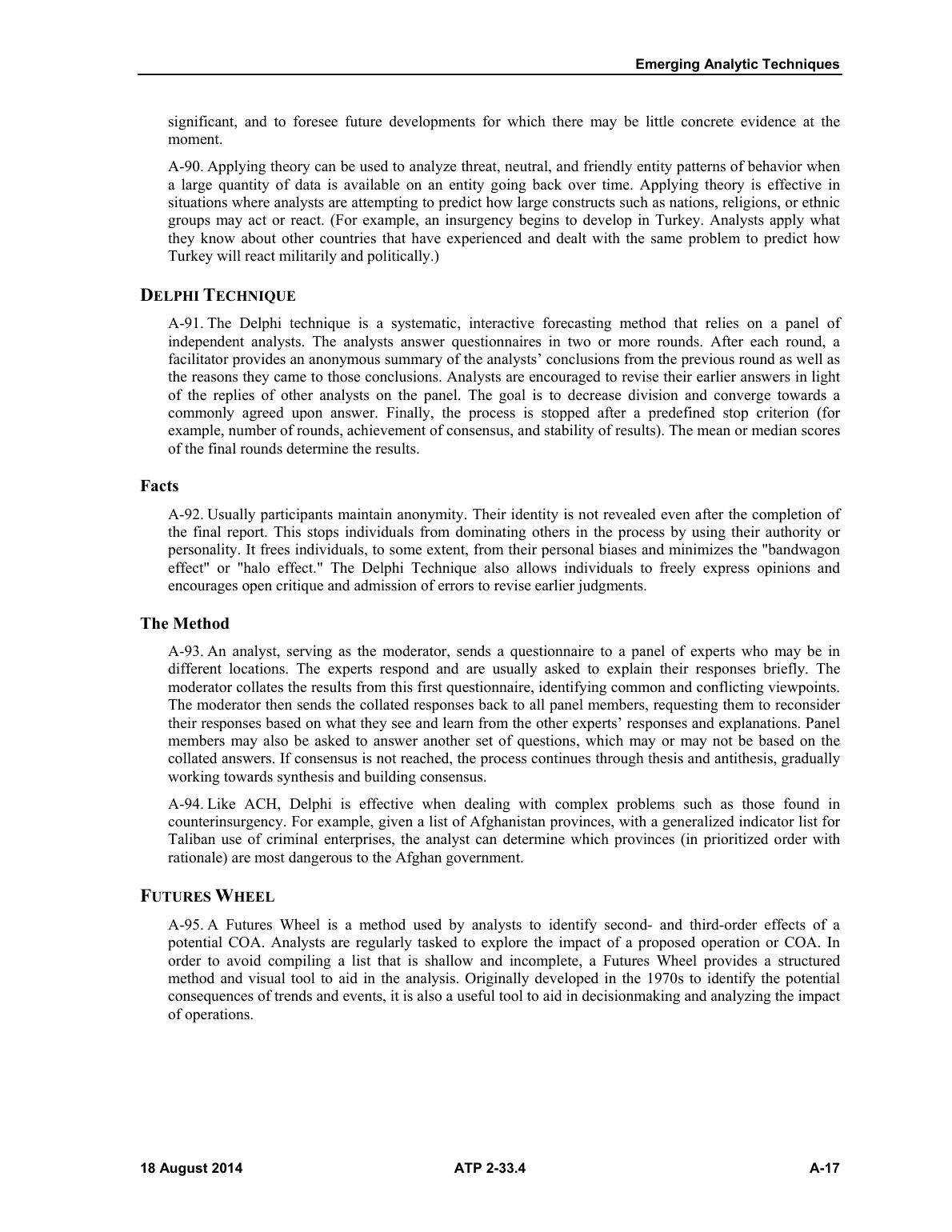
significant, and to foresee future developments for which there may be little concrete evidence at the
moment.
A-90. Applying theory can be used to analyze threat, neutral, and friendly entity patterns of behavior when
a large quantity of data is available on an entity going back over time. Applying theory is effective in
situations where analysts are attempting to predict how large constructs such as nations, religions, or ethnic
groups may act or react. (For example, an insurgency begins to develop in Turkey. Analysts apply what
they know about other countries that have experienced and dealt with the same problem to predict how
Turkey will react militarily and politically.)
DELPHI TECHNIQUE
A-91. The Delphi technique is a systematic, interactive forecasting method that relies on a panel of
independent analysts. The analysts answer questionnaires in two or more rounds. After each round, a
facilitator provides an anonymous summary of the analysts’ conclusions from the previous round as well as
the reasons they came to those conclusions. Analysts are encouraged to revise their earlier answers in light
of the replies of other analysts on the panel. The goal is to decrease division and converge towards a
commonly agreed upon answer. Finally, the process is stopped after a predefined stop criterion (for
example, number of rounds, achievement of consensus, and stability of results). The mean or median scores
of the final rounds determine the results.
Facts
A-92. Usually participants maintain anonymity. Their identity is not revealed even after the completion of
the final report. This stops individuals from dominating others in the process by using their authority or
personality. It frees individuals, to some extent, from their personal biases and minimizes the "bandwagon
effect" or "halo effect." The Delphi Technique also allows individuals to freely express opinions and
encourages open critique and admission of errors to revise earlier judgments.
The Method
A-93. An analyst, serving as the moderator, sends a questionnaire to a panel of experts who may be in
different locations. The experts respond and are usually asked to explain their responses briefly. The
moderator collates the results from this first questionnaire, identifying common and conflicting viewpoints.
The moderator then sends the collated responses back to all panel members, requesting them to reconsider
their responses based on what they see and learn from the other experts’ responses and explanations. Panel
members may also be asked to answer another set of questions, which may or may not be based on the
collated answers. If consensus is not reached, the process continues through thesis and antithesis, gradually
working towards synthesis and building consensus.
A-94. Like ACH, Delphi is effective when dealing with complex problems such as those found in
counterinsurgency. For example, given a list of Afghanistan provinces, with a generalized indicator list for
Taliban use of criminal enterprises, the analyst can determine which provinces (in prioritized order with
rationale) are most dangerous to the Afghan government.
FUTURES WHEEL
A-95. A Futures Wheel is a method used by analysts to identify second- and third-order effects of a
potential COA. Analysts are regularly tasked to explore the impact of a proposed operation or COA. In
order to avoid compiling a list that is shallow and incomplete, a Futures Wheel provides a structured
method and visual tool to aid in the analysis. Originally developed in the 1970s to identify the potential
consequences of trends and events, it is also a useful tool to aid in decisionmaking and analyzing the impact
of operations.