ATP 2-33.4, page 122
Intelligence Analysis
Army Techniques Publication: Intelligence Analysis
2014 public edition (Archive.org)
Searchable page text (OCR / PDF)
Appendix A
A-18
ATP 2-33.4
18 August 2014
Facts
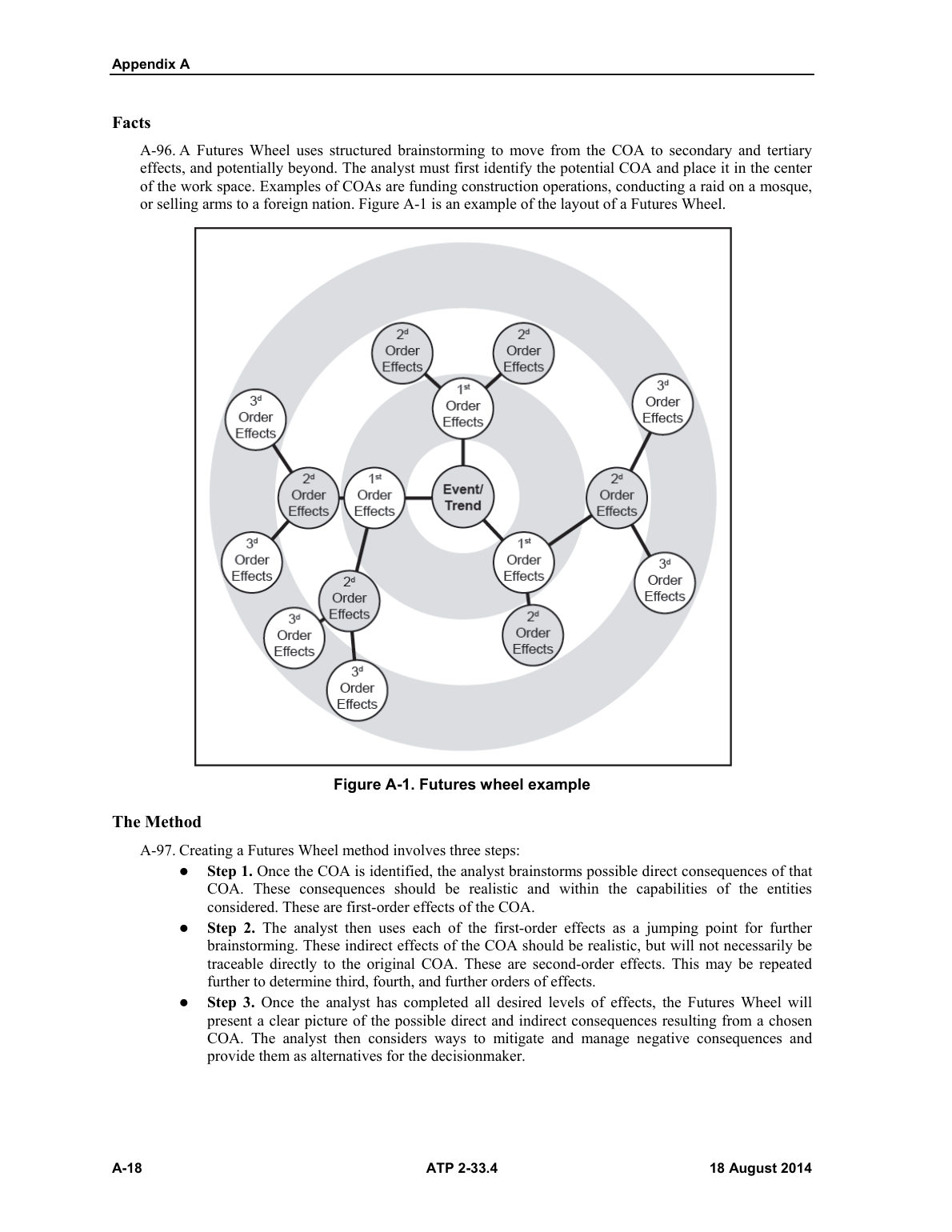
A-96. A Futures Wheel uses structured brainstorming to move from the COA to secondary and tertiary
effects, and potentially beyond. The analyst must first identify the potential COA and place it in the center
of the work space. Examples of COAs are funding construction operations, conducting a raid on a mosque,
or selling arms to a foreign nation. Figure A-1 is an example of the layout of a Futures Wheel.
Figure A-1. Futures wheel example
The Method
A-97. Creating a Futures Wheel method involves three steps:
Step 1. Once the COA is identified, the analyst brainstorms possible direct consequences of that
COA. These consequences should be realistic and within the capabilities of the entities
considered. These are first-order effects of the COA.
Step 2. The analyst then uses each of the first-order effects as a jumping point for further
brainstorming. These indirect effects of the COA should be realistic, but will not necessarily be
traceable directly to the original COA. These are second-order effects. This may be repeated
further to determine third, fourth, and further orders of effects.
Step 3. Once the analyst has completed all desired levels of effects, the Futures Wheel will
present a clear picture of the possible direct and indirect consequences resulting from a chosen
COA. The analyst then considers ways to mitigate and manage negative consequences and
provide them as alternatives for the decisionmaker.