JP 3-0, page 107
Joint Operations
Joint Publication: Joint Operations
11 August 2011 public edition
Searchable page text (OCR / PDF)
V-1
CHAPTER V
JOINT OPERATIONS ACROSS THE RANGE OF MILITARY
OPERATIONS
1. Introduction
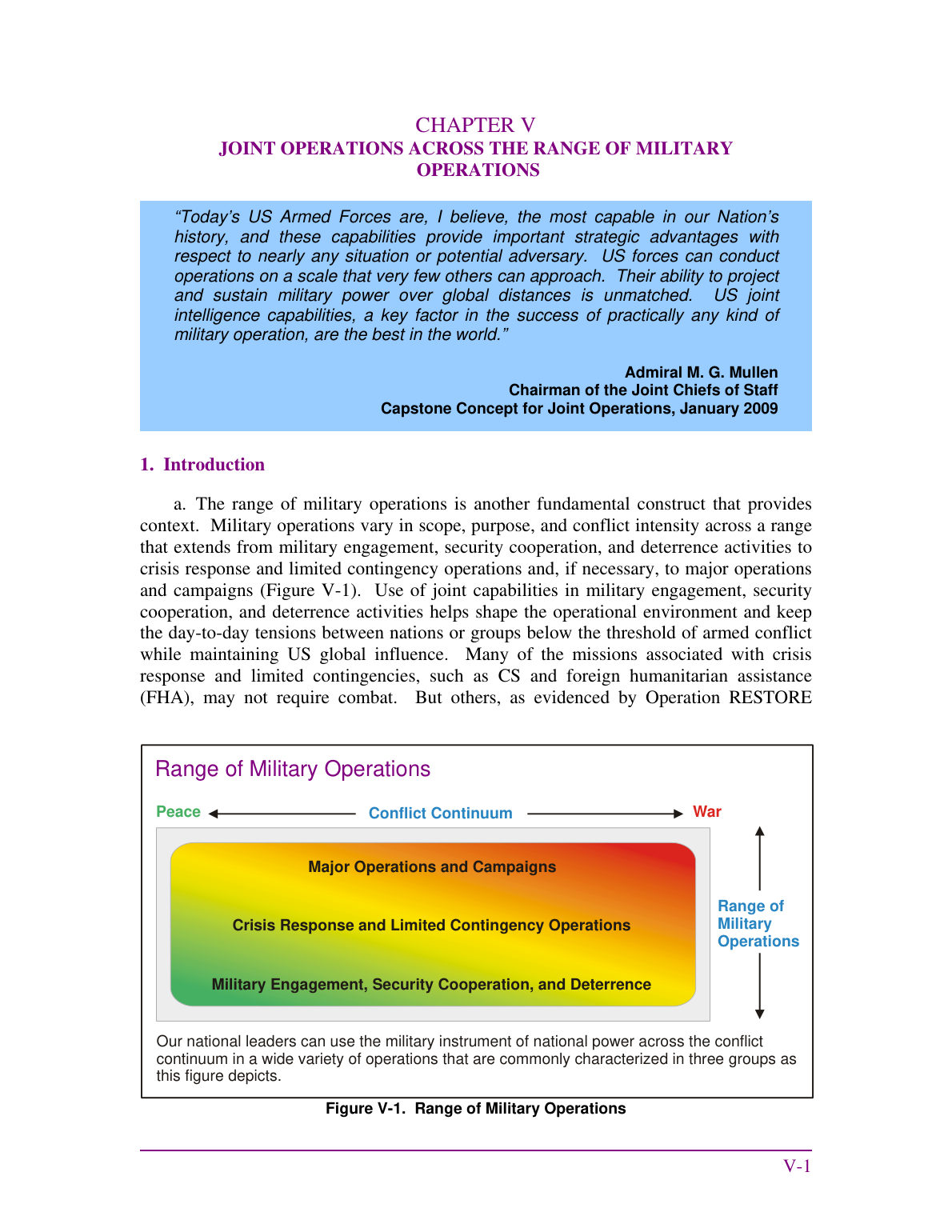
a. The range of military operations is another fundamental construct that provides
context. Military operations vary in scope, purpose, and conflict intensity across a range
that extends from military engagement, security cooperation, and deterrence activities to
crisis response and limited contingency operations and, if necessary, to major operations
and campaigns (Figure V-1). Use of joint capabilities in military engagement, security
cooperation, and deterrence activities helps shape the operational environment and keep
the day-to-day tensions between nations or groups below the threshold of armed conflict
while maintaining US global influence. Many of the missions associated with crisis
response and limited contingencies, such as CS and foreign humanitarian assistance
(FHA), may not require combat. But others, as evidenced by Operation RESTORE
“Today’s US Armed Forces are, I believe, the most capable in our Nation’s
history, and these capabilities provide important strategic advantages with
respect to nearly any situation or potential adversary. US forces can conduct
operations on a scale that very few others can approach. Their ability to project
and sustain military power over global distances is unmatched. US joint
intelligence capabilities, a key factor in the success of practically any kind of
military operation, are the best in the world.”
Admiral M. G. Mullen
Chairman of the Joint Chiefs of Staff
Capstone Concept for Joint Operations, January 2009
Figure V-1. Range of Military Operations
Range of Military Operations
Major Operations and Campaigns
Military Engagement, Security Cooperation, and Deterrence
Crisis Response and Limited Contingency Operations
Range of
Military
Operations
Our national leaders can use the military instrument of national power across the conflict
continuum in a wide variety of operations that are commonly characterized in three groups as
this figure depicts.
Peace
Conflict Continuum
War