JP 3-0, page 71
Joint Operations
Joint Publication: Joint Operations
11 August 2011 public edition
Searchable page text (OCR / PDF)
Joint Functions
III-19
q. Language, Regional, and Cultural Expertise. Language skills, regional
knowledge, and cultural awareness enable effective joint operations. Deployed joint forces
must be capable of understanding and effectively communicating with native populations,
local and national government officials, and coalition partners. Supporting this capability
should be an understanding of the regional and local culture, economy, politics, religion, and
customs. Lessons learned from Operation IRAQI FREEDOM (OIF) and Operation
ENDURING FREEDOM (OEF) proves that these force-multiplying capabilities can save
lives and are integral to mission accomplishment. Consequently, commanders will integrate
foreign language and regional expertise capabilities in contingency, security cooperation, and
supporting plans, and provide for them in support of daily operations and activities.
For specific planning guidance and procedures regarding language and regional expertise,
refer to CJCSI 3126.01, Language and Regional Expertise Planning.
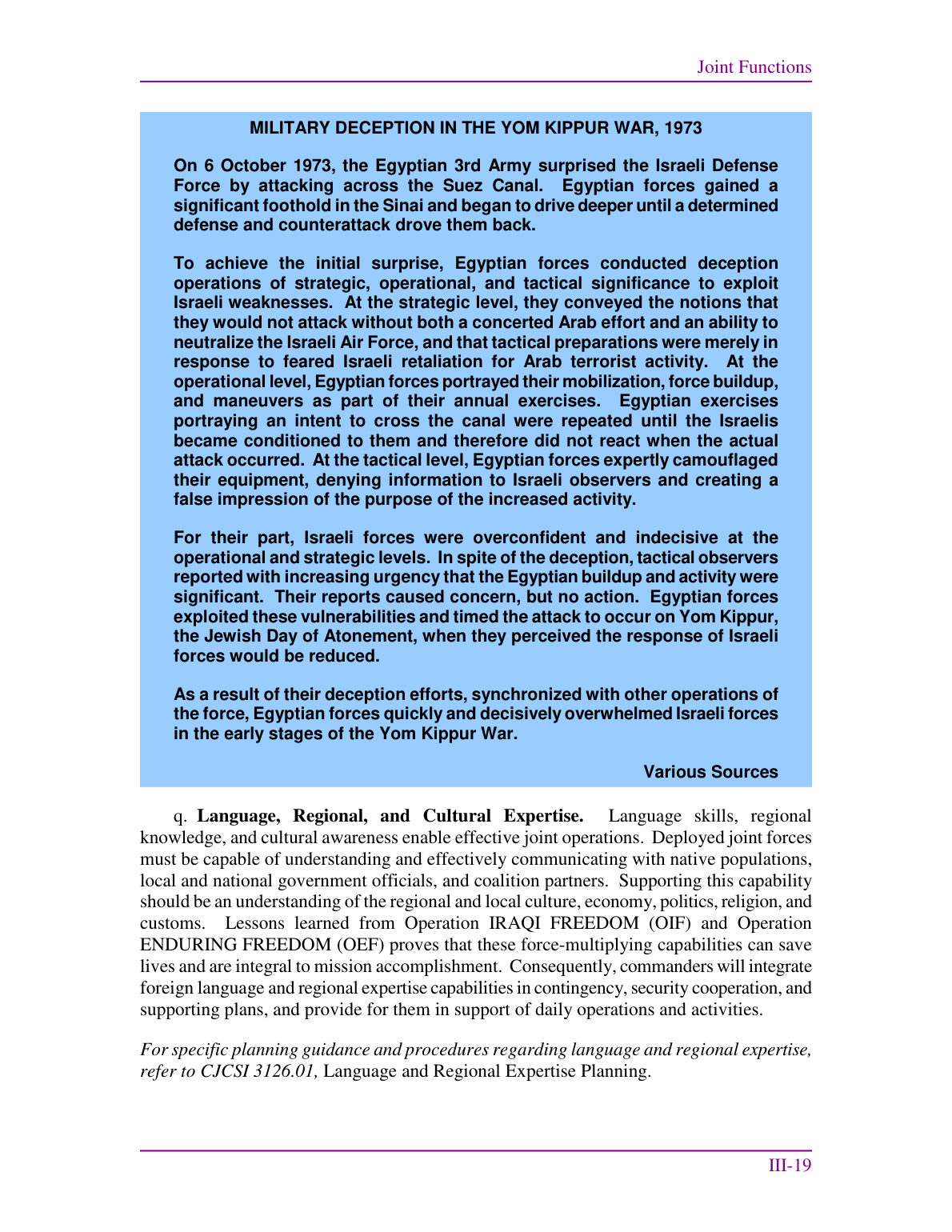
MILITARY DECEPTION IN THE YOM KIPPUR WAR, 1973
On 6 October 1973, the Egyptian 3rd Army surprised the Israeli Defense
Force by attacking across the Suez Canal. Egyptian forces gained a
significant foothold in the Sinai and began to drive deeper until a determined
defense and counterattack drove them back.
To achieve the initial surprise, Egyptian forces conducted deception
operations of strategic, operational, and tactical significance to exploit
Israeli weaknesses. At the strategic level, they conveyed the notions that
they would not attack without both a concerted Arab effort and an ability to
neutralize the Israeli Air Force, and that tactical preparations were merely in
response to feared Israeli retaliation for Arab terrorist activity. At the
operational level, Egyptian forces portrayed their mobilization, force buildup,
and maneuvers as part of their annual exercises. Egyptian exercises
portraying an intent to cross the canal were repeated until the Israelis
became conditioned to them and therefore did not react when the actual
attack occurred. At the tactical level, Egyptian forces expertly camouflaged
their equipment, denying information to Israeli observers and creating a
false impression of the purpose of the increased activity.
For their part, Israeli forces were overconfident and indecisive at the
operational and strategic levels. In spite of the deception, tactical observers
reported with increasing urgency that the Egyptian buildup and activity were
significant. Their reports caused concern, but no action. Egyptian forces
exploited these vulnerabilities and timed the attack to occur on Yom Kippur,
the Jewish Day of Atonement, when they perceived the response of Israeli
forces would be reduced.
As a result of their deception efforts, synchronized with other operations of
the force, Egyptian forces quickly and decisively overwhelmed Israeli forces
in the early stages of the Yom Kippur War.
Various Sources