JP 3-60, page 34
Joint Targeting
Joint Publication: Joint Targeting
31 January 2013 public edition
Searchable page text (OCR / PDF)
Chapter II
II-4
JP 3-60
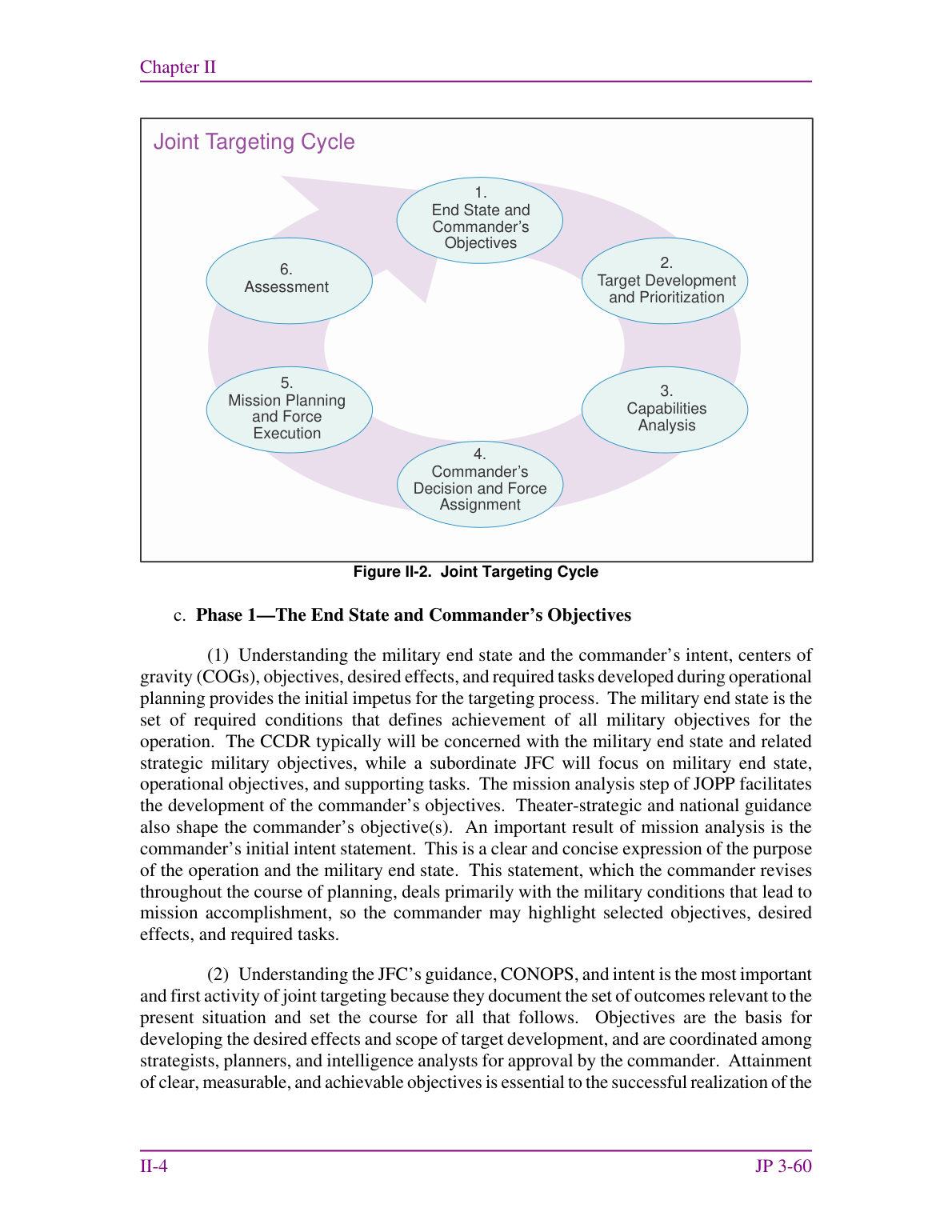
c. Phase 1—The End State and Commander’s Objectives
(1) Understanding the military end state and the commander’s intent, centers of
gravity (COGs), objectives, desired effects, and required tasks developed during operational
planning provides the initial impetus for the targeting process. The military end state is the
set of required conditions that defines achievement of all military objectives for the
operation. The CCDR typically will be concerned with the military end state and related
strategic military objectives, while a subordinate JFC will focus on military end state,
operational objectives, and supporting tasks. The mission analysis step of JOPP facilitates
the development of the commander’s objectives. Theater-strategic and national guidance
also shape the commander’s objective(s). An important result of mission analysis is the
commander’s initial intent statement. This is a clear and concise expression of the purpose
of the operation and the military end state. This statement, which the commander revises
throughout the course of planning, deals primarily with the military conditions that lead to
mission accomplishment, so the commander may highlight selected objectives, desired
effects, and required tasks.
(2) Understanding the JFC’s guidance, CONOPS, and intent is the most important
and first activity of joint targeting because they document the set of outcomes relevant to the
present situation and set the course for all that follows. Objectives are the basis for
developing the desired effects and scope of target development, and are coordinated among
strategists, planners, and intelligence analysts for approval by the commander. Attainment
of clear, measurable, and achievable objectives is essential to the successful realization of the
Figure II-2. Joint Targeting Cycle
Joint Targeting Cycle
1.
End State and
Commander’s
Objectives
2.
Target Development
and Prioritization
3.
Capabilities
Analysis
4.
Commander’s
Decision and Force
Assignment
5.
Mission Planning
and Force
Execution
6.
Assessment